The modern corporate landscape is defined by a relentless pursuit of optimization. In an era of shifting market dynamics, unpredictable supply chains, and rising overhead costs, organizations can no longer afford to tolerate systemic friction, manual bottlenecks, or fragmented workflows. To remain competitive, leadership teams are looking toward automation, data analytics, and corporate automation as primary levers for transformation.
Yet, as billions of dollars pour into machine learning and automated workflows, a troubling paradox has emerged: many organizations find that their technology investments actually introduce more complexity rather than reducing it.
The missing link is not the capability of the technology itself, but the lack of a cohesive deployment blueprint. To achieve true, scalable Operational Efficiency, organizations must move away from isolated, ad-hoc projects and instead adopt a systematic approach to technology deployment.
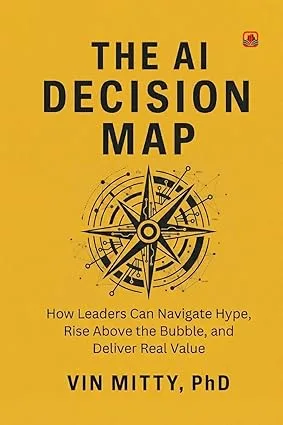
In his book, The AI Decision Map, author Vin Mitty provides an essential operational guide for the modern executive. The book moves past industry hype to deliver a practical framework showing how a structured, value-driven AI Implementation can fundamentally streamline corporate workflows, eliminate waste, and drive measurable business outcomes.
Part 1: The Efficiency Dilemma in the Automation Era
For decades, the standard playbook for improving enterprise productivity was straightforward: standardize processes, eliminate redundant steps, and introduce software to handle basic administrative tasks. This approach worked exceptionally well for traditional, static legacy software.
However, intelligent software systems represent a completely different paradigm. Because these systems are dynamic—relying on continuous data inputs, shifting variables, and complex human-machine interaction loops—they cannot simply be plugged into an existing ecosystem without careful orchestration.
When a company rushes into a disorganized AI Implementation, it often creates what operational experts call "digital bloat." This occurs when automated tools are layered haphazardly on top of broken, analog processes. Instead of resolving bottlenecks, the organization ends up with a chaotic mix of siloed data pipelines, confused employees, and opaque automated tools that no one fully trusts or understands.
True Operational Efficiency is never achieved by merely automating a broken process; it is achieved by re-architecting the process itself to leverage data-driven capabilities safely and sustainably.
Part 2: The Core Components of Structured Implementation
To prevent digital bloat and ensure that new technological deployments deliver maximum value, The AI Decision Map outlines a comprehensive roadmap for enterprise deployment. This blueprint dictates that a successful AI Implementation requires a balance between technical readiness, architectural safety, and organizational alignment.
According to Mitty’s methodology, an enterprise deployment must be built upon four foundational pillars:
1. Rigorous Data Diagnostics and Pipeline Auditing
An automated model is entirely dependent on the data that feeds it. The implementation process must begin with an exhaustive audit of the organization’s data infrastructure. Leaders must verify data cleanliness, eliminate systemic information silos, and establish stable, real-time data pipelines. Attempting to deploy predictive or generative tools on top of unstructured, unverified data assets is a guaranteed way to generate errors and operational delays.
2. Tailored Infrastructure and Use-Case Selection
Not every business problem requires an incredibly complex machine learning model. A mature deployment framework focuses on selecting the right tool for the specific task at hand. By mapping unique operational challenges to targeted, right-sized technical solutions, organizations avoid over-engineering their software architecture and minimize unnecessary compute costs.
3. Integrated Risk Management and Governance Guardrails
Deploying intelligent software systems introduces distinct structural risks, including data privacy concerns, algorithmic drift, and changing compliance requirements. A structured implementation approach integrates compliance and monitoring protocols directly into the system architecture from day one. This ensures that the systems remain secure, compliant, and transparent, avoiding costly retroactive fixes or brand damage.
4. Human-Centric Interface Design and Workflow Fusion
A digital tool is only valuable if the workforce actively uses it. The deployment strategy must prioritize building intuitive, friction-free interfaces that blend naturally into the daily routines of employees. By focusing heavily on user experience and clear task delegation between human workers and automated assistants, organizations maximize tool utilization and accelerate internal workflows.
Part 3: Unlocking True Operational Efficiency
When a structured deployment roadmap is executed correctly, the impact on an organization’s performance metrics is immediate and profound. Operational Efficiency is not just about cutting costs; it is about expanding an organization's capacity, accelerating decision-making velocity, and unlocking hidden value across every department.
The AI Decision Map highlights three primary operational zones where structured automation drives a step-change in corporate productivity:
1. Eliminating Cognitive Overhead and Friction
In every major enterprise, highly skilled professionals spend a significant portion of their workweeks performing administrative tasks—such as sorting data, manually routing documents, formatting compliance reports, or searching through unorganized internal databases.
By executing a targeted AI Implementation, organizations can automate these low-value, high-volume tasks. Shifting this cognitive burden away from human workers allows teams to redirect their time and energy toward strategic planning, creative problem-solving, and client relationship management, dramatically boosting output per employee.
2. Accelerating Corporate Decision Velocity
In fast-moving global markets, time is a critical variable. Waiting weeks for manual data aggregation, cross-departmental reviews, and legacy reporting can cause an enterprise to miss major market opportunities or respond too slowly to operational disruptions.
Intelligent workflows can ingest millions of data points simultaneously, identify underlying patterns, and generate actionable strategic recommendations in real time. This rapid processing speed enables leadership teams to make complex, informed operational decisions in a fraction of the time, providing a clear competitive advantage.
3. Transitioning from Reactive to Predictive Operations
Traditional corporate operations are inherently reactive: a machine breaks down, a supply chain bottleneck occurs, or a customer churns, and the organization scrambles to fix the issue after the damage is done.
Structured automated systems shift the operational model from reactive to predictive. By analyzing historical trends and continuous data feeds, predictive algorithms can identify a potential equipment failure, supply disruption, or shifting consumer preference before it occurs. This foresight allows teams to intervene early, minimizing downtime and saving millions of dollars in unnecessary operational costs.
Part 4: The AI Decision Map Practical Lifecycle
To help business leaders convert these high-level strategic concepts into daily corporate realities, The AI Decision Map breaks down the deployment lifecycle into four sequential, manageable phases.
Phase 1: Opportunity Identification and Prioritization
The implementation lifecycle begins with a comprehensive, cross-functional audit of all internal workflows. Rather than attempting to automate everything at once, the framework instructs leaders to evaluate potential projects using a strict value-versus-complexity matrix. The goal is to filter out overly complex vanity projects and focus exclusively on high-probability opportunities that solve real operational bottlenecks.
Phase 2: Baseline Quantification and Pilot Deployment
Before a single line of code is written or a vendor contract is signed, the organization must establish strict operational baselines. Current processing times, error rates, and resource costs must be meticulously recorded.
The company then launches a controlled pilot program in a single department or ring-fenced environment. This allows the implementation team to track the technology’s performance directly against the baseline, mathematically proving the impact on Operational Efficiency before expanding the budget.
Phase 3: Comprehensive Enterprise Scale and Training
Once the pilot program successfully validates the business case, the project transitions into full-scale enterprise deployment. This phase requires a heavy investment in change management and human factors.
Organizations must build comprehensive upskilling pathways and clear communication channels to ensure the workforce understands how to interact with the new tools. Technology alone cannot transform a business; long-term productivity gains are achieved only when human workers are fully trained, empowered, and aligned with the new digital workflows.
Phase 4: Continuous Auditing and Optimization Loops
The final phase of the framework emphasizes that an intelligent deployment is an iterative journey, not a static destination. After deployment, systems must be audited continuously to monitor for model drift, verify security protocols, and gather qualitative feedback from end-users. This continuous feedback loop ensures that the technology adapts to changing market realities and continues to deliver optimal performance over time.
Part 5: Balancing Innovation with Execution Discipline
The central takeaway of The AI Decision Map is that technology deployment and performance optimization are inextricably linked. An organization cannot achieve one without a deep commitment to the other.
Vin Mitty’s framework demonstrates that true market leaders avoid both extremes. They use a structured AI Implementation strategy to build scalable, secure, and cohesive digital systems, while maintaining an unyielding focus on objective metrics to ensure that every single initiative drives undeniable, verifiable Operational Efficiency.
Conclusion: Organizing the Future of Business
The integration of artificial intelligence into core enterprise operations is far more than a passing IT trend; it represents a fundamental rewiring of how corporate value is generated, maintained, and scaled. However, winning this transition does not require the largest research budget or the most complex custom models. It requires operational discipline, clarity of purpose, and a structured approach to execution.
By embracing the practical, step-by-step principles laid out in The AI Decision Map, modern executives can cut through the industry noise and build a streamlined, future-proof enterprise. Utilizing a systematic approach to AI Implementation ensures that an organization’s digital tools are secure, scalable, and perfectly tailored to its core business objectives. Simultaneously, maintaining an absolute focus on Operational Efficiency guarantees that the company remains lean, agile, and deeply profitable.
As the corporate world steps forward into an increasingly automated future, The AI Decision Map remains an indispensable guide for leaders looking to transform the promise of advanced technology into sustained, real-world operational excellence.