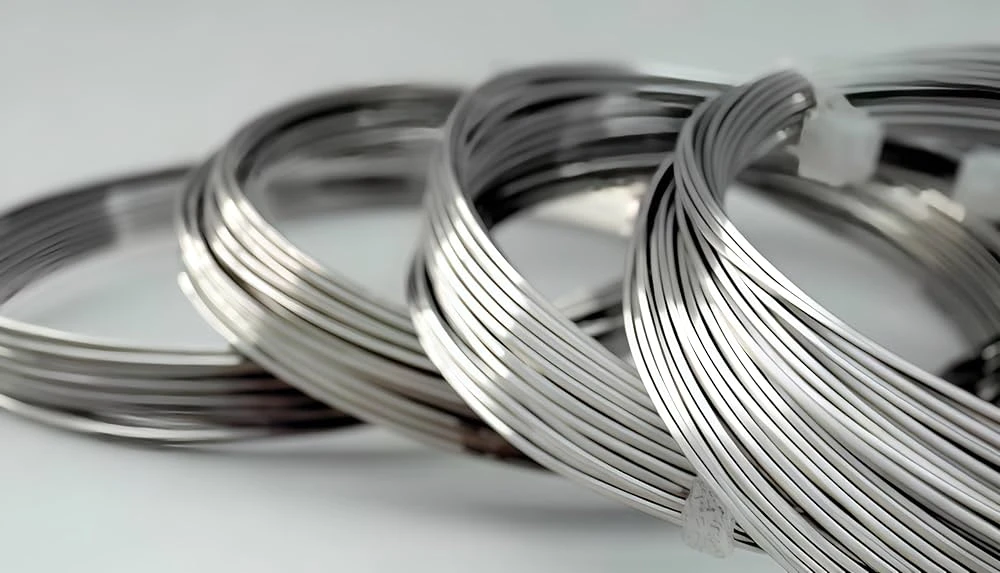
Stainless Steel 304 wire is one of the most widely used stainless steel products due to its excellent corrosion resistance, strength, and versatility. Commonly used in construction, industrial, and decorative applications, SS 304 wire offers durability and long service life in a variety of environments.
This comprehensive guide covers chemical composition, mechanical properties, types, standards, manufacturing, applications, advantages, testing, and pricing factors of Stainless Steel 304 wire.
What is Stainless Steel 304 Wire?
Stainless Steel 304 wire (UNS S30400) is an austenitic chromium-nickel stainless steel. The “304” grade contains approximately:
- 18% Chromium (Cr)
- 8% Nickel (Ni)
This composition provides:
- High corrosion resistance
- Excellent formability
- Good tensile strength
- Non-magnetic properties in the annealed condition
SS 304 wire is suitable for both industrial and decorative purposes due to its combination of durability and aesthetic appeal.
Chemical Composition of SS 304 Wire
Typical chemical composition:
- Chromium (Cr): 18–20%
- Nickel (Ni): 8–10.5%
- Carbon (C): Max 0.08%
- Manganese (Mn): Max 2%
- Silicon (Si): Max 1%
- Phosphorus (P): Max 0.045%
- Sulfur (S): Max 0.03%
- Iron (Fe): Balance
Chromium provides corrosion resistance, and nickel improves toughness and formability.
Mechanical Properties
Stainless Steel 304 wire offers a balanced combination of strength and flexibility:
- Tensile Strength: ~515 MPa
- Yield Strength: ~205 MPa
- Elongation: ~40%
- Hardness: ~70–90 HRB
- Density: 8.0 g/cm³
These properties make SS 304 wire suitable for forming, bending, and drawing operations.
Types of Stainless Steel 304 Wire
SS 304 wire is available in various forms depending on its application:
1️⃣ Annealed Wire
- Soft, highly ductile
- Ideal for bending, forming, and weaving
2️⃣ Cold-Drawn Wire
- Higher tensile strength
- Used in springs, fasteners, and industrial components
3️⃣ Welded Wire
- Formed into meshes or screens
- Commonly used in fencing and filtration
4️⃣ Polished / Decorative Wire
- Mirror or bright finishes for aesthetics
- Used in furniture, architectural, and jewelry applications
5️⃣ Spring Wire
- High-strength wire for industrial springs and clips
Standard Specifications
Stainless Steel 304 wire is manufactured according to international standards:
- ASTM A313 (spring and wire rod)
- ASTM A580 (bright wire)
- ASTM A580M
- ASTM A582 (cold-finished wire)
- UNS S30400
- ISO / DIN standards
These standards ensure dimensional accuracy, chemical composition, and mechanical properties.
Available Sizes & Dimensions
SS 304 wire is available in:
- Diameter: 0.1 mm to 25 mm
- Coil Weight: 1 kg to 1000 kg per coil
- Custom lengths: As per project requirements
Fine gauge wires are used for medical and filtration applications, while thicker wires are suitable for structural and industrial purposes.
Key Features & Advantages
✔ Excellent corrosion resistance to most chemicals and atmospheric conditions
✔ High tensile strength and ductility
✔ Non-magnetic in annealed condition
✔ Easy to draw, bend, and form
✔ Hygienic and easy to clean
✔ Long service life
✔ Resistant to oxidation and rust
Applications of Stainless Steel 304 Wire
Stainless Steel 304 wire is versatile and widely used across industries:
1️⃣ Industrial Applications
- Springs and clips
- Fasteners and bolts
- Wire ropes and cables
- Filtration systems
2️⃣ Construction & Architecture
- Fencing mesh
- Wire curtains and safety mesh
- Reinforcement wires
3️⃣ Food & Beverage Industry
- Conveyor belts
- Sieves and strainers
- Food processing equipment
4️⃣ Medical & Pharmaceutical
- Surgical instruments
- Dental wires
- Medical meshes
5️⃣ Decorative & Artistic Applications
- Jewelry
- Wire art
- Architectural designs
Corrosion Resistance
SS 304 wire is highly resistant to:
- Atmospheric corrosion
- Mild acids and alkalis
- Water and steam
- Food acids
However, in high-chloride environments (like seawater), SS 316 wire is preferred for better pitting resistance.
Welding & Fabrication
Stainless Steel 304 wire can be welded and fabricated using:
- TIG (GTAW)
- MIG (GMAW)
- Resistance welding
- Spot welding
Cold-drawn wire is harder to weld, while annealed wire is highly workable.
Testing & Certification
To ensure quality and reliability, SS 304 wire can be supplied with:
- Mill Test Certificate (MTC)
- Third Party Inspection (TPI)
- Chemical & Mechanical Test Reports
- Tensile Testing
- Hardness Testing
Testing is especially important for industrial and critical applications.
Price of Stainless Steel 304 Wire
The price of SS 304 wire depends on:
- Wire diameter and length
- Type (annealed, cold-drawn, spring)
- Surface finish (polished or mill finish)
- Quantity ordered
- Certification requirements
- Raw material (nickel) market rates
- Manufacturer and brand
- Import/export duties
Cold-drawn and high-finish wires are generally more expensive than standard annealed wire.
SS 304 Wire vs SS 316 Wire
FeatureSS 304 WireSS 316 WireCorrosion ResistanceVery GoodExcellentChloride ResistanceModerateHighCostModerateHigherApplicationsGeneral industrial & decorativeMarine & chemical
SS 304 is widely used for general purposes, while 316 is chosen for harsher chemical or marine environments.
Why Choose Stainless Steel 304 Wire?
Choose SS 304 wire for applications requiring:
- Cost-effective corrosion resistance
- Good tensile strength and ductility
- Easy fabrication and forming
- Long-lasting performance in industrial, decorative, or hygienic environments
It provides the best balance of strength, workability, and corrosion resistance for most applications.
Conclusion
Stainless Steel 304 wire is a versatile, durable, and reliable solution for industrial, construction, decorative, and hygienic applications. With excellent corrosion resistance, mechanical strength, and formability, it is ideal for springs, fasteners, meshes, and artistic projects.