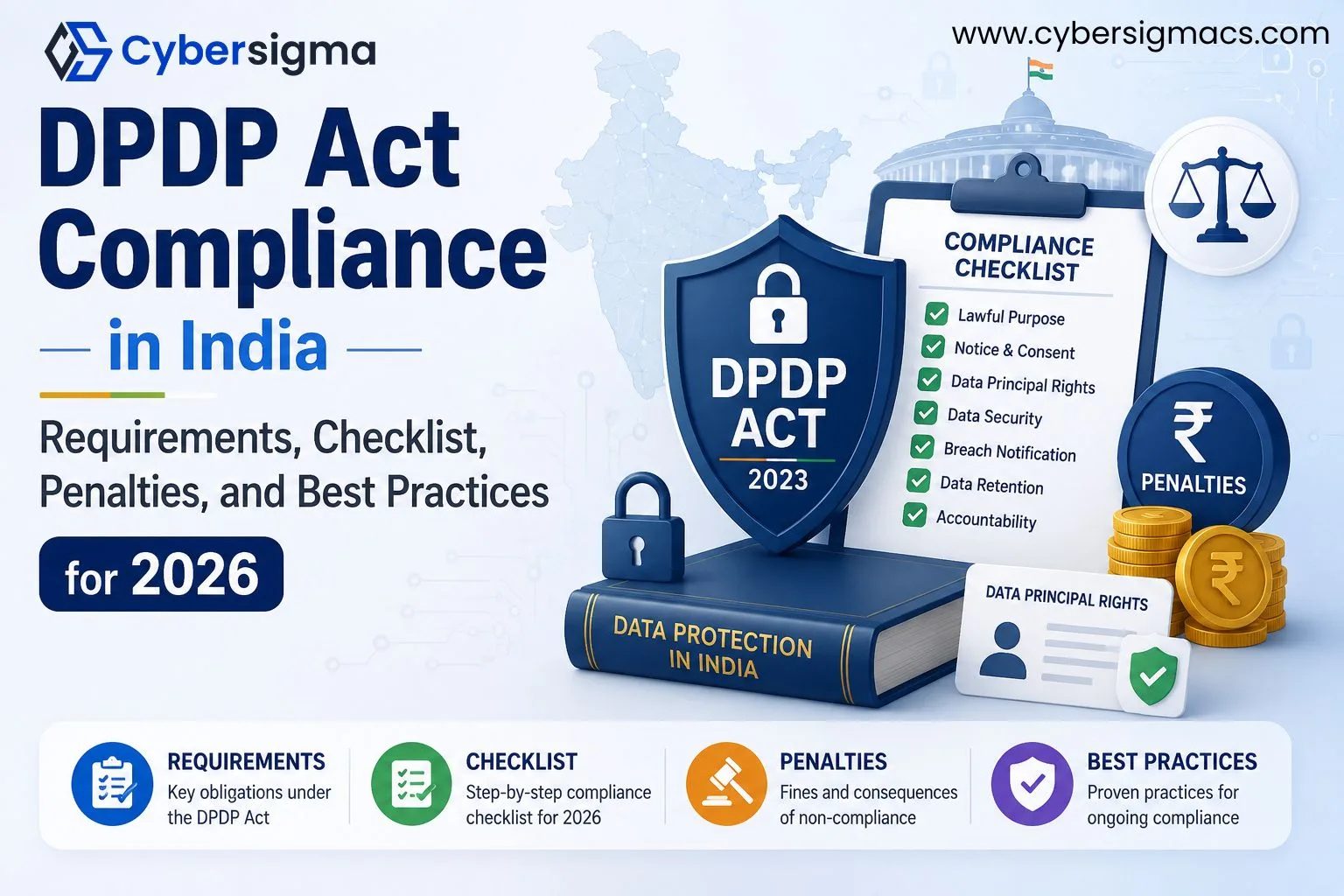
Look, let's be direct about something. Most Indian businesses are still treating DPDP Act compliance like a future problem. Something to deal with once the rules are finalized or before the deadline hits.That deadline isn't abstract anymore. The DPDP Rules were notified in November 2025. The Data Protection Board is being constituted. The enforcement calendar is set for May 2027.
That's roughly 11 months from now. And if you're reading this without a compliance program in place or with one that exists only on paper you're closer to a problem than you probably realize.
India has had data rules before, technically. The IT Act, 2000 and the SPDI Rules tried to cover sensitive personal data, but enforcement was weak, scope was narrow, and most businesses ignored them without consequence. The Digital Personal Data Protection Act, 2023 is different. It has a real regulator with real powers and financial penalties that start at ₹50 crore and go up to ₹250 crore per violation. That changes the math completely.
This guide is written for the people who actually have to figure out what to do: compliance leads, CISOs, founders, legal teams, and IT managers who need more than a summary of the law. You need to know what's required, what the real risks are, and where to start. That's what we've tried to build here.
What is DPDP Act Compliance?
The Digital Personal Data Protection Act, 2023 is India's first standalone privacy law. Before it, data protection was scattered across the IT Act, sector-specific RBI and SEBI guidelines, and various consumer protection rules. The DPDP Act consolidates this into one coherent framework governing how digital personal data is collected, processed, stored, and deleted.
The Act establishes two main roles. The Data Fiduciary is any organization, a company, government body, or individual that decides why and how personal data is processed. Think of this as the entity that sets the rules. A Data Processor handles data on behalf of a fiduciary. And the Data Principal is the person the data belongs to the individual.
A few terms worth knowing clearly:
• Personal Data: Any data that can directly or indirectly identify an individual.
• Data Fiduciary: The organization that determines the purpose and means of processing.
• Data Processor: An entity that processes data on behalf of the fiduciary.
• Consent: Free, specific, informed, and unambiguous agreement from the Data Principal.
• SDF (Significant Data Fiduciary): A fiduciary designated by the government for enhanced oversight based on data volume, sensitivity, or risk.
• DPBI (Data Protection Board of India): The regulatory and adjudicatory body that enforces the Act.
The Act covers digital personal data processed inside India. It also covers data processed outside India when it's connected to offering goods or services to people in India. So a company based in Singapore running an Indian e-commerce site? They're in scope. There's no carve-out based on where you're incorporated.
Why DPDP Act Compliance Matters for Businesses
Some organizations still frame this as a legal compliance issue that lives in the legal team's inbox. That framing is going to get people into trouble. Here's why this matters beyond just ticking boxes:
The Penalties Are Real
The penalties are not symbolic. ₹250 crore for a single violation involving inadequate security safeguards. ₹200 crore for processing without valid consent. These are not "slap on the wrist" numbers. For most mid-sized Indian businesses, a penalty at that level is existential. And unlike some regulatory frameworks where fines are negotiated down to nothing, the DPBI has real adjudicatory powers and a mandate to enforce.
Customers Now Have Enforceable Rights
Customer expectations have shifted. Indian consumers are increasingly aware that they have data rights. The right to access what you hold on them. The right to have it corrected or deleted. The right to withdraw consent. Businesses that can't honor these rights will face complaints — not just from regulators but from customers who are increasingly savvy about this.
B2B Contracts Will Start Requiring It
B2B contracts will require it. Enterprises and public sector bodies are already starting to include DPDP compliance requirements in vendor agreements and RFPs. If you process data for other organizations, your compliance posture will become a qualification criterion. This is already happening in sectors like fintech, healthtech, and SaaS.
Breach Costs Are Already High Before Regulatory Action
Breaches are expensive even before regulatory fines. IBM's 2025 Cost of a Data Breach Report put the average breach cost in India at approximately ₹22 crore. Add regulatory penalties on top of that, and the case for investing in compliance becomes financially obvious.
DPDP Act Compliance Requirements for 2026
The DPDP Rules 2025 take the Act's principles and translate them into practical obligations. Here's what actually needs to happen inside your organization:
1. Consent Management
Consent is the primary lawful basis for processing under DPDP. Unlike GDPR, which gives organizations six different lawful bases to choose from, DPDP essentially runs on consent for most processing activities (with narrow exceptions like employment contexts or publicly available data). This has significant operational implications.
Consent must be free, specific, informed, and unambiguous. It needs to be captured before data collection, not buried in a 40-page terms and conditions document that nobody reads. Each purpose requires separate consent. And this is the part most organizations underestimate: withdrawing consent must be as easy as giving it. If your opt-in takes two clicks, your opt-out can't take fifteen steps through a settings menu.
2. Privacy Notices
Before collecting personal data, you must provide a clear, plain-language notice explaining what you're collecting, why you're collecting it, who you'll share it with, and how the person can exercise their rights. Plain language is the operative phrase. Regulatory-style dense paragraphs won't cut it.
3. Data Principal Rights
Data Principals have five rights under the Act that organizations must operationalize not just acknowledge in a policy document:
• Right to Access: Confirmation of whether data is being processed and a summary of what is held.
• Right to Correction: Fix inaccurate or misleading personal data.
• Right to Erasure: Delete data when no longer needed or when consent is withdrawn.
• Right to Grievance Redressal: A working mechanism to receive and respond to data-related complaints.
• Right to Nominate: Designate someone to exercise rights in the event of death or incapacity.
4. Data Retention and Purpose Limitation
You can't hold personal data indefinitely. Data must be retained only as long as needed for the stated purpose, and then deleted. This sounds simple but creates real operational challenges: defining what necessary means for each data type, building automated deletion workflows, managing backups and archives that often contain personal data, and ensuring third-party processors also delete data when required.
5. Personal Data Breach Notification
When a breach happens unauthorized access, exfiltration, accidental exposure Data Fiduciaries must notify both the DPBI and the affected Data Principals. The DPDP Rules 2025 specify the format and timeline. Missing this notification window carries a penalty of up to ₹200 crore. This makes breach detection and a practiced incident response process genuinely business-critical, not just good security hygiene.
6. Security Safeguards
The Act requires reasonable security safeguards without prescribing specific technologies. In practice, this translates to encryption of personal data at rest and in transit, access controls limiting who can see what, security monitoring, and documented processes for managing and responding to incidents.
7. Significant Data Fiduciary Obligations
Organizations designated as Significant Data Fiduciaries face additional obligations: an India-based Data Protection Officer, an independent Data Auditor, and Data Protection Impact Assessments for new processing activities. SDF designation criteria haven't been fully published, but large platforms and high-volume data processors should assume they'll be in scope.
DPDP Compliance Checklist for 2026
Use this DPDP compliance checklist to assess your current compliance status. Priority ratings reflect enforcement risk and operational dependencies, with critical items requiring immediate attention.
S.nCompliance ActionCategoryPriority1Map all personal data flows — systems, APIs, third parties, backupsData DiscoveryCritical2Classify data by type and sensitivity (contact, financial, health, behavioral)Data DiscoveryCritical3Build a granular, purpose-specific consent capture mechanismConsentCritical4Implement consent withdrawal — as easy as opt-in, not buried in settingsConsentCritical5Draft and publish a plain-language Privacy Notice per DPDP Rules 2025NoticeCritical6Set up breach detection, internal escalation, and notification workflowBreach MgmtCritical7Define DPBI notification format and timeline (as per Rules 2025)Breach MgmtCritical8Build a mechanism for data access requests from Data PrincipalsData RightsHigh9Enable correction and erasure of personal data on requestData RightsHigh10Define retention schedules and automate deletion at end of retention periodData RetentionHigh11Implement Role-Based Access Controls (RBAC) on all personal data systemsSecurityHigh12Encrypt personal data at rest and in transit across all environmentsSecurityHigh13Conduct VAPT on all applications and APIs handling personal dataSecurityHigh14Review and update third-party Data Processing Agreements (DPAs)Vendor MgmtHigh15Appoint a Data Protection Officer if your organization is or may be an SDFGovernanceMedium16Establish a privacy governance owner (committee or named lead)GovernanceMedium17Conduct a formal DPDP Compliance Gap AssessmentAuditMedium18Train employees on consent rules, data handling, and breach reportingAwarenessMedium19Develop and test an Incident Response Plan covering personal data breachesBreach MgmtMedium20Document all processing activities and maintain records for auditDocumentationMedium
DPDP Act Penalties and Consequences of Non-Compliance
Schedule 1 of the DPDP Act lays out the maximum penalty for each category of violation. These are not annual caps they apply per violation. Multiple violations in the same investigation attract separate penalties.
ViolationMax PenaltySection ReferenceFailure to implement adequate security safeguards₹250 CroreSchedule 1 Item 1Processing without valid consent₹200 CroreSchedule 1 Item 2Failure to protect children's data₹200 CroreSchedule 1 Item 3Failure to notify breach to DPBI / Data Principal₹200 CroreSchedule 1 Item 4Non-fulfilment of Data Principal rights₹50 CroreSchedule 1 Item 5Non-compliance with DPBI orders₹50 CroreSchedule 1 Item 6
The DPBI considers six factors when determining the actual penalty amount: the severity and duration of the non-compliance, the type of data involved (sensitive data attracts higher penalties), whether the violation was repeated, any financial gain the organization derived from non-compliance, the mitigation steps taken, and proportionality given the organization's size and circumstances.
Beyond fines, the DPBI can order mandatory deletion of unlawfully processed data, require system changes, and publicly disclose violations. For many organizations, the reputational damage from a public DPBI finding will be more damaging than the monetary penalty.
Best Practices for DPDP Compliance
Compliance frameworks built on documentation alone don't survive regulatory scrutiny. Here's what actually works:
1. Get Governance Right First
Get governance right before anything else. Who in your organization owns data privacy? Not just "the legal team" or "IT" — who specifically is accountable, has the authority to make decisions, and reports to leadership? For most businesses this means creating a privacy governance function, even if it's one person with clear authority, not a committee that meets annually.
2. Build Consent Mechanisms That Actually Function
Build consent mechanisms that function, not just exist. Audit every touchpoint where you collect personal data — sign-up forms, mobile apps, checkout flows, CRM integrations, marketing systems. For each, ask: is consent genuinely granular, recorded, and withdrawable? Most organizations discover significant gaps when they actually map this out.
3. Fix Your Vendor Management Gaps
Vendor management is a compliance gap that bites organizations in audits. Every third party that processes personal data on your behalf — analytics providers, cloud platforms, email marketing tools, HR systems — needs a data processing agreement that reflects DPDP obligations. Review and update these agreements now, before you're under investigation.
4. Build Audit as a Recurring Function
Build audit as a recurring function, not a one-time project. Internal reviews, external assessments, and triggered reviews when you launch new products or migrate systems. Significant Data Fiduciaries will be required to engage independent Data Auditors. Everyone else should treat regular audits as basic due diligence.
5. Train Your People — and Document That You Did
Train your people. Most breaches and most compliance failures have a human element. Front-line staff need to know what personal data they're handling, what the consent rules are, and how to recognize and report a potential breach. Document the training — the DPBI will ask for evidence of compliance culture, not just compliance policies.
6. Test Your Incident Response Before You Need It
Test your incident response plan before you need it. Breach notification under DPDP has tight timelines. An untested IRP will fail under pressure. Run tabletop exercises, define escalation paths clearly, and integrate your notification workflow with your security monitoring tools.
Common DPDP Compliance Challenges
Every organization faces obstacles on the path to DPDP compliance. Here are the ones that trip people up most consistently:
Data Discovery and Mapping
Data mapping is harder than it looks. Personal data lives in more places than most organizations know: CRM systems, email archives, Slack conversations, cloud storage, analytics platforms, application logs, backup tapes, legacy databases. You cannot protect what you haven't found. Data discovery is tedious work, but it's the foundation that everything else depends on.
Consent Tracking Across Channels
Consent tracking across channels is operationally complex. Getting consent is one problem; maintaining a record of it, knowing when it expires, and handling withdrawal across multiple systems is another. Most organizations need some form of consent management infrastructure whether a dedicated platform or purpose-built internal tooling.
Third-Party and Supply Chain Risk
Third-party risk is consistently underestimated. When you audit your vendor list, you often find data flowing to places nobody formally approved. Analytics pixels collecting behavioral data. SaaS tools with broad data access permissions. Cloud services operating under terms that predate DPDP. Cleaning this up takes time and occasionally requires replacing tools.
Legacy Systems and Technical Debt
Legacy systems weren't designed with privacy in mind. They may not support data deletion, granular access controls, or consent-linked processing restrictions. Organizations carrying significant technical debt face a choice between retrofitting controls onto old systems (expensive and often imperfect) or accelerating migration to modern platforms (also expensive but more durable).
Finding the Right Expertise
DPDP compliance requires both legal and technical expertise working together. Many SMEs and mid-market businesses don't have both in-house. Bridging that gap through external advisory support rather than treating compliance as purely a legal exercise or purely an IT exercise tends to produce better outcomes.
How Cybersecurity Supports DPDP Compliance
The DPDP Act's requirement for reasonable security safeguards is not vague it maps directly onto capabilities that the information security profession has been building for years. Here's how cybersecurity supports compliance:
Vulnerability Assessment and Penetration Testing (VAPT)
Vulnerability Assessment and Penetration Testing identifies exploitable weaknesses in your applications, APIs, and infrastructure before attackers do. For DPDP compliance, VAPT provides technical evidence that your security controls are not just present but actually effective. If you process personal data through web applications or APIs and most organizations do, VAPT is not optional.
Risk Assessments and Data Protection Impact Assessments
Risk assessments and DPIAs help you understand where personal data is most exposed and where controls are weakest. For Significant Data Fiduciaries, DPIAs are a mandatory step before deploying new processing activities. For everyone else, they're good practice that also creates documented evidence of your compliance effort.
Security Monitoring and SIEM
Breach detection depends on visibility. Security monitoring and SIEM systems give you the ability to spot anomalous access patterns, unusual data movement, and unauthorized processing in near real-time. Without this capability, you may not know a breach has occurred until after the notification window has already closed.
Incident Response
Incident response capability translates the DPBI's notification requirements from a policy obligation into something you can actually execute under pressure. A practiced IR plan with clear timelines, defined roles, and tested notification workflows is what separates organizations that manage breaches effectively from those that compound them.
Identity and Access Management
Identity and access management controls — RBAC, MFA, privileged access management directly support the DPDP principle that personal data should be accessible only to those who need it for specific purposes. These aren't just security best practices; under DPDP, they're demonstrable evidence of reasonable safeguards.
How CyberSigma Helps Organizations Achieve DPDP Act Compliance
CyberSigma works with organizations across India to build DPDP compliance services india programs that hold up under scrutiny both regulatory and technical.
DPDP Compliance Gap Assessment
Our DPDP Compliance Gap Assessment is where most engagements start. We evaluate your current data practices, technical controls, and governance structures against the requirements of the DPDP Act and DPDP Rules 2025, and deliver a prioritized remediation roadmap. The output is practical and specific, not a generic compliance framework you have to interpret yourself.
VAPT Testing
Our VAPT engagements cover web applications, mobile apps, APIs, cloud environments, and internal networks. Every engagement is aligned to the security safeguard requirements of the DPDP Act, and our reports are structured to provide the technical evidence organizations need for audit purposes.
Risk Management and DPIAs
We support risk management and DPIAs for organizations assessing new processing activities, launching new products, or undergoing significant system changes. For Significant Data Fiduciaries, we provide independent Data Audit support as required under the DPDP Rules.
Security Consulting and Privacy by Design
Our security consulting practice helps organizations embed privacy and security controls into architecture and product design not retrofit them after the fact. From access control design to data classification frameworks to policy development, we work at the intersection of technical and governance requirements.
Ongoing Compliance Support
DPDP compliance doesn't end with initial implementation. We offer managed compliance programs, periodic audits, regulatory monitoring, and incident response retainer services that keep your compliance posture current as the regulatory environment evolves.
Frequently Asked Questions on DPDP Act Compliance
1. Who does the DPDP Act apply to?
Basically any organization that handles digital personal data of people in India. That includes Indian companies of all sizes, multinationals with Indian operations, and foreign companies targeting Indian consumers with goods or services. There's no turnover threshold, no exemption for startups, no carve-out for small data collectors. If you collect email addresses from Indian users, you're in scope. The only meaningful exemptions relate to government processing for national security purposes and certain research contexts.
2. When does DPDP compliance actually become mandatory?
The DPDP Rules were notified in November 2025. Compliance is phased over 18 months, with full enforcement expected by May 13, 2027. But expected by May 2027 isn't a reason to wait. Core operational requirements consent mechanisms, privacy notices, breach notification, and data principal rights fulfillment should be live by mid-2026. Organizations that start building now will meet the deadline comfortably. Organizations that start in Q1 2027 will be scrambling.
3. What's the highest penalty under the DPDP Act?
₹250 crore per violation for failure to implement adequate security safeguards that results in a personal data breach. Processing without valid consent or failing to protect children's data both carry up to ₹200 crore. Failing to notify a breach or honor data principal rights carries up to ₹200 crore and ₹50 crore respectively. These are per-violation caps, not annual limits. A single investigation could result in multiple separate penalties being imposed simultaneously.
4. How is the DPDP Act different from GDPR?
Several important ways. DPDP relies almost entirely on consent as the lawful basis for processing, while GDPR gives organizations six lawful bases (legitimate interests, contract, legal obligation, etc.). DPDP defines children as under 18, versus GDPR's under 16 in most contexts. Penalty structures are different DPDP caps at ₹250 crore per violation while GDPR can reach 4% of global annual turnover. And DPDP has its own regulatory body, the DPBI, rather than data protection authorities in each EU member state. If you're GDPR-compliant, you have a solid foundation but DPDP has specific requirements that need to be addressed separately.
5. What makes an organization a Significant Data Fiduciary?
The Central Government designates SDFs based on factors including the volume and sensitivity of data processed, potential national security implications, risk to Data Principals, and the organization's ability to impact India's sovereignty or public order. SDFs face additional obligations: an India-based DPO, an independent Data Auditor, and DPIAs for new processing activities. The government hasn't published a final SDF list or detailed criteria, but large consumer platforms, healthtech companies, and organizations processing sensitive data at scale should assume SDF designation is possible and start preparing accordingly.
6. What triggers the breach notification requirement?
Any unauthorized access, use, disclosure, alteration, or destruction of personal data that compromises confidentiality, integrity, or availability. This is broader than just hacker attacks; it includes accidental exposure through misconfigured systems, unauthorized access by an employee, loss of a device containing personal data, or a ransomware attack. When a breach occurs, the organization must notify the DPBI and affected Data Principals in the format and within the timeline specified in the DPDP Rules 2025. Delayed notification is itself a violation carrying penalties up to ₹200 crore.
7. Do startups and small businesses need to comply?
Yes, fully. There's no SME exemption. The DPBI may consider organizational size when determining the penalty amount, but the compliance obligations are the same regardless of company size. For startups, the practical argument for early compliance is actually stronger: it's significantly cheaper and less disruptive to build privacy into your product architecture from the beginning than to retrofit it after you've scaled to millions of users. Privacy-by-design is not just a regulatory requirement it's a better way to build.
8. How does the DPDP Act handle children's personal data?
With strict protections. Verifiable parental or guardian consent is required before processing any personal data of a child (under 18). Processing that may cause harm to a child including behavioral tracking, targeted advertising, or monitoring is prohibited. Significant Data Fiduciaries face even stricter restrictions. If you run a consumer-facing platform that children might use, your age verification and parental consent mechanisms need to be reviewed as a priority. This is an area where the DPBI is likely to pay close attention in early enforcement actions.
DPDP Act compliance has moved out of the future planning category and into the current obligation category. The rules exist. The regulator is being constituted. The penalties are real and substantial.
The organizations that are going to struggle are the ones treating this as a documentation exercise drafting privacy policies without building the underlying systems, processes, and controls to actually honor them. The DPBI will look for evidence that consent is genuinely captured, breaches are detected and reported, and data principal rights are honored in practice, not just acknowledged on a policy page.
Start with a gap assessment. You need to know where you actually stand before you can prioritize. Map your data flows. Build consent mechanisms that function. Update your vendor agreements. Train your teams. And test your incident response plan before a breach forces you to use it under pressure.
The compliance deadline is May 2027. That sounds like enough time until it isn't. Start now.