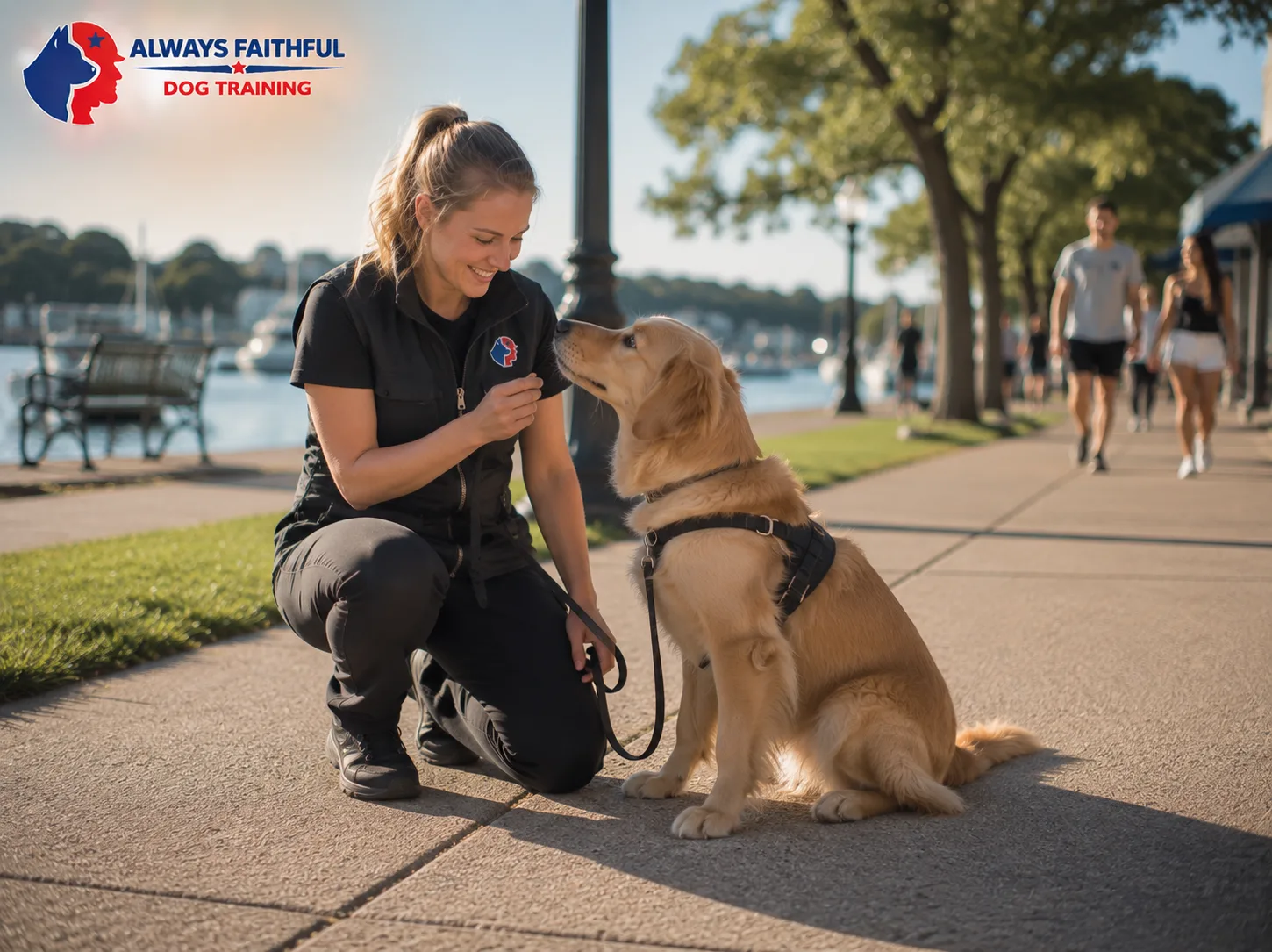
Dogs do not experience the world as quietly as people do. A walk may include passing vehicles, moving people, other animals, unfamiliar sounds, changing smells, and countless distractions. Even inside the home, television, visitors, household activity, and sudden movement can compete for a dog's attention. Effective Dog training can help dogs learn how to remain responsive when their surroundings become more active. For owners searching for Dog training Near me, understanding the role of focus is an important part of building reliable everyday behavior.
Focus Is More Than Simply Looking at the Owner
When people talk about a dog's attention, they often imagine the dog staring directly at them. Visual attention can be useful, but genuine focus involves much more.
A focused dog is able to notice what is happening around it without immediately reacting to every new stimulus. The dog can hear a sound, observe movement, and still respond to a familiar direction from its handler.
This skill develops gradually. Dogs are naturally curious, and investigating their surroundings is part of normal behavior. Training does not require eliminating that curiosity. Instead, it can teach the dog when to investigate and when to return attention to the person handling the situation.
Begin in Places Where Success Is Possible
Trying to establish concentration in the busiest environment available can make training unnecessarily difficult.
A quieter room provides fewer competing stimuli. Once the dog can respond consistently there, the owner can introduce slightly more activity. This might include another person walking through the room, a toy being moved nearby, or an outdoor sound coming through a window.
The idea is to increase difficulty gradually.
When a dog succeeds repeatedly at one level, the next challenge becomes easier to manage. If distractions are introduced too quickly, the dog may simply learn that ignoring the handler is easier than responding.
Short Sessions Can Build Stronger Habits
Dog training sessions are not automatically better.
A dog that becomes mentally tired may lose interest, become restless, or start making mistakes. Short sessions allow owners to concentrate on one specific behavior while the dog is still engaged.
For example, an owner might spend a few minutes practicing a response to a simple direction. Later, the same skill can be revisited in another room or during a quiet outdoor activity.
Over time, these small sessions can create a stronger habit of paying attention.
Consistency also gives the dog more opportunities to understand what a particular signal means rather than receiving a large amount of information at once.
Movement Can Become a Powerful Distraction
Many dogs respond strongly to movement.
A person walking past, a child running through the house, a bicycle passing outside, or another dog moving nearby can immediately capture attention. These situations provide useful training opportunities because they reveal whether the dog can maintain a response while something interesting is happening.
Owners can begin with slow, predictable movement at a comfortable distance. As the dog becomes more reliable, the activity can become slightly more challenging.
This approach teaches an important lesson: movement does not always require chasing, following, barking, or pulling.
The dog can notice the movement and still remain connected to the handler.
Sound Deserves Its Own Training Strategy
Some distractions are difficult because they cannot be seen.
A dog may hear a door close, a vehicle approaching, another animal barking, or an unfamiliar noise from another room. The sudden sound may cause the dog to stop paying attention or immediately investigate.
Instead of waiting for unexpected noises to cause a problem, owners can incorporate ordinary sounds into controlled training situations.
The purpose is not to overwhelm the dog. It is to help the dog discover that hearing something interesting does not automatically mean abandoning the current task.
This becomes particularly valuable in homes where there is frequent activity.
What Professional Dog Training Can Add
Owners can practice many attention-building exercises independently, but professional guidance can provide another level of structure.
A qualified trainer can observe exactly when the dog loses concentration and identify what type of distraction causes the biggest change. One dog may struggle with movement, while another may become distracted by smells or unfamiliar people.
Dog training should therefore be adjusted according to the individual animal rather than treated as a universal checklist.
For someone researching Dog training Near me, this distinction can be useful when comparing training options. The most relevant questions are not only about distance or convenience but also about whether the training addresses practical behaviors that occur in the dog's normal environment.
Taking Focus From the Living Room to the Outside World
A dog may respond perfectly inside a quiet home and then behave completely differently outdoors.
This does not necessarily mean the dog has forgotten its training. The environment has simply become much more challenging.
Outdoor spaces introduce greater distances, unfamiliar smells, changing sounds, moving objects, and unpredictable events. That is why training needs to progress beyond one familiar location.
Owners can gradually practice the same skills in a hallway, yard, driveway, quiet sidewalk, or another appropriate setting. Each new environment gives the dog an opportunity to learn that the same expectations continue to apply.
The Middle of Training Is Where Real-Life Challenges Appear
As a dog's skills improve, distractions should become increasingly realistic. This is where Dog training Near me becomes a practical search for many owners because professional instruction can help bridge the gap between practicing commands at home and using them during everyday activities.
A dog may need to respond while a person is walking past, while another dog is visible at a distance, or while ordinary neighborhood activity is taking place. These situations test whether the dog has learned a dependable behavior or simply memorized a response in a quiet room.
Gradual exposure gives owners a way to build reliability without turning every training session into an overwhelming challenge.
Rewarding Attention Through Clear Communication
Dogs need to understand which behavior their handlers want.
If the owner repeatedly gives a direction while the dog is distracted and then moves immediately to another command, the communication can become unclear. Timing matters because the dog needs to connect its response with the expectation.
Clear signals, appropriate timing, and consistent follow-through can make training easier to understand.
The objective is not simply to get the dog to obey for a few seconds. It is to create communication that remains useful when circumstances become less predictable.
When Distraction Is Actually Information
Losing focus can tell an owner something valuable.
If a dog consistently stops responding when another dog appears, that situation identifies an area that needs more gradual practice. If the dog loses concentration whenever people run nearby, movement may be the relevant trigger.
Instead of viewing every mistake as failure, owners can use these moments to identify the next training challenge.
This creates a more thoughtful process. Training becomes a way of discovering what the dog can handle today and what should be practiced next.
Making Attention Part of Everyday Life
Focus does not need to be limited to formal training sessions.
Owners can encourage useful attention while moving around the house, preparing for a walk, changing rooms, spending time outdoors, or navigating ordinary household activity. Small moments of appropriate responsiveness can reinforce the idea that communication with the handler is relevant throughout the day.
With repetition, the dog begins to understand that paying attention is not something reserved for a particular training session.
It is a practical skill that supports everyday life.
Building a Dog That Can Think Through Distractions
The ultimate purpose of Dog training is not to create a dog that never notices anything around it. A healthy level of environmental awareness is normal and useful.
Instead, training can help the dog learn to process distractions without automatically reacting to them.
When a dog can notice movement, hear a sound, observe another animal, or encounter a new environment while still responding appropriately to its handler, everyday situations become easier to manage.
For owners searching for Dog training Near me, this focus-based approach offers a useful way to think about training beyond basic commands. A Dog training program that gradually introduces realistic distractions can help turn attention into a dependable everyday skill.