A common belief in Florida is that medical marijuana is only for people with cancer or a few rare diseases. That is not true. Florida law names a short list of conditions, but it also lets physicians certify patients whose conditions are comparable. Because of this, many people with chronic pain, anxiety or arthritis qualify too.
This guide explains how Florida decides who qualifies, which conditions doctors see most often and what to expect at your evaluation.
The conditions Florida law names
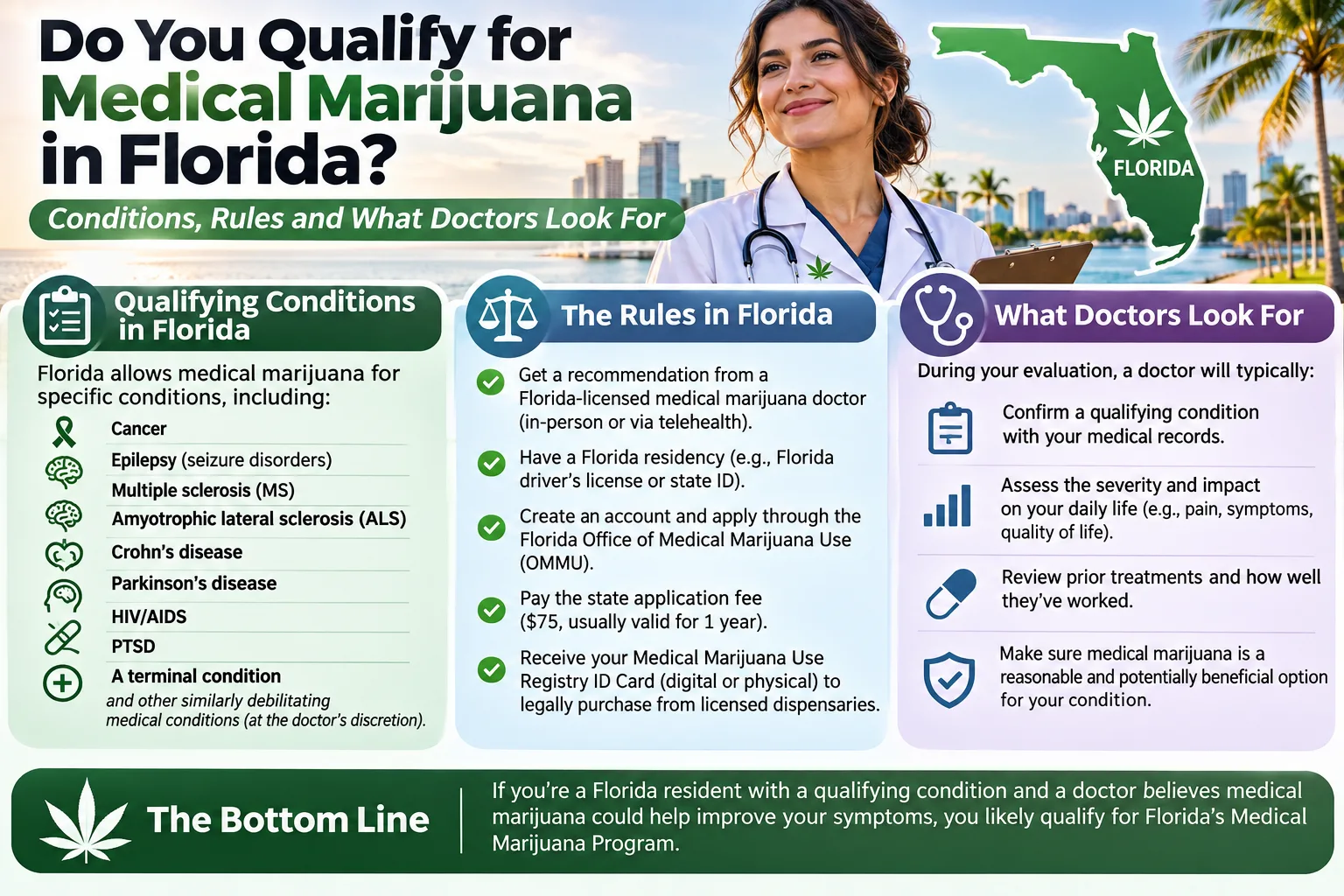
Florida Statute 381.986 lists these qualifying conditions:
- Cancer
- Epilepsy
- Glaucoma
- HIV and AIDS
- Post-traumatic stress disorder (PTSD)
- Amyotrophic lateral sclerosis (ALS)
- Crohn's disease
- Parkinson's disease
- Multiple sclerosis (MS)
If you have one of these diagnoses, a qualified physician can certify you after an exam. A diagnosis alone does not guarantee approval. The physician still decides whether medical marijuana is right for you.
Three more ways to qualify
The named list is only part of the law. Florida gives physicians three more ways to certify a patient.
- A condition of the same kind or class. A physician can certify a condition that is comparable to one on the list, based on clinical judgment. This is how most patients with conditions not named in the law qualify.
- A terminal condition. This is a progressive illness expected to cause death within one year. A physician other than the certifying doctor must diagnose it.
- Chronic nonmalignant pain. This is pain caused by, or starting from, a qualifying condition that continues past that condition's usual course.
Conditions that often qualify through physician judgment
These conditions are not named in the statute. A physician may still certify them as comparable conditions:
- Chronic pain: long-term pain, neuropathy, fibromyalgia, migraines and endometriosis
- Arthritis: rheumatoid arthritis, osteoarthritis, psoriatic arthritis and ankylosing spondylitis
- Mental health: anxiety disorders, depression, insomnia and OCD
- Digestive: ulcerative colitis, IBS, severe nausea and appetite loss
- Neurological: seizure disorders, muscle spasms, essential tremor, Tourette syndrome, traumatic brain injury and spinal cord injury
- Neurodegenerative: Alzheimer's disease, dementia and muscular dystrophy
- Cancer treatment side effects: nausea and pain from chemotherapy or radiation
None of these is approved automatically. Your physician weighs your history, symptoms and past treatments before deciding. For every named and comparable condition grouped by category, plus document and minor-patient rules, see this guide to Florida medical marijuana qualifying conditions.
Who can certify you
Only a Florida qualified physician can certify a patient. The doctor must hold a Florida license and complete the state's required training. Your first certification must be in person, with a physical exam. Renewals can be done by telehealth with the same physician.
After certifying you, the physician enters the certification into the state's Medical Marijuana Use Registry. You then apply for your state ID card.
What to bring to your evaluation
The state does not require medical records for your ID card application. Your physician still needs to confirm your diagnosis, though. These items make the visit go faster:
- Recent doctor's notes or a diagnosis letter
- Test results or imaging reports, if you have them
- A list of your current medications
- Proof of Florida residency, such as a Florida driver license or ID card
Seasonal residents without a Florida ID can use two documents showing a Florida address, such as a lease, deed or a utility bill dated within the last two months.
Can minors qualify?
Yes, with extra safeguards. A patient under 18 needs a qualifying condition, registration with the state and written consent from a parent or legal guardian. Minors cannot buy products themselves. A registered caregiver buys for them.
Caregivers must be at least 21, live in Florida, complete a state-approved course and pass a background check, unless they are a close relative. Smokable forms are allowed for minors only in narrow cases. The patient must have a terminal condition, and a board-certified pediatrician must agree that smoking is the most effective option.
What happens after approval
Once your physician certifies you, apply for your state ID card online. The state charges $75 a year, and online applications take about 10 business days on average to approve. Your card is valid for one year, and you can renew up to 45 days before it expires.
With an active card, you can buy from any licensed Florida Medical Marijuana Treatment Center. Smokable marijuana is limited to 2.5 ounces in a rolling 35-day period.
Things to know before you apply
- Out-of-state cards are not accepted. Florida does not honor medical marijuana cards from other states.
- Employers can keep drug-free policies. Florida law does not require employers to allow medical marijuana use, especially in safety-sensitive jobs.
- Federal firearm rules apply. Federal law treats marijuana users as prohibited from buying or owning firearms, even with a state card.
- Crossing state lines is illegal. Do not take medical marijuana out of Florida.
The bottom line
Florida's named list is short, but the law gives physicians room to certify many other conditions. If you live with chronic pain, anxiety, arthritis or a long-term condition that hasn't responded to other treatment, an evaluation is the best way to find out if you qualify. Bring your records, ask questions and let the physician guide the decision.
For official rules, visit the Florida Office of Medical Marijuana Use at knowthefactsmmj.com, and read the full text of Florida Statute 381.986.
This article is for general information and is not medical or legal advice. Talk with a Florida qualified physician about your situation.