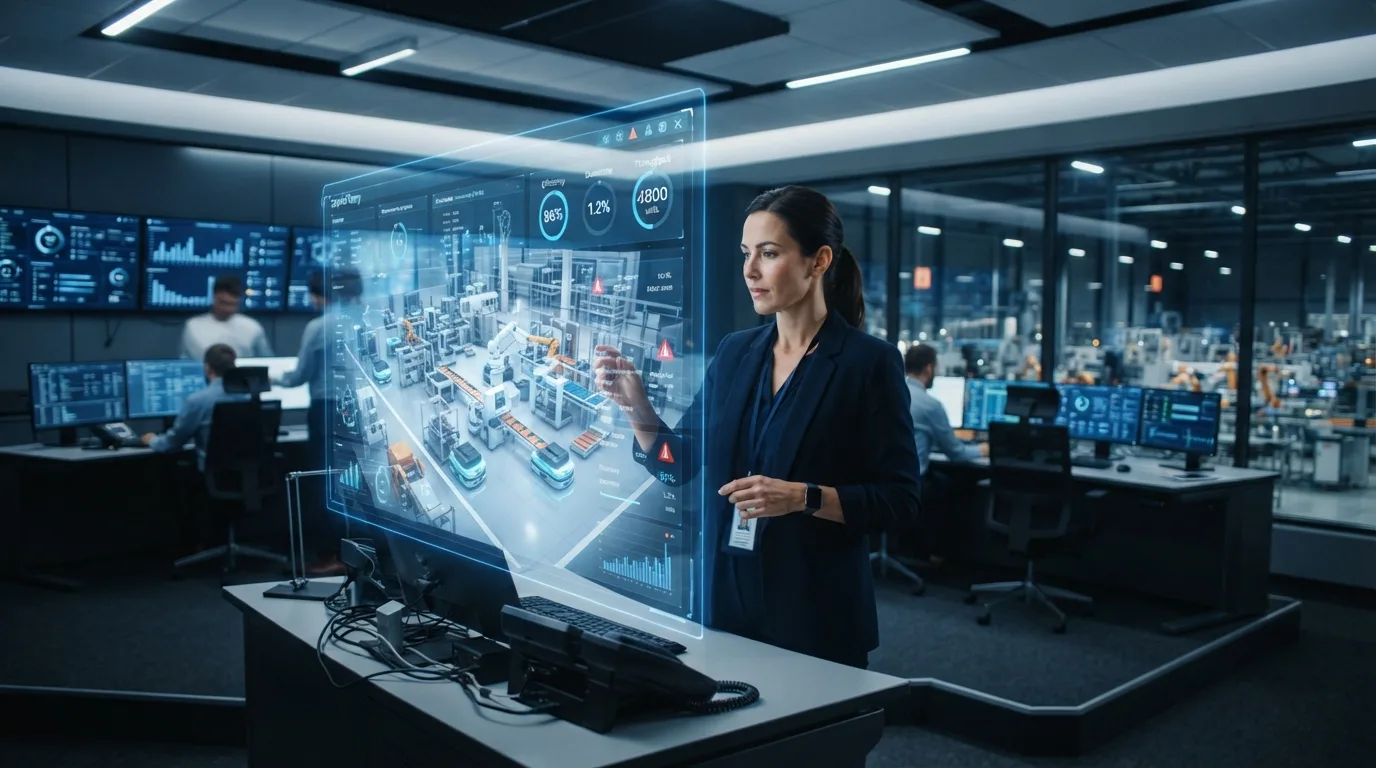
Enterprise leaders face constant pressure to run leaner operations, cut unplanned downtime, and base decisions on evidence rather than instinct. Digital twin technology has become one of the practical answers. A digital twin is a living virtual model of a physical asset, process, or system that updates continuously from real-world data. It lets teams monitor performance, test ideas, and predict outcomes without touching the physical operation.
The technology sits at the center of Industry 4.0 and digital transformation, drawing on Industrial IoT sensors, cloud computing, real-time analytics, and increasingly AI. The five strategies below show how organizations turn that capability into measurable business performance.
What Is Digital Twin Technology?
Digital twin technology creates a real-time virtual replica of a physical asset, process, or system. It combines live sensor data, simulation, and analytics to mirror how the real object behaves.
Organizations use it to monitor conditions, test scenarios, predict failures, and improve operational efficiency without disrupting live operations.
The concept moves well beyond static 3D design files. A true twin stays connected to its physical counterpart across the full life cycle, which is what makes it useful for everyday operational decisions rather than one-off engineering work.
How Does Digital Twin Technology Improve Business Performance?
It improves performance by giving teams a safe, data-rich space to catch problems early, test decisions, and act before small issues turn expensive. Studies of early adopters link digital twins to shorter development cycles, lower maintenance costs, and steadier output.
Five Digital Twin Technology Strategies That Improve Business Performance
The value of digital twin technology shows up in how it is applied, not just adopted.
1. Start With High-Value Assets
Not every machine needs a twin on day one. The strongest programs begin where failure is most expensive or most disruptive, such as a critical production line, a turbine, or a bottleneck in the supply chain.
Focusing on high-value assets first keeps early costs contained and produces a clear return that justifies wider rollout. Many manufacturers begin with a single asset, prove the numbers, then scale toward a full plant twin.
2. Connect Real-Time IoT Data
A twin is only as good as the data feeding it. Industrial IoT sensors and connected devices stream temperature, vibration, pressure, and output readings into the model so it reflects current conditions rather than last month's.
Real-time analytics turn that stream into a live picture of asset performance. In smart manufacturing, this connection lets a plant twin flag drift on the line the moment it appears, well before a defective batch reaches the floor.
3. Shift Maintenance From Reactive to Predictive
Predictive maintenance is one of the clearest wins. By comparing live sensor data against expected behavior, a twin spots the early signs of wear and forecasts failure before it halts production.
Asset performance management built on this approach reduces unplanned downtime, extends equipment life, and smooths scheduling. In capital-heavy sectors such as oil and gas, operators have used twins to cut unexpected stoppages sharply and save millions each year.
4. Simulate Changes Before You Deploy Them
Simulation is where digital twins protect the business from costly mistakes. Teams can test a new production schedule, a layout change, or a process adjustment inside the model and study the outcome before committing resources.
This lowers the risk of industrial automation projects and speeds approval, because leaders see the likely effect instead of guessing. Emirates Team New Zealand famously used a twin to evaluate thousands of hydrofoil designs without building each one.
5. Pair the Twin With AI and Machine Learning
The biggest gains arrive when AI and machine learning sit on top of the twin. Machine learning models find patterns people miss, while AI can recommend the next action or, in advanced setups, adjust operations on its own. This turns the twin from a monitoring tool into a decision engine.
Organizations without deep in-house data science often work with providers of enterprise AI solutions to connect these models to their enterprise systems and existing dashboards. The payoff is faster, better-informed decisions across the operation.
Why Are Companies Investing in Digital Twin Technology?
Companies invest because both the market signal and the returns are strong. Analysts value the global digital twin market in the tens of billions of dollars for 2026, with forecasts reaching several hundred billion within the decade.
McKinsey expects the category to grow roughly 60 percent a year through the middle of the decade and links twins to faster AI deployment and lower operating costs. Around three-quarters of large enterprises now use twins to help scale AI, yet only a small share have moved past pilots, which leaves clear room for early movers.
Which Industries Benefit the Most?
Manufacturing leads adoption, followed by energy, automotive, aerospace, healthcare, and smart cities. Production teams use twins for predictive maintenance and line optimization, while energy firms model grids and reservoirs.
Siemens and other industrial vendors now pair twins with AI to guide factory workers in real time. Healthcare applies the same idea to model facilities and, increasingly, patient physiology. The common thread is any operation where downtime is costly and data is plentiful.
How Can Organizations Get Started?
Getting started is more manageable than many leaders expect. A sensible path begins with one clear business problem, a single high-value asset, and the sensor data already on hand.
Cloud computing lets teams run a focused pilot without heavy upfront hardware, then expand once the twin proves its worth. Strong data governance and a named owner matter more than buying the largest platform on the market.
The Bottom Line
Digital twin technology has moved from an experimental idea to a working part of Industry 4.0 and digital transformation strategy. The organizations seeing the most value treat twins as a core layer of enterprise intelligence rather than a side project. They start small, feed the model real-time data, and layer AI on top for sharper decisions. For leaders weighing where to invest next, the question is no longer whether digital twins belong in the enterprise, but which problem to solve first.
Frequently Asked Questions
What is the difference between a digital twin and a simulation?
A simulation models a scenario at a single point in time, while a digital twin stays connected to its physical counterpart and updates continuously from live data. That ongoing link is what lets a twin support real-time monitoring and prediction rather than a one-time study.
How much does it cost to build a digital twin?
Costs vary widely by scope. A focused pilot on one asset can start modestly and run on a subscription model, while a full enterprise-wide twin represents a larger, phased investment. Most organizations begin small to prove value before scaling.
Do digital twins require replacing existing enterprise systems?
No. A twin usually sits on top of existing PLCs, SCADA, ERP, and IoT sensors, connecting through standard data protocols. It adds a layer of intelligence rather than replacing the systems already in place.
How does AI make digital twins more useful?
AI and machine learning analyze the data a twin collects to detect patterns, predict failures, and recommend actions. Advanced setups can adjust operations automatically, turning the twin into an active decision-support tool.
Which industries use digital twin technology the most?
Manufacturing, energy, automotive, aerospace, healthcare, and smart-city planning are among the heaviest users. Any sector with expensive assets, high downtime costs, and rich sensor data tends to benefit most.