Managing large-scale civil assets and preserving ancient historical monuments have traditionally relied on manual site surveys, periodic physical inspections, and fragmented paper documentation.
Whether dealing with a suspension bridge carrying tens of thousands of commuter vehicles daily or a century-old sandstone temple battling environmental weathering, facility teams usually had to react long after visible cracks or structural degradation appeared on the surface.
Today, digital spatial engineering is completely transforming this reactive approach. Developing a dynamic Digital Twin bridges physical assets with high-precision computational models. This provides civil engineers, urban planners, and cultural conservators with a living, real-time mirror of reality that permanently changes how structures are preserved, monitored, and operated.
Defining the Architecture of a Digital Twin
At its fundamental technical foundation, a Digital Twin is far more than an ordinary 3D computer animation or an architectural blueprint. It is an evolving, synchronized virtual replica of a physical entity, continuously updated through connected Internet of Things (IoT) sensors, spatial telemetry, and computational analytics.
A production-grade spatial virtual model combines four primary technological pillars that work in complete harmony:
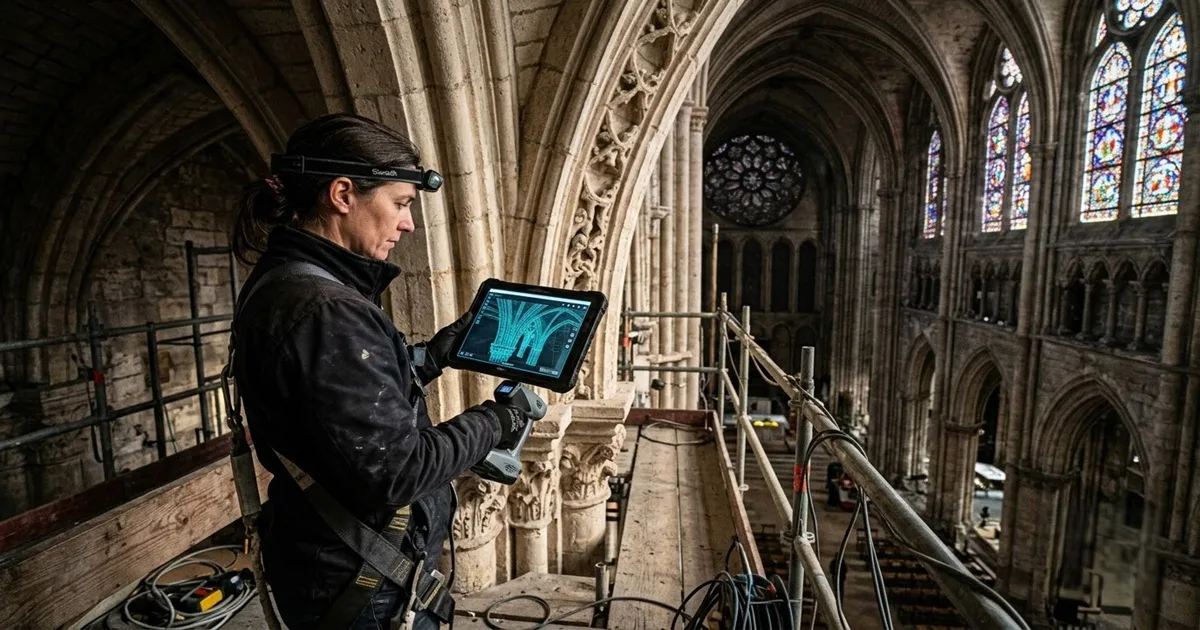
- High-Precision Spatial Reality Capture: Terrestrial LiDAR scanners, drone photogrammetry, and mobile laser mapping capture physical geometry down to millimeter-level spatial fidelity, recording complex organic surfaces and architectural contours.
- Continuous IoT Telemetry Streams: Vibration sensors, tiltmeters, strain gauges, and ambient climate probes stream continuous structural health data into central processing hubs, reflecting environmental loads instantly.
- Bidirectional Data Synchronization: Advanced algorithms process field sensor updates while feeding simulation findings back to automated environmental controls, smart HVAC units, and preventive maintenance scheduling systems.
- Physics-Based Predictive Simulation: Computational fluid dynamics, finite element analysis, and AI stress models simulate extreme weather conditions, traffic wear, and material fatigue decades into the future.
Critical Applications of a Digital Twin in Modern Infrastructure
Public works authorities and civil engineering contractors deploy spatial models across mission-critical civil sectors to resolve complex logistical bottlenecks:
- Predictive Bridge and Highway Maintenance: Instead of shutting down busy highway corridors for routine manual inspections, structural engineers run live sensor checks on expansion joints and load-bearing cables, detecting micro-shifts before structural fatigue poses danger to the public.
- Municipal Water and Power Grid Management: Utility operators simulate sudden peak surges or localized pipeline leaks across municipal digital replicas, optimizing flow pressure and preventing widespread urban service outages during extreme heatwaves.
- Mass Transit Operations and Station Crowd Flow: Metro networks model commuter movement across platform stairs and turnstiles, adjusting train dwell times and dispatching station staff during peak transit hours to ensure safety and comfort.
- Environmental Resilience and Flood Modeling: Coastal cities run sea-level rise scenarios and storm surge models against virtual elevation maps to engineer optimal drainage canals, overflow reservoirs, and protective seawall defenses.
How Heritage Preservation Benefits from a Digital Twin
Historical monuments, ancient ruins, and archaeological galleries face delicate conservation threats where physical intervention must remain completely non-invasive:
1. Permanent Non-Invasive Documentation via a Digital Twin
Historic masonry and ancient timber suffer inevitable weathering from atmospheric pollutants, heavy footfall, and seasonal humidity fluctuations. By combining sub-millimeter photogrammetry with multispectral imaging, conservators record every carved inscription and pigment shade in digital archives. If natural disasters strike, architects possess an uncorrupted digital blueprint to guide faithful restoration without guesswork.
2. Microclimate Simulation Inside Ancient Chambers with a Digital Twin
Centuries-old frescoes and delicate parchment scrolls react severely to changes in carbon dioxide, temperature, and moisture introduced by crowds of tourists. Virtual replicas simulate indoor air currents, allowing curators to adjust unobtrusive climate control vents and set daily visitor quotas without placing obtrusive machinery inside historic rooms.
3. Immersive Cultural Storytelling and Democratic Public Access
Delicate archaeological sites that are completely closed to public footfall can now be explored virtually. Patrons walk through accurate spatial reconstructions inside digital museum environments or through web browsers, democratizing cultural education worldwide while protecting fragile antiquities from wear.
Latest 2026 Innovations in Digital Twin Technology
Entering 2026, computational modeling has advanced from isolated point clouds into dynamic, real-time spatial operating ecosystems:
- Neural Radiance Fields (NeRF) and 3D Gaussian Splatting: Engineering teams generate photorealistic 3D volumetric assets from smartphone video clips in hours rather than weeks of manual photogrammetry stitching, drastically lowering reality-capture costs.
- Edge-AI Telemetry Ingestion: Localized neural chips mounted on bridges and heritage domes process acoustic and structural frequency shifts on-device, flagging dangerous structural anomalies instantly without relying on cloud bandwidth.
- Automated Generative Repair Schematics: When micro-fractures appear in structural replicas, generative AI models draft verified engineering repair schematics, citing historical masonry techniques or modern civil building codes.
- Open Geospatial Interoperability Standards: Universal data exchange protocols allow city governments to link transport, power, and heritage models into one cohesive municipal spatial operating system for cross-departmental collaboration.
Building a Resilient Bridge Between Past and Future
Adopting a comprehensive Digital Twin framework marks a profound shift in civil management and heritage stewardship. By translating cold stone, steel girders, and ancient monuments into responsive, data-rich computational environments, organizations can safeguard public safety and preserve historical beauty simultaneously. As spatial technology continues to evolve, these living digital mirrors ensure our most critical modern infrastructure stays resilient while our most precious cultural memories remain protected for generations to come.