Market Overview
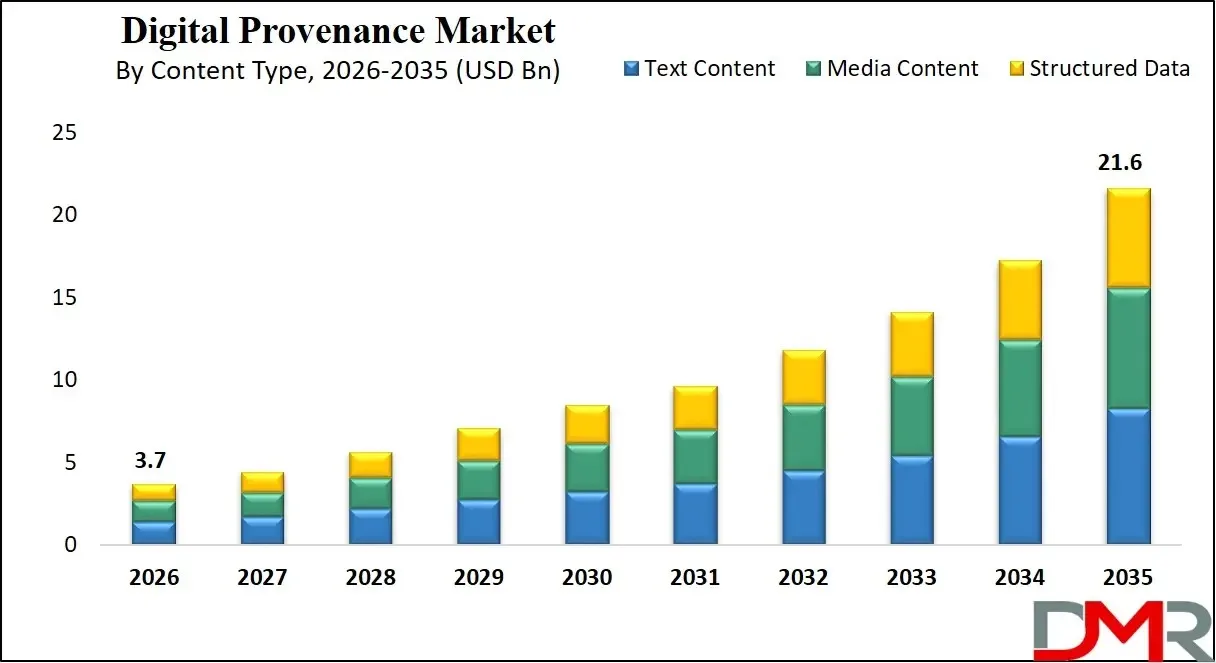
According to Dimension Market Research, the Global Digital Provenance Market size is expected to reach USD 3.7 billion in 2026 and grow at a CAGR of 21.8%, reaching USD 21.6 billion by 2035, driven by rising demand for content authentication, data integrity, AI-generated content detection, deepfake detection, blockchain-based traceability, and digital trust frameworks across industries.
Digital provenance refers to the verifiable record of the origin, ownership, and modification history of digital assets, including documents, images, videos, software, and data records. It uses technologies such as cryptography, blockchain, watermarking, and metadata tagging to establish authenticity and traceability.
The market is expanding rapidly as organizations across media, finance, government, and technology sectors seek to combat misinformation, verify content authenticity, and ensure data integrity. The rise of generative AI and synthetic media has intensified the need for robust provenance solutions that can distinguish human-created from AI-generated content.
The market is also being shaped by regulatory initiatives focused on AI governance, digital trust frameworks, and content authenticity standards, alongside growing investment in cybersecurity and blockchain-based traceability solutions.
Definition and Market Significance
Digital provenance refers to the technologies, processes, and standards used to verify the origin, ownership, and integrity of digital content and data. It encompasses cryptographic verification, blockchain-based tracking, watermarking, metadata management, and AI-powered content authentication.
The importance of digital provenance lies in its ability to establish trust in digital ecosystems by verifying that content is authentic, unaltered, and from a legitimate source. This is critical for combating misinformation, protecting intellectual property, ensuring regulatory compliance, and maintaining brand integrity.
Digital provenance also supports broader digital transformation objectives by enabling secure content distribution, facilitating audit trails for regulatory compliance, and building trust in AI-generated content through transparent attribution and verification.
Request a Complimentary PDF Sample
https://dimensionmarketresearch.com/request-sample/digital-provenance-market/
Market Drivers
A major factor driving the Digital Provenance Market is the rising threat of misinformation and deepfake content. The proliferation of AI-generated synthetic media, including deepfake videos and voice clones, has created urgent demand for provenance solutions that can verify content authenticity and detect manipulation.
The growing adoption of blockchain-based traceability is another key driver supporting market expansion. Blockchain technology provides immutable, transparent records of digital asset origin and ownership, enabling verifiable provenance across supply chains, media distribution, and digital transactions.
Increasing regulatory focus on AI governance and content authenticity is also contributing to market growth. Governments and industry bodies are developing frameworks and standards that require organizations to implement provenance solutions for compliance, transparency, and accountability.
Market Trends
The integration of AI-powered content authentication is emerging as an important trend in the market. AI and machine learning algorithms are being used to detect manipulated content, verify origin, and assess authenticity in real time, enabling proactive protection against misinformation.
Another significant trend is the adoption of content provenance standards such as the Coalition for Content Provenance and Authenticity (C2PA) framework. These standards embed verifiable metadata into digital media, enabling platforms and consumers to trace content origin and editing history.
The growing use of digital watermarking and cryptographic signatures is also transforming the market, enabling content creators and distributors to embed verifiable identifiers that persist across platforms and formats.
Market Restraints
Despite its strong growth potential, the Digital Provenance Market faces certain limitations. High implementation costs pose significant challenges, as deploying provenance solutions requires investment in blockchain infrastructure, AI detection tools, and integration with existing content management systems.
Interoperability and standardization issues are another significant restraint. The lack of universal standards for content provenance across platforms and jurisdictions can create fragmentation, limiting the effectiveness of provenance solutions.
In addition, privacy concerns related to content tracking and metadata collection can create resistance, particularly in jurisdictions with strict data protection regulations.
Market Opportunities
The expansion of digital provenance in media and entertainment presents significant growth opportunities. Content creators, studios, and streaming platforms are increasingly adopting provenance solutions to protect intellectual property, verify authenticity, and combat piracy.
The growth of blockchain-based supply chain traceability is another promising opportunity. Digital provenance is being applied to track the origin and authenticity of physical goods, including luxury items, pharmaceuticals, and agricultural products, enabling transparency and reducing counterfeiting.
Furthermore, the development of provenance solutions for AI-generated content attribution is expected to open new opportunities, enabling organizations to verify and label synthetic media in compliance with emerging regulations.
Segmentation
The Digital Provenance Market is categorized based on component, technology, application, and end-user industry.
By component, software solutions are expected to lead, driven by demand for content authentication platforms, blockchain-based provenance systems, and AI-powered detection tools. Services, including consulting, integration, and managed services, are also growing rapidly.
By technology, blockchain-based provenance is expected to dominate, offering immutable and transparent records. AI-powered content authentication, watermarking, and cryptographic verification are also significant and growing segments.
By application, content authentication and deepfake detection are expected to lead, driven by the urgent need to combat misinformation and synthetic media. Supply chain traceability, intellectual property protection, and regulatory compliance are also key applications.
By end-user industry, media and entertainment, BFSI, government, and technology are expected to be the leading segments, with media and entertainment driving significant demand for content authenticity solutions.
Regional Analysis
North America is estimated to dominate the Digital Provenance Market, with 39.0% of the total world market share in 2026 due to the large adoption of AI-based content authentication and advanced cybersecurity systems. The presence of large technology suppliers and the early implementation of digital trust models in BFSI, media, and government is an advantage to the region. Demand is also being driven by the increasing interest in deepfakes, misinformation, and data integrity. Moreover, the regional supremacy is still being strengthened by facilitative regulatory policies and investments in AI governance.
Europe holds a substantial share of the digital provenance market, driven by stringent data protection regulations, growing focus on AI governance, and increasing adoption of content authenticity standards. The United Kingdom, Germany, France, and the Nordic countries are key markets.
Asia Pacific is projected to be the fastest-growing region, driven by rapid digitalization, expanding media and entertainment industries, and increasing government initiatives focused on digital trust and cybersecurity in countries such as China, India, Japan, and South Korea.
Latin America and the Middle East & Africa are gradually adopting digital provenance solutions as digital infrastructure improves and awareness of content authenticity grows, with Brazil, Mexico, the UAE, and Saudi Arabia emerging as key markets.
Competitive Landscape
The Digital Provenance Market is highly competitive, with a mix of technology companies, blockchain platforms, AI content authentication providers, and specialized provenance startups competing on accuracy, interoperability, and integration capabilities. Leading players are investing in AI-powered detection, blockchain infrastructure, and standards-based provenance solutions to strengthen their market position.
Prominent players include major technology companies, blockchain platforms, and specialized provenance solution providers focused on content authentication, deepfake detection, and supply chain traceability. Recent developments include new content provenance standards, partnerships between technology companies and media organizations, and regulatory initiatives focused on AI content labeling and transparency.
Technological Advancements
Rapid advancements in AI-powered content authentication, blockchain traceability, and cryptographic verification are transforming the digital provenance market. AI and machine learning algorithms enable real-time detection of manipulated content, while blockchain provides immutable records of origin and ownership.
The development of content provenance standards and digital watermarking technologies is also playing a significant role, enabling verifiable attribution and traceability across digital platforms and formats.
Consumer Adoption Patterns
Media organizations, content creators, financial institutions, government agencies, and technology companies are increasingly adopting digital provenance solutions to protect intellectual property, verify content authenticity, and ensure regulatory compliance. The growing availability of standards-based provenance tools is making these solutions more accessible across industries.
Regulatory Environment
Regulatory frameworks across different regions, including AI governance initiatives, content authenticity standards, and data protection regulations, significantly influence the digital provenance market. Compliance with these regulations drives investment in provenance solutions and shapes market development.
Market Challenges
The digital provenance market faces challenges related to high implementation costs, interoperability and standardization issues, privacy concerns, and the need for continuous innovation to keep pace with evolving synthetic media technologies.
Future Outlook
The future of the Digital Provenance Market remains exceptionally promising as AI-generated content proliferates and organizations prioritize digital trust and content authenticity. Increasing adoption of blockchain-based traceability, AI-powered content authentication, and standards-based provenance frameworks is expected to drive strong market growth during the forecast period, with the market projected to reach USD 21.6 billion by 2035 at a CAGR of 21.8%.
FAQs
What is the expected size of the Digital Provenance Market in 2026?
The market is expected to reach USD 3.7 billion in 2026.
What is the projected market value by 2035?
The market is forecast to reach USD 21.6 billion by 2035.
What is the CAGR of the Digital Provenance Market?
The market is expected to grow at a CAGR of 21.8% during 2026–2035.
Which component segment dominates the market?
Software solutions are expected to lead, driven by content authentication platforms and blockchain-based provenance systems.
Which region leads the global digital provenance market?
North America is estimated to dominate with 39.0% of the total world market share in 2026.
Summary of Key Insights
The Global Digital Provenance Market is expected to grow from USD 3.7 billion in 2026 to USD 21.6 billion by 2035, recording a CAGR of 21.8% during the forecast period. Software solutions lead the component segment, while blockchain-based provenance dominates technology. Content authentication and deepfake detection lead applications, and media and entertainment leads end-user demand. North America holds the largest regional share with 39.0% of global revenue in 2026, while Asia Pacific is projected as the fastest-growing region.
Purchase the Full Report
https://dimensionmarketresearch.com/checkout/digital-provenance-market/