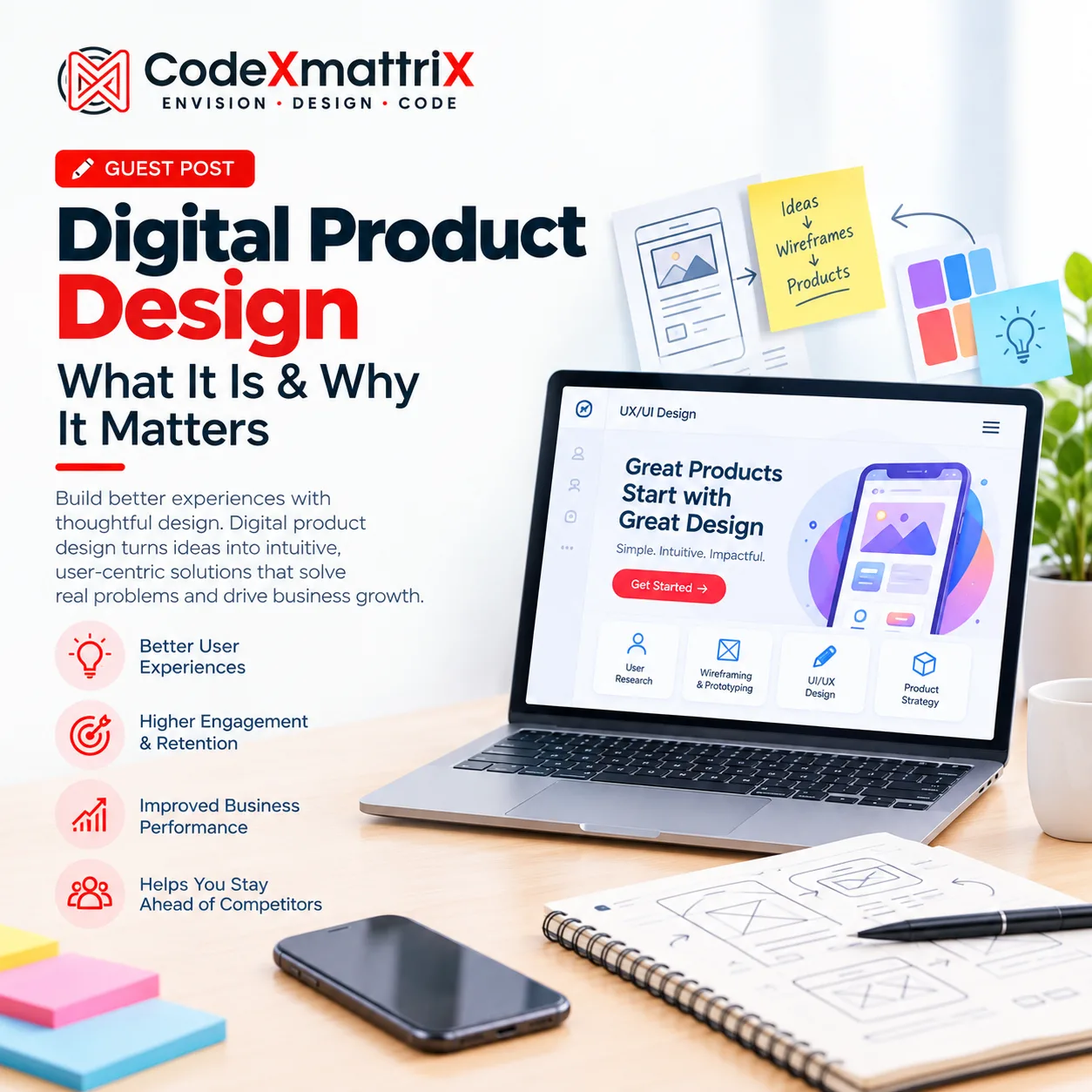
When people refer to the term "digital product design", many of them immediately associate it with beautiful interfaces, modern concepts and appealing app design. However, good digital product design is much more than just the aesthetic part of a digital product.
A successful digital product should be understandable, simple to use, relevant for the target audience and help it solve a specific task or a problem, while a product design is critically important for its experience and overall approachability.
This is why businesses are now more interested than ever in a good digital product design before diving into substantial product development.
What is digital product design?
Digital product design is a concept of product development that focuses on the requirements and expectations of a product's users and the objectives of a business offering the product.
Digital product design covers "everything from "user research and requirement planning to user flows, wireframes, prototypes, interface design, testing, and development support".
A good design process involves asking questions such as
- "Who will use the product?"
- "What problem do they want to solve?"
- "What additional challenges may they encounter?"
- "What features will be useful for them"
- "How can a product make their experience better?"
- "What does a business want to achieve?".
Answering these questions helps businesses to avoid developing features that their target audience will never use.
Why is digital product design important?
Let's imagine that you downloaded an application with a beautiful UI but it takes a while to actually get used to the interface. Chances are, you will keep exploring it for a few seconds more and then leave.
This is where product design can make a big difference.
A digital product is not judged only by its appearance but also by its overall experience, starting from the first interaction a user has with it.
Good digital product design can help businesses to Create Better User Experiences
Users tend to appreciate products with a good balance of predictability and ease of use, where they can navigate content and features smoothly to achieve their goals. A good digital product uses clear language, intuitive navigation and organisation, sensible interaction patterns and logical placement of controls and content to make the process effortless.
A well-designed product will make the experience flow naturally and intuitively towards a user's goal rather than forcing them to figure out what to do next.
Solve Real Customer Problems
One of the most important benefits of a good product design is dedicated focus on real problems experienced by users.
Before developing a product, businesses can learn more about their target audience and what they are looking for, thus helping set the direction for the product and avoid wasting time and money on unneeded features.
Reduce Development Mistakes
Modifying a digital product can be expensive and time-consuming, especially if it is already in development or has launched.
Designing user flows, wireframes, and prototypes before actual development can help spot potential issues and allow stakeholders to see the planned experience and make changes if necessary before substantial investment has been made.
Support Business Goals
Finally, a digital product also needs to make sense for a business that offers it.
An e-commerce store, for example, may benefit from an intuitive experience that guides users through the purchase funnel and encourages them to become returning customers, whereas a SaaS application may want to facilitate the onboarding process and introduce users to its main features to get them to become active users. A business offering some services may want to attract more leads.
A well-designed product will bring together the requirements and goals of a business and an end-user, creating a positive experience that serves both parties.
The Main Steps in Digital Product Design
Digital product design rarely involves a single step in a specific order. Instead, it is a multi-step process where different stages complement each other. Generally speaking, there are several key steps in the process:
1. User Research in Digital Product Design
The first step in product design is researching the target audience.
This stage typically includes analysing customer behaviour, exploring pain points, understanding their expectations from a product and learning about similar products on the market.
This research helps the design team to have a good idea of what the product should address.
2. Requirement Planning
Once the problems that a digital product should address have been identified, the design team and a business can set product requirements.
At this stage, it is important to separate must-have features (the ones that a product cannot exist without) and nice-to-have features (the ones that enrich the product experience but are not critical). This is especially important for startups that do not always need all the bells and whistles right away.
3. User Flow Mapping
The next step in product design is mapping out the user flows for a digital product.
User flows are diagrams that represent the steps a user will take while interacting with a product. For example, making a purchase in an e-commerce store may involve the following steps: landing on the homepage, searching for a product, browsing through product cards, adding a product to the cart, heading to the checkout page, entering personal and payment information and completing the purchase.
By visualising the process, designers can see what steps are necessary, what actions lead to a negative experience and what improvements they can suggest before planning the actual design of the product.
4. Wireframing
Wireframes give a general idea of how a digital product will look like.
While they do not normally focus on the visual aspect of the product, they are good for planning the general location of information, features, controls and other elements on a page or screen.
5. Prototyping
A prototype represents a functional mockup of a digital product that allows end-users and stakeholders to get an idea of how the product will work.
Stakeholders and users can offer feedback, after which the design can be refined and made into a prototype again until an acceptable result is achieved.
6. UI Design
UI design builds upon the wireframes and prototypes and focuses on the overall look and feel of the product. UI designers plan the colour scheme and typography, incorporate graphics, icons and images, organise the information architecture, size elements, add animations and other effects to create a visually appealing but intuitive interface.
7. Testing and Improvement
Testing should not be seen as an end-goal but as an ongoing process that helps to make a digital product intuitive and intuitive. Iterating on the design based on the feedback received can help resolve some of the most pressing issues and ensure that a product is ready for development.
Digital Product Design Is More Than Just UI Design
Sometimes people confuse UI design and digital product design, mistaking the two for each other.
While UI design focuses on the visual aspects of an interface, such as colours, typography, spacing between elements, graphics, icons, animations and images, digital product design is a multi-faceted concept that encompasses the entire product, from its purpose and target audience, through users' tasks and interactions, to a prototype and development.
Simply put, UI design is an important part of a digital product but the product design as a whole involves a bigger picture.
Why startups should focus on product design before development
Every decision that a startup makes involves the use of time and money, so any unnecessary step should be avoided. At the same time, launching a product with poorly planned features and an unintuitive interface can result in serious losses for a young business. With that in mind, a research-driven design process can give startups an opportunity to test some of their ideas before actually developing a product.
This can be especially important when it comes to developing an "MVP (Minimum Viable Product)". Instead of guessing what a product should offer and what users will actually want, a startup can learn about their problems and come up with a solution that directly addresses them. Once the product concept has been chosen, designers can set the overall direction and develop a simple prototype to see how users will react before investing substantial resources into development.
Choosing the Right Digital Product Design Partner
The right design partner will understand the importance of both people and business.
Look for a team that demonstrates the willingness to understand your idea, ask questions, learn about the users and discuss your business requirements rather than jumping to the visual presentation. A good design process will involve research, user flows, prototyping and feedback, design and development.
CodeXmattrix, for example, focuses on digital product design that combines research, flow mapping, design and engineering to help businesses transform their ideas into digital products and MVP concepts. Such an approach can be ideal for businesses that seek to move from concept to application or website without leaving design out of the equation.
Final Thoughts
Ultimately, digital product design is about building something that can serve real users with real problems while fulfilling a business need. While an attractive interface may draw someone in, it is a well-designed product that keeps them there. From users' tasks and flows to prototypes, testing, feedback and developer collaboration, every step in design helps to shape the final product experience. By investing time and effort into the design process prior to substantial development, companies can maximise their chances of turning an idea for a website, application, SaaS platform, or any digital product into a reality.