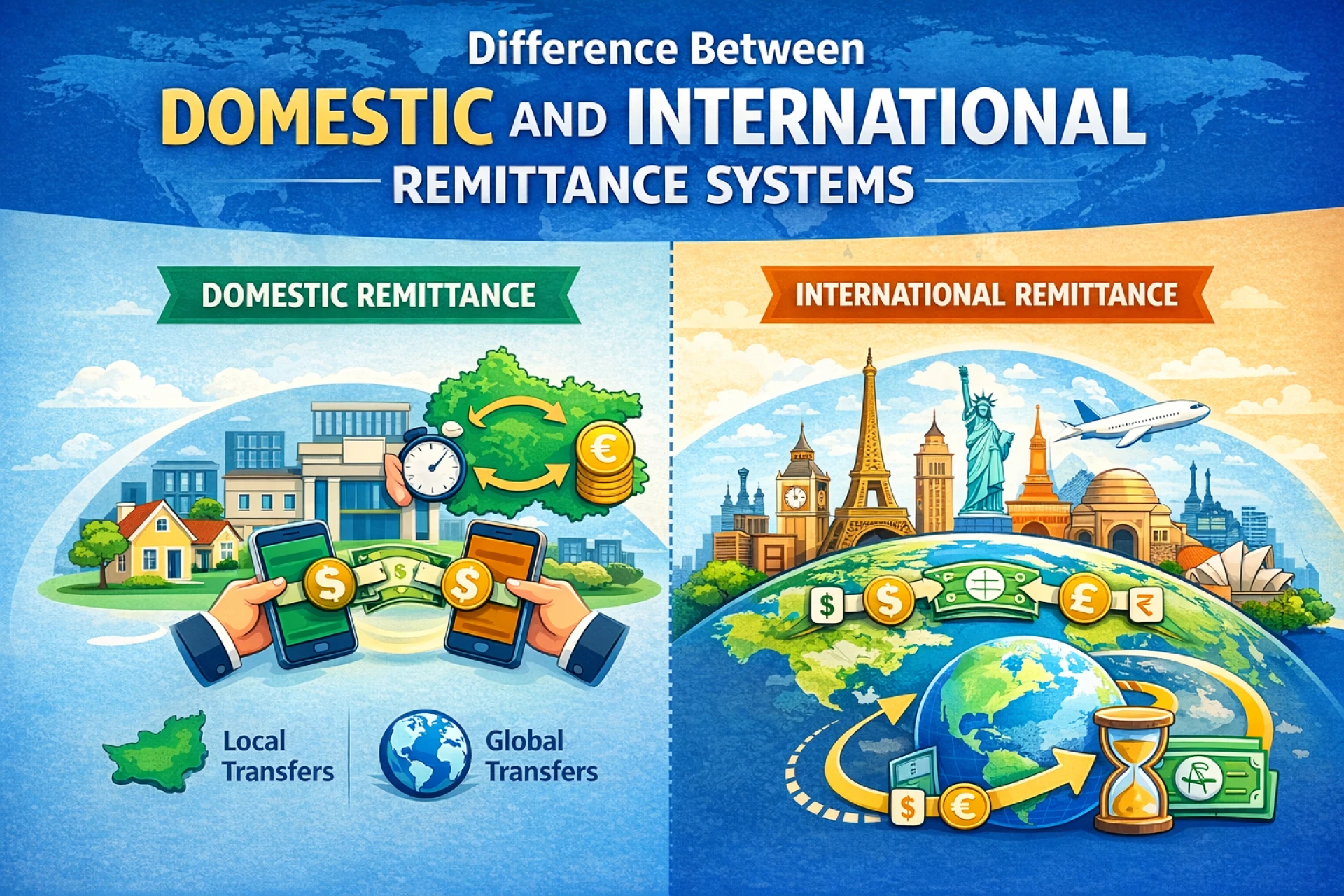
Money remittance systems are an essential part of today’s financial world. They allow individuals and businesses to transfer money safely and efficiently, whether within a country or across borders. With the growth of digital payments and fintech platforms, remittance systems have become faster, more transparent, and more accessible. Broadly, remittance systems are classified into domestic remittance systems and international remittance systems. Although both serve the same purpose, they differ greatly in terms of operation, cost, compliance, and technology.
What Is a Remittance System?
A remittance system is a financial mechanism that enables money to be transferred from a sender to a receiver through banks, financial institutions, or digital platforms. These systems can be traditional, such as bank transfers, or digital, such as mobile wallets and online money transfer platforms. Remittance systems are widely used for personal, commercial, and institutional payments.
Understanding Domestic Remittance Systems
Definition of Domestic Remittance
A domestic remittance system allows money transfers within the same country. Both the sender and the receiver are governed by the same national financial system and regulatory authority.
How Domestic Remittance Systems Work
Domestic remittances operate through local banking networks, national payment rails, or mobile-based payment systems. Since transactions stay within national borders, they are settled quickly and securely.
Key Features of Domestic Remittance Systems
Domestic remittance systems use a single national currency, which eliminates foreign exchange costs. They offer faster transaction processing, often in real time or within the same day. Regulatory compliance is simpler, as only one country’s KYC and AML rules apply. Transaction costs are generally low due to fewer intermediaries and no currency conversion.
Common Use Cases
Domestic remittance systems are commonly used for salary payments, bill payments, peer-to-peer transfers, merchant settlements, and government benefit disbursements.
Understanding International Remittance Systems
Definition of International Remittance
An international remittance system enables money transfers across different countries, involving multiple currencies and financial institutions.
How International Remittance Systems Work
International remittances pass through global banking networks, correspondent banks, or digital payout partners. These transactions often involve currency conversion and additional settlement steps, which increase complexity.
Key Features of International Remittance Systems
International remittance systems support multiple currencies and require foreign exchange conversion. They involve higher regulatory complexity due to compliance with multiple countries’ laws. Transaction processing time is longer, ranging from a few hours to several days. Costs are higher because of FX margins, correspondent banking fees, and compliance overhead.
Common Use Cases
International remittance systems are widely used by migrant workers sending money home, businesses making cross-border payments, students paying international education fees, and individuals covering overseas medical or travel expenses.
Major Differences Between Domestic and International Remittance Systems
Geographic Scope
Domestic remittance systems operate within one country, while international remittance systems connect multiple countries.
Currency Involvement
Domestic remittances use a single currency, whereas international remittances involve two or more currencies.
Transaction Speed
Domestic transfers are usually instant or same-day, while international transfers can take longer due to intermediary processing and regulatory checks.
Cost Structure
Domestic remittances are low-cost, whereas international remittances are more expensive due to FX charges and cross-border fees.
Regulatory Compliance
Domestic systems follow one country’s regulations, while international systems must comply with multiple regulatory authorities and international standards.
Technology Used in Remittance Systems
Technology in Domestic Remittance
Domestic remittance platforms rely on national payment infrastructure, banking APIs, and centralized settlement systems. The technology focus is on speed, reliability, and scalability.
Technology in International Remittance
International remittance systems require advanced technology such as multi-currency wallets, real-time FX engines, cross-border payment APIs, global payout integrations, and compliance automation tools.
Compliance and Security Considerations
Compliance in Domestic Remittance
Domestic remittance systems require standard KYC verification and local AML compliance. The risk level is relatively low due to limited jurisdictional exposure.
Compliance in International Remittance
International remittance systems demand enhanced due diligence, sanctions screening, transaction monitoring, and cross-border reporting. These systems face higher risks related to fraud, money laundering, and regulatory penalties.
Business Perspective: Choosing the Right Remittance System
Businesses that focus on local markets often prefer domestic remittance systems due to lower costs and faster deployment. However, companies aiming to serve international customers or migrant populations require international remittance capabilities. Many fintech companies begin with domestic remittance services and later expand globally using white-label or API-based international remittance software.
Future Trends in Remittance Systems
Domestic remittance systems are moving toward fully digital and real-time transactions. International remittance systems are evolving to offer faster settlements, better transparency, and reduced costs through fintech innovation, digital wallets, and API-driven platforms.
Conclusion
Domestic and international remittance systems play equally important roles in the global financial ecosystem. Domestic remittance systems are simple, fast, and cost-effective, making them ideal for local transactions. International remittance systems, while more complex, are essential for enabling global money movement. Understanding the differences between these systems helps businesses choose the right technology and build efficient, compliant, and scalable remittance services.