The Shift from Billboards to Browsers
There was a time when marketing lived in the physical world of TV commercials, glossy magazines, radio jingles, and flyers. Brands measured success by how many people saw their ads, not necessarily by how many responded. Fast forward to today, and the story has changed. A single viral post or targeted ad can now reach millions within hours.
The evolution from traditional methods to digital marketing has not just changed. The tools we use have transformed how people connect with brands. Consumers no longer wait to see an ad; they engage, comment, share, and compare before making decisions. Marketing is no longer one-way communication; it is a conversation.
However, this does not imply that conventional marketing is no longer useful. It has emotional resonance and trustworthiness that screens can't always match. Knowing when to combine the two worlds is where the true power resides.
Traditional Marketing: The Old-School Charmer That Still Works!
Marketing consisted of TV commercials, radio mentions, print advertisements, and outdoor billboards until smartphones took over attention spans. According to studies, print advertisements outperform a number of internet platforms, generating a response rate of about 9% and delivering 70–80% higher recall than digital ones.
Yet the numbers are shifting. 2025 U.S. TV ad spending will decline from $57.7 billion to $54.7 billion by 2027. Meanwhile, newspaper ad revenue will drop from $4.9 billion to $3.56 billion in the same period, marking a −10.34% CAGR. Newspaper readership has also fallen sharply, from 63.2 million in 1990 to 24.3 million in 2025, with only 5% of Americans reading printed newspapers daily.
Even radio is feeling the change, with daily listenership down to 31%, and only 15% among people under 30. Interestingly, high-income households remain loyal as nearly 60% of those earning over $100K tune in weekly.
These trends show a clear pattern: while traditional advertising still commands trust, it struggles to match the speed and reach of digital marketing.
Digital Marketing: The Dynamic and Data-Driven Revolution
Digital marketing did not just modernize advertising, but democratized it. With the right tools and creativity, even small businesses can reach global audiences without million-dollar budgets. The power lies in precision:- understanding who your audience is, what they care about, and how they behave online.
By 2025, global digital ad spending will exceed $700 billion, making up more than 65% of total ad spend worldwide. In the U.S. alone, digital advertising represents over three-quarters of total spending, led by mobile ads projected at $200 billion+ and social media ads reaching $95.7 billion.
The performance speaks for itself. Influencer marketing delivers an average ROI of $5.78 per $1 spent nearly double the return of standard online ads. Even PPC advertising yields about $2 for every $1 invested. Compare that to print, which, despite its $8.98 billion spend, often struggles with tracking and engagement.
Unlike traditional methods, digital marketing gives real-time insights. You know exactly how many people clicked, how long they stayed, and what made them convert. That clarity reshapes strategy and digital continues to outpace traditional formats.
The Key Differences That Define Both Worlds
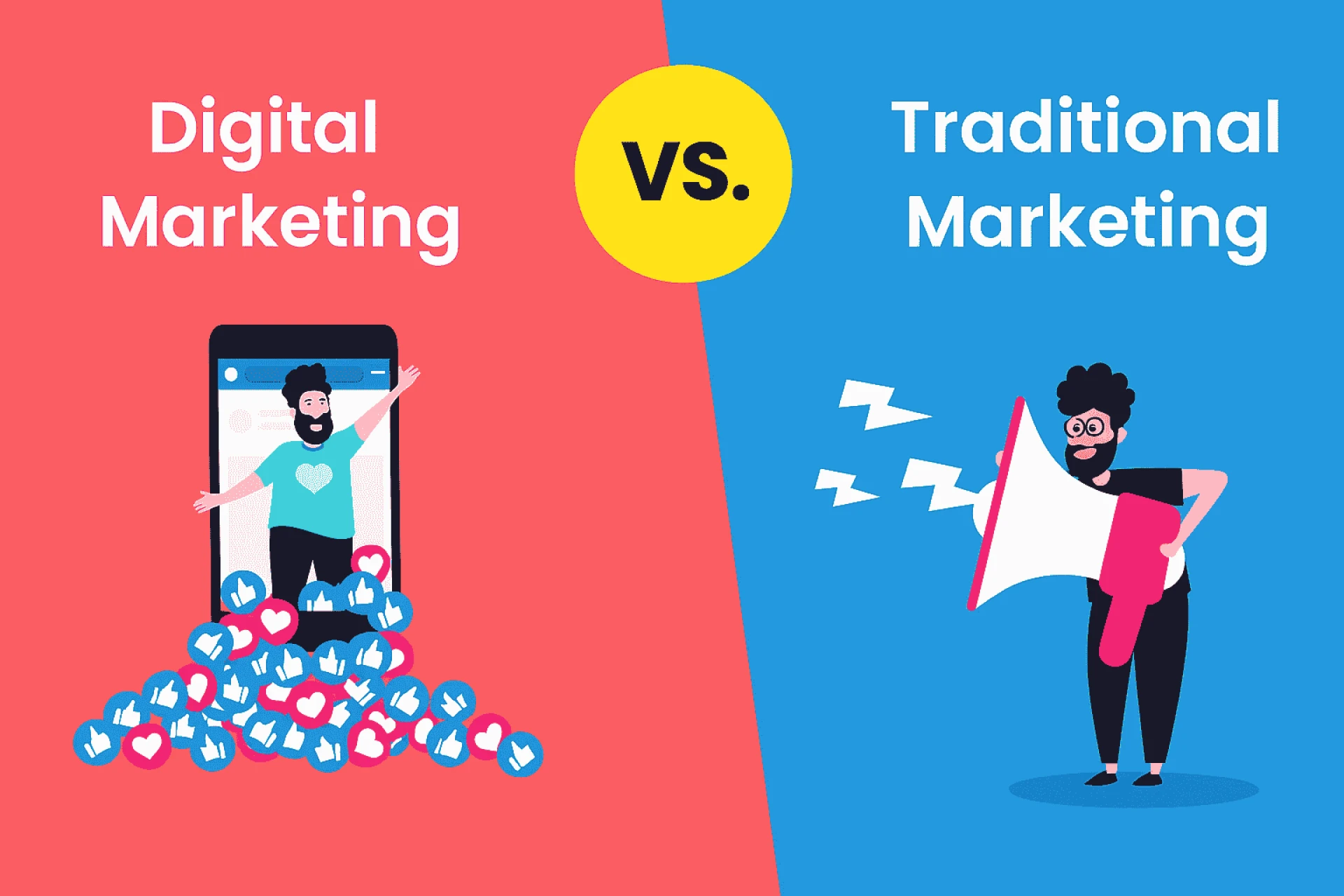
The distinction between traditional and digital marketing is not just about tools, but interaction as well. Traditional marketing broadcasts and digital engages.
- Reach:- Local audiences are the focus of traditional media. Digital media can reach a global audience or a specific niche.
- Cost:- Traditional methods necessitate a significant initial outlay of funds. Flexible budgets are made possible by digital.
- Feedback:- Traditional methods rely on outcomes that are delayed. Instant engagement metrics are provided by digital.
- Analytics:- Conventional methods provide broad insights. Digital offers thorough, up-to-date tracking.
- Personalization:- Traditional speaks broadly; Digital tailors content to each user.
- Adaptability:- Traditional takes weeks to change. Digital can pivot overnight.
Both hold value, as one builds recognition, and the other deepens relationships.
The Hybrid Advantage: Where Traditional Meets Digital
Smart brands don’t pick sides; they integrate. The most effective strategies today merge offline authenticity with online agility. A billboard with a QR code. A print feature linked to an Instagram campaign. A radio mention that drives listeners to a website funnel.
Data backs this up. Businesses using omnichannel marketing retain 89% more customers than those without it. They enjoy a 250% higher purchase rate, a 13% increase in average order value, and nearly 9.5% annual revenue growth triple that of brands without omnichannel presence. Around 74% of shoppers use social media to influence purchase decisions, while 73% engage across multiple platforms before buying.
The takeaway? Integration drives consistency, and consistency builds trust.
Choosing the Right Balance for Your Business
Every business operates at its own pace. Some thrive on the tactile feel of brochures; whereas others grow through SEO-driven leads. The key is alignment:- matching your marketing medium to your audience’s habits and expectations.
If your goal is brand awareness, traditional methods like print or event sponsorships can create strong impressions. If you are focused on conversion and engagement, digital marketing offers measurable, flexible tools to test and scale.
Ask yourself: where does your audience spend most of their time on screens, in stores, or both? The answer helps define where to focus your energy.
Transitioning Smartly: Evolving, Not Replacing
Shifting from traditional to digital marketing is not about abandoning the old, but modernizing how it works for you. Start small: digitize what you already do well. If print ads perform locally, replicate the tone and visuals on social media. If radio spots connect emotionally, transform them into short-form video content.
One small business owner once relied only on flyers and local magazines. After implementing a simple digital content strategy with automated posting and targeted ads, her inquiries grew fivefold in three months. That is the power of combining human creativity with digital precision.
This balance keeps your marketing relevant without losing its roots.
Conclusion: The Future Belongs to Adaptive Brands!
Traditional marketing will always hold a place in storytelling. It builds recognition and familiarity. Digital marketing adds agility, scalability, and personalization. Together, they form a robust ecosystem that connects brands with people at every stage of their journey.
The future does not belong to one method over another but to those who adapt and integrate. The smartest marketers understand that success is not about being everywhere. It is about being effective everywhere.
So, where does your brand stand today? Maybe it is time to find your balance between tradition and innovation, where timeless connection meets modern growth.