Diamond colour plays an important role in the beauty, character and value of a lab-grown diamond. Although the differences between neighbouring colour grades can be extremely subtle, selecting the right grade helps us achieve a bright appearance while keeping the jewellery within budget.
Lab-grown diamonds are assessed according to the same internationally recognised colour-grading standards used for mined diamonds. A properly graded laboratory-grown diamond may receive a colour grade ranging from D, completely colourless, to Z, noticeably tinted. Understanding these grades allows us to choose a diamond that complements its shape, setting and metal colour without paying for a visual difference that may be difficult to notice once the jewellery is worn.
What Is Diamond Colour in a Lab-Grown Diamond?
Diamond colour refers to the presence or absence of visible colour within the stone. In white diamonds, the highest grades contain the least noticeable colour. A colourless diamond allows light to pass through without a warm yellow or brown tint, helping it appear crisp, bright and icy.
The term can initially seem confusing because a higher colour grade actually means less colour. A D-grade lab-grown diamond is considered completely colourless, while diamonds further down the scale gradually display warmer tones.
Colour must not be confused with brilliance. Colour describes the diamond’s body tone, whereas brilliance describes the white light reflected from the diamond. A well-cut G-colour diamond can therefore appear brighter and more attractive than a poorly cut D-colour stone.
For this reason, we evaluate colour alongside cut, clarity, carat weight, shape and setting design rather than considering it in isolation.
How Lab-Grown Diamonds Receive a Colour Grade
Professional gemmological laboratories examine loose diamonds under controlled lighting conditions. The diamond is usually compared with master stones that represent established points on the D-to-Z colour scale.
Grading is completed before the diamond is placed into jewellery because a setting can influence how its colour appears. Yellow gold, rose gold and surrounding gemstones may reflect colour into a diamond, while white gold and platinum can make warmer undertones more noticeable.
An independent grading report normally records important information such as:
- Whether the diamond is laboratory-grown
- The diamond’s colour grade
- Clarity grade
- Cut grade, where applicable
- Carat weight
- Measurements and proportions
- Polish and symmetry
- Fluorescence
- Growth method or additional comments
- Report number and identifying inscription, where provided
We recommend checking the report number and matching it with the laser inscription on the diamond whenever an inscription is available.
Understanding the Lab-Grown Diamond Colour Scale
The standard white-diamond colour scale begins at D and ends at Z. It is divided into groups that describe the general amount of visible colour.
Colour rangeClassificationGeneral appearanceD to FColourlessCrisp, icy and exceptionally whiteG to JNear-colourlessWhite face-up with slight warmth in lower gradesK to MFaint colourNoticeable warmth, especially in larger stonesN to RVery light colourClear yellow or brown tintS to ZLight colourStronger and easily visible body colourEach grade represents a narrow range. The difference between a G and H diamond, for example, can be difficult to identify without controlled lighting and a direct side-by-side comparison.
D to F Colourless Lab-Grown Diamonds
D Colour Lab-Grown Diamonds
D is the highest grade on the traditional colour scale. A D-colour lab-grown diamond contains no detectable colour when examined under recognised grading conditions.
This grade is suitable for buyers who want the most colourless appearance available. It works particularly well with platinum, white gold and minimalist solitaire settings, where the diamond remains the main visual focus.
D colour may carry a premium, especially in larger diamonds. We therefore recommend comparing it with E and F grades before deciding, as the differences may be very difficult to see once the diamond is mounted.
E Colour Lab-Grown Diamonds
E-colour diamonds are also classified as colourless. Minute traces of colour may be detected by an experienced grader under laboratory conditions, but the stone will normally appear beautifully white to the unaided eye.
An E-colour lab-grown diamond offers a highly refined appearance and can be a practical alternative to D colour for premium engagement rings, earrings and diamond pendants.
F Colour Lab-Grown Diamonds
F is the final grade within the colourless category. It offers a bright, clean appearance and usually performs exceptionally well in white-metal settings.
For buyers seeking a luxury colourless diamond without automatically selecting the highest-priced grade, F colour can provide an attractive balance. In everyday jewellery, many people will not see a meaningful face-up difference between a well-cut F diamond and a higher colour grade.
G to J Near-Colourless Lab-Grown Diamonds
G Colour Lab-Grown Diamonds
G is one of the most popular colour grades because it sits immediately below the colourless range. A well-cut G-colour diamond generally appears white when viewed from the top, particularly after it has been set in jewellery.
We often consider G colour an excellent choice for buyers who want a premium white appearance while using more of their budget for cut quality, carat weight or the setting.
H Colour Lab-Grown Diamonds
H colour is another strong value option. It remains within the near-colourless category and usually looks bright in engagement rings, pendants, earrings and wedding jewellery.
A slight warmth may become visible when an H diamond is compared directly with a D or E stone. When viewed separately, however, a well-cut H-colour diamond can appear impressively white.
H colour works with platinum and white gold, but it can look particularly harmonious in yellow or rose gold because the warmer metal reduces the contrast between the diamond and its setting.
I Colour Lab-Grown Diamonds
I-colour diamonds may show a gentle warm tone, especially when viewed from the side or placed beside a colourless diamond. The appearance depends heavily on the diamond’s shape, size and setting.
Round brilliant diamonds tend to conceal colour effectively because their facet pattern produces strong light return. An I-colour round diamond may therefore appear whiter than an I-colour step-cut stone of a similar size.
For yellow-gold and rose-gold jewellery, I colour can offer excellent visual value. The warmth of the metal creates a cohesive appearance, making a higher colour grade less essential.
J Colour Lab-Grown Diamonds
J is the lowest grade in the near-colourless range. It can display visible warmth, particularly in larger diamonds and colour-sensitive shapes. Nevertheless, it may remain an attractive option when the stone has an excellent cut and is paired with a suitable setting.
We frequently recommend assessing J-colour diamonds individually rather than making a decision from the grade alone. A bright round brilliant J diamond in yellow gold can look elegant, while a large emerald-cut J diamond in platinum may reveal more warmth.
K to M Lab-Grown Diamonds with Faint Colour
Diamonds graded K, L or M contain a more noticeable warm tint. These grades are not automatically unattractive. They can create a soft, vintage-inspired appearance and work beautifully in yellow-gold or rose-gold designs.
A faint-colour diamond may be suitable for:
- Vintage-style engagement rings
- Yellow-gold solitaire rings
- Rose-gold halo designs
- Jewellery with warm-coloured gemstones
- Larger diamonds selected with a value-focused budget
We advise viewing these diamonds through clear videos or in person. Their undertones may differ, with some appearing yellowish, brownish or slightly grey. Personal preference becomes especially important within this colour range.
Which Lab-Grown Diamond Colour Grade Offers the Best Value?
For many buyers, G to H colour provides the strongest balance between whiteness and value. These diamonds generally appear colourless when viewed face-up but may cost less than comparable D-to-F stones.
The best-value grade still depends on the complete jewellery design:
- For platinum or white-gold solitaires, we generally consider F to H colour.
- For yellow-gold rings, G to J colour can work beautifully.
- For rose-gold settings, H to J colour often blends naturally with the metal.
- For emerald and Asscher cuts, a higher colour grade may be preferable.
- For round brilliant diamonds, near-colourless grades can provide excellent value.
- For large centre stones, increasing the colour grade may produce a more noticeable improvement.
Rather than choosing the highest grade automatically, we compare the diamond’s actual appearance with the intended setting.
How Diamond Shape Affects Visible Colour
Diamond shape can significantly influence colour perception. Brilliant-cut shapes contain facet arrangements designed to create intense light return, which can help disguise subtle warmth. Step-cut shapes have broad, open facets that make the diamond’s body colour easier to observe.
Round Brilliant Diamonds
Round brilliant diamonds are highly effective at concealing colour. G, H and even carefully selected I grades can appear white, particularly when the stone has excellent proportions and strong light performance.
Oval, Pear and Marquise Diamonds
Elongated brilliant shapes can retain colour near their pointed ends. An oval diamond may appear white in the centre while displaying slight warmth at the tips. We recommend examining the complete diamond rather than relying only on its colour grade.
Emerald and Asscher-Cut Diamonds
Emerald and Asscher cuts reveal colour more readily because of their large step facets. Buyers who want a crisp, icy appearance may prefer a higher grade, commonly within the D-to-G range.
Cushion and Radiant-Cut Diamonds
Cushion and radiant diamonds vary considerably according to their facet patterns. Some conceal warmth efficiently, while others show more body colour. Individual assessment is therefore essential.
How Carat Weight Influences Diamond Colour
Colour generally becomes more noticeable as diamond size increases. A larger stone contains more material through which body colour can be observed. A one-carat H-colour diamond may appear very white, while a much larger H-colour diamond can show slightly more warmth from the side.
For larger centre stones, we may recommend moving one grade higher if the buyer wants an especially white appearance. This is particularly relevant for elongated shapes and open-sided settings.
Small accent diamonds behave differently. Their limited size makes subtle colour differences difficult to detect. Matching remains important, however, because side stones that are noticeably whiter or warmer than the centre diamond can create an inconsistent appearance.
Choosing Diamond Colour for White, Yellow and Rose Gold
Platinum and White Gold
White metals create a cool background and reflect white tones into the diamond. They are ideal for colourless and near-colourless stones, but they may also reveal warmth in lower colour grades.
For a bright white-metal design, D to H colour is usually a dependable range. I or J colour can still work, but we recommend inspecting the stone and setting combination carefully.
Yellow Gold
Yellow gold can make a near-colourless diamond appear whiter by comparison. It also reduces the need to pay a premium for a colourless grade.
A popular approach is to use a yellow-gold band with white-gold or platinum prongs. The white prongs maintain a neutral frame around the diamond while the yellow band creates warmth throughout the overall design.
Rose Gold
Rose gold complements diamonds with gentle warmth. H, I and J colour grades can look balanced and elegant in rose-gold settings. Colourless diamonds also work well, creating a stronger contrast between the stone and the metal.
Diamond Colour Versus Cut Quality
We rarely recommend sacrificing cut quality simply to obtain a higher colour grade. Cut controls how effectively light enters, travels through and returns from the diamond. A diamond with excellent light performance can appear lively, bright and visually clean.
A poorly cut colourless diamond may look dull, while a beautifully cut near-colourless diamond can display stronger brilliance and greater visual impact.
When allocating a budget, we generally prioritise:
- A strong and attractive cut
- A colour grade appropriate for the shape and setting
- Eye-clean clarity
- The desired carat weight
- A verified independent grading report
This approach produces a more balanced piece of jewellery than concentrating on a single grade.
Does Fluorescence Affect Lab-Grown Diamond Colour?
Fluorescence refers to the visible glow that some diamonds display under ultraviolet light. A grading report may record fluorescence as none, faint, medium, strong or very strong.
Fluorescence does not automatically improve or reduce a diamond’s beauty. In some stones, blue fluorescence can make a slightly warm diamond appear whiter under certain lighting conditions. In rare cases, very strong fluorescence may contribute to a hazy appearance.
We assess fluorescence together with transparency, brilliance and colour rather than treating it as a standalone problem.
Colour Grades for Lab-Grown Diamond Engagement Rings
For a classic engagement ring with a white appearance, G or H colour is often an excellent starting point. Buyers seeking a premium colourless centre may prefer D to F, while those choosing yellow or rose gold can consider I or J for greater value.
The setting style also matters. A solitaire exposes more of the centre diamond, while a halo introduces surrounding stones that must be colour-matched. If the halo diamonds are significantly whiter than the centre stone, they can make its warmth more noticeable.
For three-stone rings, we match the side diamonds closely with the centre stone. A difference of one colour grade may be acceptable in many designs, provided the stones look cohesive when viewed together.
Colour Matching for Eternity Rings, Earrings and Necklaces
Jewellery containing several diamonds requires consistent colour matching. In an eternity ring or tennis bracelet, even a small group of warmer stones may interrupt the visual flow.
Diamond stud earrings should also be matched for colour, size, cut and overall brilliance. The two diamonds do not need identical grading characteristics, but they should appear balanced when worn.
For necklaces and pendants, the appropriate grade depends on the design and viewing distance. A well-cut near-colourless diamond can deliver excellent brightness without the premium associated with the highest grades.
IGI Certification for Lab-Grown Diamonds in Dubai
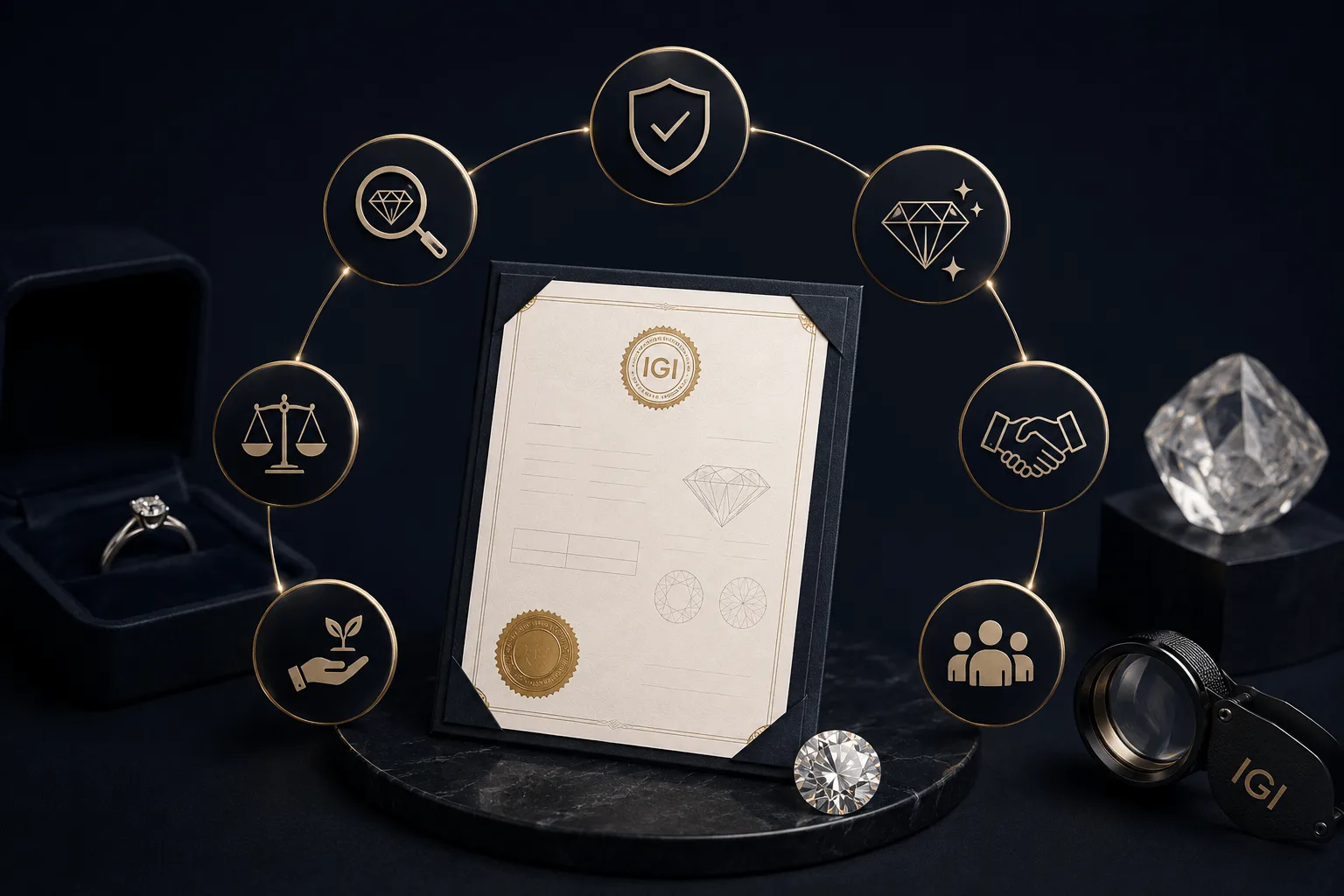
An IGI report provides an independent description of a lab-grown diamond’s characteristics. It allows us to verify the colour grade rather than depending solely on a seller’s description.
Before selecting a diamond, we recommend confirming that:
- The report identifies the stone as laboratory-grown
- The report number matches the diamond’s inscription, where applicable
- The colour grade is clearly stated
- Measurements match the selected stone
- Cut, polish and symmetry are reviewed
- Fluorescence and additional comments are considered
- The report can be verified through the laboratory’s official report-checking facility
Certification supports an informed comparison, but two diamonds with the same colour grade can still look different. Cut proportions, transparency, undertones and facet patterns may affect their face-up appearance.
How We Help Select the Right Lab-Grown Diamond Colour
At Laxmi Jewellers Dubai, we consider the complete design before recommending a colour grade. We review the diamond’s shape, carat weight, cut, metal colour, setting style and surrounding stones to determine where a higher grade will make a visible difference.
For buyers creating a personalised engagement ring or jewellery piece, our certified lab-grown diamond guidance in Dubai helps align the centre diamond with the setting, design preferences and budget.
Frequently Asked Questions About Lab-Grown Diamond Colour
Do lab-grown diamonds have the same colour grades as mined diamonds?
Yes. White lab-grown diamonds are graded using the same D-to-Z colour scale used for mined diamonds. The grade describes the amount of detectable body colour in the stone.
Is a D-colour lab-grown diamond always the best choice?
D is the highest colour grade, but it is not always the most practical choice. A G or H diamond may appear equally white once set, particularly when it has an excellent cut.
Can we see the difference between G and H colour?
The difference is usually subtle. It may be visible during a direct side-by-side comparison under controlled lighting, but many buyers cannot identify it once the diamonds are viewed separately.
What colour grade is best for a lab-grown diamond engagement ring?
G to H is a popular range for balancing a white appearance with value. D to F suits buyers seeking a premium colourless stone, while I to J can work beautifully in yellow or rose gold.
What colour grade should we choose for an emerald-cut diamond?
Emerald cuts reveal body colour more easily than round brilliant diamonds. For an icy appearance, D to G is often preferred. H colour can also provide good value when the individual diamond faces up white.
Are lower-colour lab-grown diamonds poor quality?
No. Colour is only one quality characteristic. A warmer diamond can still have excellent cut, clarity and brilliance. Some buyers deliberately choose warmer grades for vintage-style or yellow-gold jewellery.
Choose an IGI Certified Lab-Grown Diamond in Dubai
The best lab-grown diamond colour grade is the one that looks beautiful in the chosen setting and provides sensible value. D to F diamonds offer a crisp colourless appearance, G to J diamonds provide versatile near-colourless options, and warmer grades can complement yellow gold, rose gold and vintage-inspired designs.
By reviewing the diamond’s colour together with its cut, shape, size, certification and setting, we can create jewellery that appears bright, balanced and refined. Explore IGI Certified Lab-Grown Diamonds in Dubai with Laxmi Jewellers and select a diamond suited to your design, preferences and budget.