
Worldwide people seek diamonds for their sparkling appearance coupled with their exclusive nature and elegant appeal. The degree of transparency within a diamond alongside its internal and external inclusions establishes its quality and market value. Clarity refers to the presence of inclusions and blemishes within or on the surface of a diamond. Each diamond possesses distinctive natural characteristics that function similarly to fingerprints for identification. The study of diamond clarity patterns serves as a vital requirement for those planning to acquire fine diamonds as engagement rings, valuable gemstone collections or heirloom items.
Earth Shine Jewels delivers premium diamonds along with total diamond purchase education to every customer. The article provides extended details regarding diamond clarity properties and evaluation criteria along with their impact on diamond value and marketplace appearance.
Key Takeaways
- Understand what is the real meaning of diamond clarity and what are the various classifications of diamond clarity like inclusions and blemishes.
- Get to know how the GIA approves the diamond clarity scale.
- Read more about what are the various types of diamond inclusions and blemishes.
What is Diamond Clarity?
Diamond clarity determines the number and severity of patterns and inclusion both inside and outside the gemstone. Two classification types exist for diamond imperfections.
- Inclusions – Internal flaws are seen as tiny crystals along with fractures and cavities that appear inside a diamond.
- Blemishes – Small flaws on diamond surfaces include scratches alongside nicks and the marks that form from polishing procedures.
Extreme pressure and heat conditions in which diamonds form make it natural for these defects to occur. The fewer the inclusions and blemishes, the higher the clarity grade and value of the diamond.
The GIA Diamond Clarity Scale
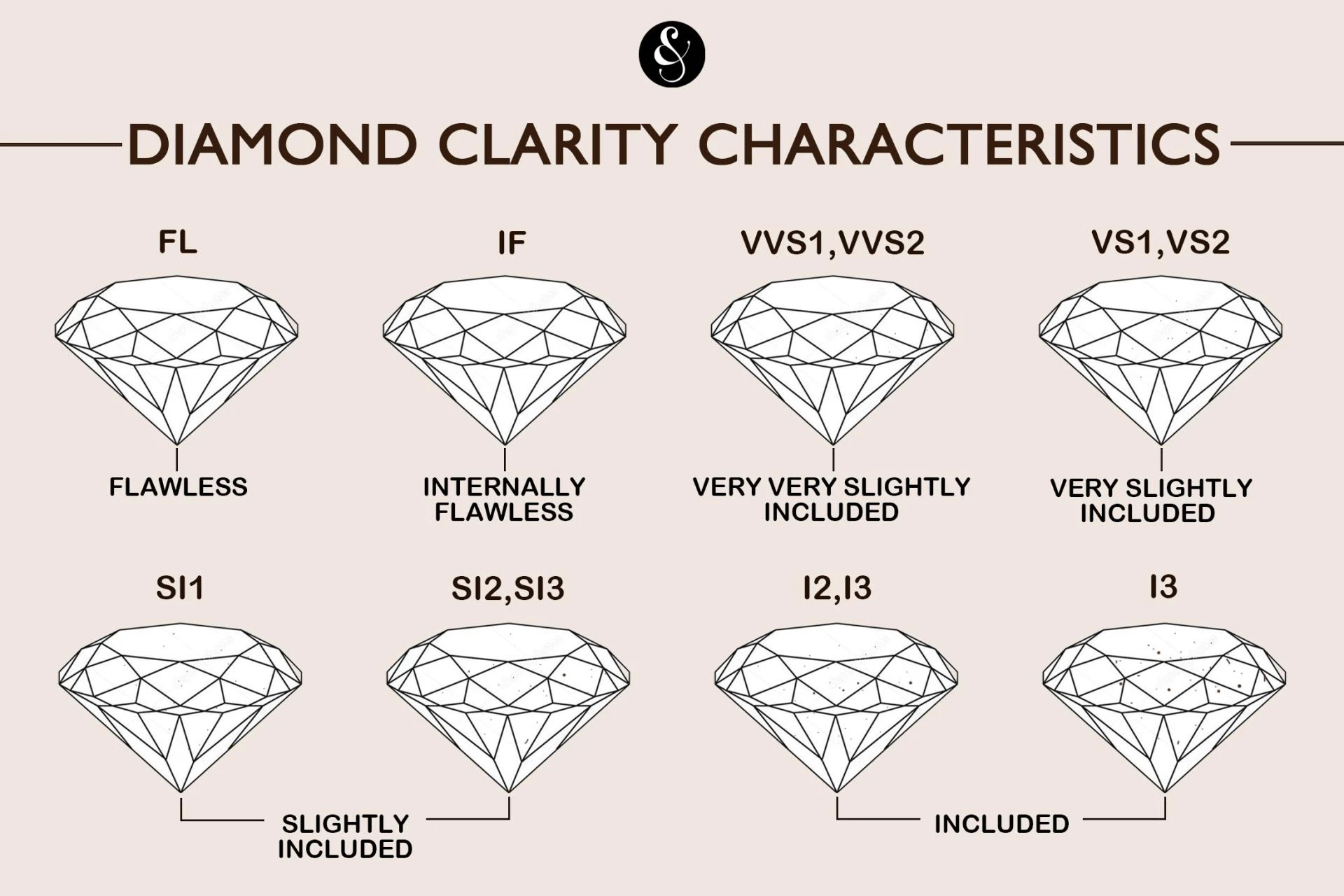
The Gemological Institute of America (GIA) sets the universally accepted diamond clarity scale through its trusted authority in grading diamonds. The following table shows the clarity grades that diamonds receive:
Diamond Clarity Grades
Clarity Grade
What It Means
Can You See Marks Under 10x Magnification?
FL (Flawless)
No marks inside or outside
Totally clean, even under a strong lens
IF (Internally Flawless)
No marks inside, only tiny ones outside
Inside is perfect, small surface marks can be polished away
VVS1 & VVS2 (Very Very Slightly Included)
Tiny marks, very hard to see
Only visible under a super strong lens
VS1 & VS2 (Very Slightly Included)
Small marks, hard to notice
Need a diamond expert to find them
SI1 & SI2 (Slightly Included)
Noticeable marks under a magnifier
Some marks can be seen without a magnifier, especially in SI2
I1, I2 & I3 (Included)
Marks are easy to see
Big marks that can affect shine and strength
Earth Shine Jewels presents a selection of diamonds that range between IF and SI clarity grades so our customers can acquire beautiful stones with minimal visual flaws.
Types of Diamond Inclusions
The range of inclusion features includes items that differ from one another in dimensions together with structure and positioning. The most common types include:
- Pinpoints – The clarity grade of a diamond includes Pinpoints which are tiny white or black spots recognizable as small dots.
- Clouds – A hazy effect emerges when numerous tiny pinpoints group together into clouds.
- Needles – Clean and needle-shaped inclusions in the diamond resemble thin needles.
- Feathers – The diamond contains tiny fractures called feathers which decrease its overall durability level.
- Crystals – Tiny embedded minerals including other diamonds or crystal formations exist within the stone structure.
- Knots – Crystals penetrate until they appear on the diamond surface.
- Cavities – A cavity represents a hole within a diamond that develops because of absent inclusions.
- Twinning Wisps – Twinning Wisps appear as wavelike threadlike inclusions that result from irregular crystal growth patterns.
Types of Diamond Blemishes
The diamond undergoes two sources of imperfections: manufacturing stages and day-to-day use. Common blemishes include:
- Scratches – Handling the diamond surface can lead to thin parallel markings referred to as scratches.
- Nicks – Regarded as nicks these are tiny chips that typically develop on the girdle section.
- Pits – The surface sometimes features minuscule holes that become visible when examined through magnification.
- Polish Marks – The reflection of light becomes affected by the presence of polish marks which develop through polishing instrument usage.
- Abrasion – As a result of factor wear and tear abrasions form at edges that make facets appear dull.
- Extra Facets – Symmetry suffers modification when diamond experts use additional cuts to eliminate inclusions.
How Clarity Affects Diamond Pricing
The price evaluation of diamonds heavily depends on their clarity characteristics. Diamonds with flawless clarity (FL) keep exceptional rarity and cost while included diamonds (I1-I3) exist at lower prices but show reduced brilliance and lose some durability.
Earth Shine Jewels advises customers to select diamonds within the VS1-SI1 classification for an optimal combination of quality and economical value. Most of the microscopic inclusions found within this clarity category remain undetectable when looked at through human eyes.
Diamond Clarity Enhancement
The process of clarity enhancement treats certain diamonds to make them look more attractive. Common methods include:
- Laser Drilling – The process of Laser Drilling uses microscopically precise lasers to remove black inclusions.
- Fracture Filling – A clear fluid injection into fractures serves to reduce their visibility.
- HPHT Treatment – High pressure combined with high temperature provides the foundation for HPHT inclusion removal.
Earth Shine Jewels enhances transparency by marking clarity-enhanced diamonds and teaching customers about these gems and their fundamental properties.
Choosing the Right Diamond Clarity for Your Needs
During diamond selection, customers need to evaluate clarity while also analyzing cut, carat, and color quality. Here are some tips:
Choose the Best Diamond
- For the most sparkle, pick VS1 or higher.
- For a good price, choose SI1 or SI2. These have tiny marks, but you may not see them.
- For investment, buy IF or VVS1. These are rare and keep their value.
Conclusion
Diamond clarity makes a diamond look beautiful and affects its price. Learning about marks and grades helps you choose better.
At Earth Shine Jewels, we sell high-quality diamonds. Every diamond is carefully checked.
Buying a diamond for love, a gift, or an investment? We can help! See our amazing collection today.
FAQs
What are diamond clarity characteristics?
These are tiny marks inside or on a diamond. They can be natural or made when cutting the diamond.
What are the 4 characteristics of diamonds?
Diamonds have 4 main qualities:
- Clarity – How clear it is (fewer marks = better).
- Cut – How well it is shaped (better cut = more sparkle).
- Color – How white or yellow it looks (whiter = better).
- Carat – How big or heavy it is (bigger = more expensive).
What are the clarity characteristics of GIA?
GIA (Gemological Institute of America) checks two types:
- Inclusions – Tiny marks inside the diamond.
- Blemishes – Tiny marks on the surface of the diamond.
What are clarity characteristics limited to the surface of a diamond called?
They are called blemishes. These are small marks on the outside of the diamond.