IMARC Group has recently released a new research study titled “Democratic Republic of the Congo (DRC) Cassava Processing Market Size, Share, Trends and Forecast by End Use and Region, 2026-2034,” offering a detailed analysis of the market drivers, segmentation, growth opportunities, trends, and competitive landscape to understand the current and future market scenarios.
Democratic Republic of the Congo (DRC) Cassava Processing Market Size, Growth, and Forecast (2026-2034)
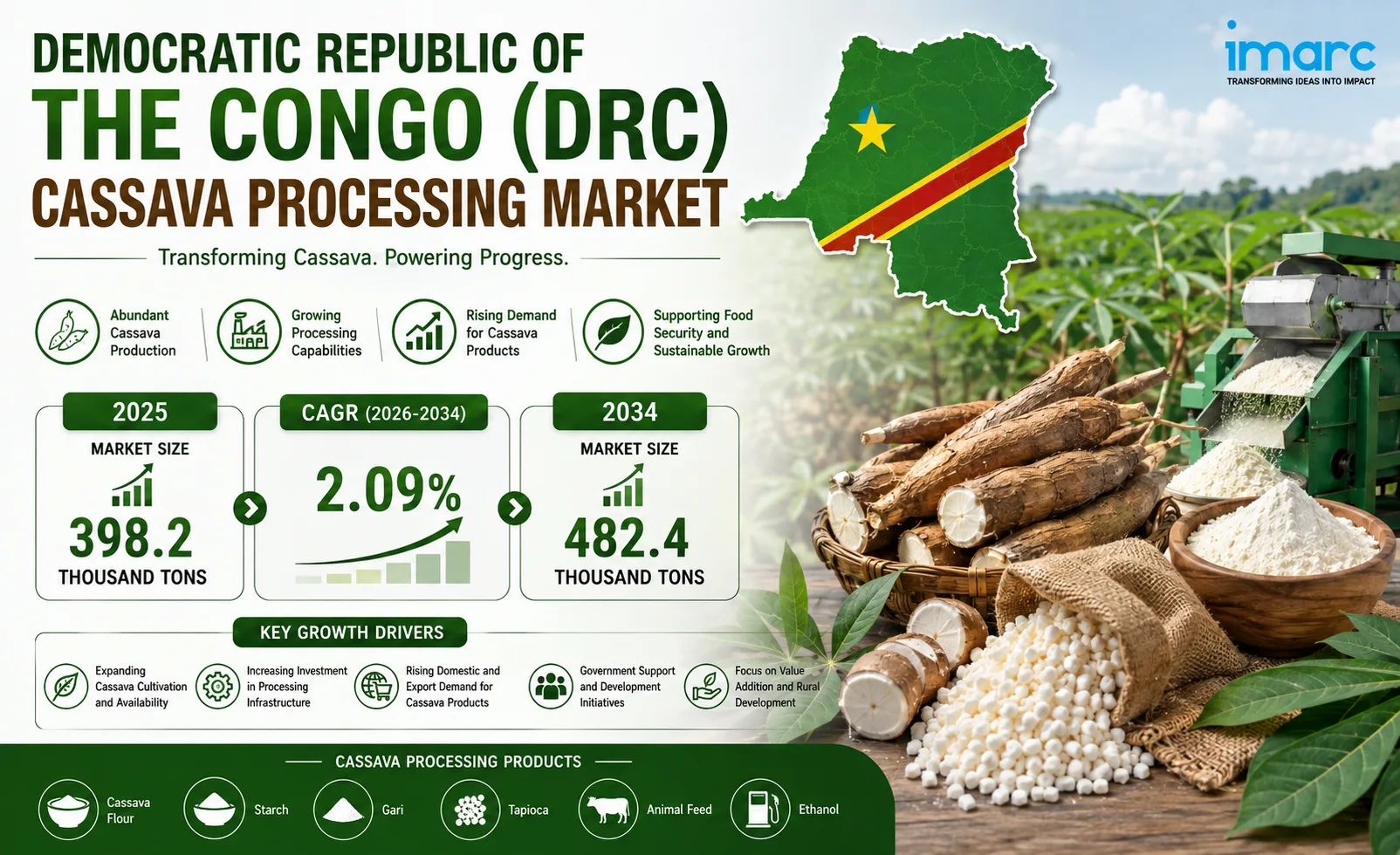
The Democratic Republic of the Congo (DRC) cassava processing market size reached 398.2 Thousand Tons in 2025 and is projected to reach 482.4 Thousand Tons by 2034, growing at a CAGR of 2.09% during 2026-2034. The market is expanding with the introduction of nutrient-rich cassava varieties and modern processing facilities. Rising demand for value-added cassava products and stronger farmer integration continue to support the Democratic Republic of the Congo (DRC) cassava processing market share across domestic food industries and emerging export-oriented segments.
- Base Year: 2025
- Historical Period: 2020-2025
- Forecast Period: 2026-2034
- Units: Thousand Tons
- Market Size in 2025: 398.2 Thousand Tons
- Market Forecast in 2034: 482.4 Thousand Tons
- Market Growth Rate (2026-2034): 2.09%
Cassava is one of the most consumed staple foods in the Democratic Republic of the Congo, and cassava processing converts the crop into stable, higher-value products such as flour, gari, chips, and starch through drying, cooking, and fermentation, which also eliminates naturally occurring cyanogenic compounds and extends shelf life. As part of broader national goals to combat food insecurity, diversify local product offerings, and support agribusiness growth, the sector is drawing increasing attention from agricultural researchers, farmers, and processing companies.
Democratic Republic of the Congo (DRC) Cassava Processing Market Trends
Nutrient-Rich Varieties Driving Processing Potential
The market is experiencing rapid expansion, fueled by innovations in agricultural practices that introduce high-value, nutrient-rich cassava varieties tailored for industrial processing. These varieties typically possess high dry matter content, which improves processing yields and product quality, along with resistance to common diseases such as cassava mosaic disease, making them more resilient and cost-effective for farmers. Many are also rich in beta-carotene, offering nutritional benefits that help address vitamin A deficiency, making them highly suitable for producing cassava flour, gari, and snacks.
The easy processing and high yield qualities of these new varieties are prompting rapid adoption by farmers, ensuring a steady supply of high-quality raw materials for processing industries. With better access to consistent inputs, the sector can focus on value addition and expansion into export markets, strengthening the DRC's competitiveness in the international cassava trade.
Infrastructure Expansion Supporting Rural Processing Capacity
Growth in the DRC cassava processing industry is closely tied to infrastructure expansion, which plays a vital role in increasing processing capacity and operational efficiency. Investment in modern processing facilities is creating opportunities for smallholder farmers to connect with organized markets, reduce post-harvest losses, and access higher-value supply chains, while reducing reliance on informal markets and improving farmer incomes.
These investments are also generating employment in rural areas, fostering local economic development through jobs in processing plants, logistics, and administration, while building local expertise in modern processing techniques. As more infrastructure projects launch, they will continue to strengthen the resilience of the supply chain and support the country's long-term food security and economic development.
Explore Growth Opportunities in the Democratic Republic of the Congo (DRC) Cassava Processing Market - Grab Your Sample Report for Evaluation: https://www.imarcgroup.com/democratic-republic-of-the-congo-cassava-processing-market/requestsample
Democratic Republic of the Congo (DRC) Cassava Processing Market Segmentation:
IMARC Group provides an analysis of the key trends in each segment of the Democratic Republic of the Congo (DRC) cassava processing market, along with forecasts at the country and regional level for 2026-2034. The report has categorized the market based on end use and region.
End Use Insights:
● Food Industry
● Feed Industry
● Others
The food industry remains the leading end use within the Democratic Republic of the Congo (DRC) cassava processing market, reflecting cassava's role as the country's most widely consumed staple, while the feed industry is gaining traction as processors expand into higher-value byproduct streams.
Regional Insights:
● Orientale
● Congo-Kasaï
● Équateur
● Katanga
Orientale and Congo-Kasaï remain key production and processing hubs within the market, supported by favorable growing conditions and established farmer networks, while Équateur and Katanga continue to expand processing capacity as infrastructure investment reaches new rural areas.
Democratic Republic of the Congo (DRC) Cassava Processing Market: Recent News and Developments
September 2024: Mole Group, a Swiss firm, announced plans to establish an agro-industrial park in Mbanza-Ngungu, DRC, to boost cassava, corn, and sugar production. The project, integrating production, processing, and conservation, aims to enhance local food supply and support economic growth in the region.
October 2025: The DRC government granted final clearance for the $1 billion Mbanza-Ngungu agro-industrial project in Kongo Central province, a public-private partnership with Mole Group supported by Switzerland's Bühler Group and Belgium's Desmet, spanning 104,000 hectares under a 99-year land tenure agreement with a planned transformation capacity of 700,000 tonnes of cassava, maize, and rice annually.
June 2026: Initial operations at the Mbanza-Ngungu agro-industrial complex were scheduled to begin, marking a major milestone for large-scale cassava processing infrastructure in the DRC and a step toward an estimated 20,000 indirect jobs across the value chain.
Challenges Impacting the Democratic Republic of the Congo (DRC) Cassava Processing Market
Many small and medium cassava processing centers across the DRC continue to rely on inefficient sun-drying methods, obsolete machinery, and inadequate infrastructure, with limited local capacity for equipment repair and minimal adherence to quality management standards, constraining processing efficiency and output consistency.
Isolation of rural production areas, limited access to financing, and underdeveloped logistics continue to restrict farmers' ability to connect with organized processing markets, keeping a significant share of cassava output within informal, lower-value channels.
Investment Opportunities in the Democratic Republic of the Congo (DRC) Cassava Processing Market
The Democratic Republic of the Congo (DRC) cassava processing market presents compelling investment opportunities supported by its projected growth from 398.2 Thousand Tons in 2025 to 482.4 Thousand Tons by 2034. Modern processing facility development represents a high-value opportunity as the sector shifts from informal, small-scale operations toward organized, higher-yield value chains.
Nutrient-rich and disease-resistant cassava variety adoption, along with value-added product development in flour, gari, and starch, represents a growing investment frontier as demand strengthens across both domestic food industries and emerging export-oriented segments.
Outlook of the Democratic Republic of the Congo (DRC) Cassava Processing Market (2026-2034)
The outlook for the Democratic Republic of the Congo (DRC) cassava processing market is positive, supported by continued adoption of nutrient-rich cassava varieties, expanding rural processing infrastructure, and large-scale agro-industrial investment. The market is projected to grow from 398.2 Thousand Tons in 2025 to 482.4 Thousand Tons by 2034 at a CAGR of 2.09%.
Continued farmer integration into organized supply chains, growth in value-added product categories, and the scale-up of major agro-industrial projects such as the Mbanza-Ngungu complex will be the defining trends shaping the market through 2034.
Competitive Landscape
The market research report has also provided a comprehensive analysis of the competitive landscape in the Democratic Republic of the Congo (DRC) cassava processing market. Competitive analysis such as market structure, key player positioning, top winning strategies, competitive dashboard, and company evaluation quadrant has been covered in the report, along with detailed profiles of major companies operating across the value chain, including agro-industrial developers such as Mole Group that are investing in large-scale cassava processing infrastructure in the country.
Frequently Asked Questions (FAQs): Democratic Republic of the Congo (DRC) Cassava Processing Market
1. How big is the Democratic Republic of the Congo (DRC) cassava processing market?
The Democratic Republic of the Congo (DRC) cassava processing market reached 398.2 Thousand Tons in 2025.
2. What is the future outlook of the Democratic Republic of the Congo (DRC) cassava processing market?
The market is projected to exhibit a CAGR of 2.09% during 2026-2034, reaching 482.4 Thousand Tons by 2034.
3. What are the key factors driving the Democratic Republic of the Congo (DRC) cassava processing market?
The market is driven by the introduction of nutrient-rich cassava varieties, expansion of modern processing facilities, rising demand for value-added cassava products, and stronger integration of smallholder farmers into organized supply chains.
4. Which end use segment leads the Democratic Republic of the Congo (DRC) cassava processing market?
The food industry leads the market, reflecting cassava's position as one of the most widely consumed staple foods in the DRC, though the feed industry and other end uses are also expanding.
5. What is the regional breakdown of the Democratic Republic of the Congo (DRC) cassava processing market?
The report covers Orientale, Congo-Kasaï, Équateur, and Katanga as the major regional markets within the Democratic Republic of the Congo (DRC) cassava processing market.
Author IMARC Group
IMARC Group is a global management consulting firm that helps the world's most ambitious changemakers to create a lasting impact. The company provide a comprehensive suite of market entry and expansion services. IMARC offerings include thorough market assessment, feasibility studies, company incorporation assistance, factory setup support, regulatory approvals and licensing navigation, branding, marketing and sales strategies, competitive landscape and benchmarking analyses, pricing and cost research, and procurement research.
Contact Us
IMARC Group,
134 N 4th St. Brooklyn, NY 11249, USA,
Email: [email protected],
Tel No: (D) +91 120 433 0800,
United States: +1-201971-6302