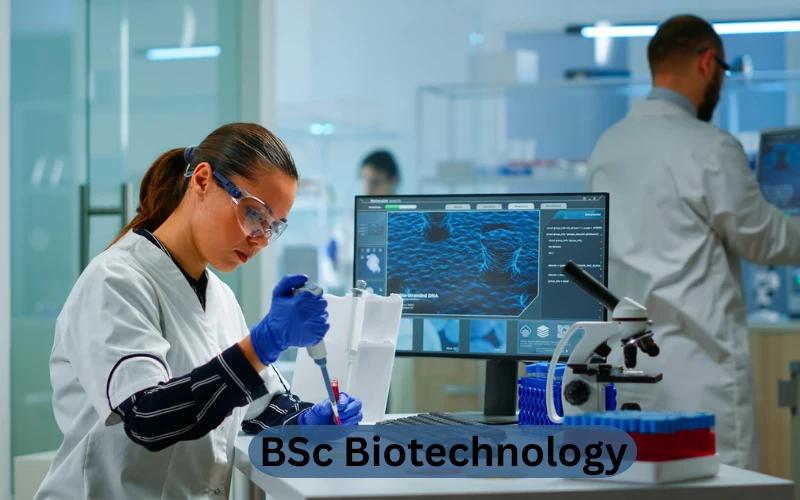
The future of this generation is for those who can decode life itself and the BSc Biotechnology course will give you that ability. The BSc Biotechnology is about embarking on a scientific journey. In this course, you’ll learn about DNA Mysteries, microorganisms, and bioinformatics. The core subjects include cell biology and genetics. You’ll also explore specialisations in medical, agricultural, and industrial biotech. From generating new medical treatments and contributing to food security and fundamentally changing the way our environment impacts the sustainability of the earth, biotechnology is where science meets imagination.
If you are interested in understanding how cells, DNA or microorganisms nuance life on earth, the BSc Biotechnology course is where you can pursue a career based on discovery. Let's understand what is BSc Biotechnology course.
What is BSc Biotechnology Course?
BSc Biotechnology course is an undergraduate programme that combines biology, chemistry, genetics and technology to understand and manipulate living organisms for biological advancement. In other words, it is understanding life as fundamentally as possible - the study of cells, DNA and microbes and using that knowledge to provide solutions within health, agricultural and environmental sustainability. If you have ever wondered how vaccines are developed, crops are modified, biofuels are generated, this course is for you.
BSc Biotechnology Course Details
The BSc Biotechnology course aims to prepare graduates for an ever-changing world with a fundamental connection between science and technology. The programme is perfect for anyone interested in how to apply biology to the global issues we face. The entire breakdown of BSc Biotechnology course details - eligibility, duration and fees, can be found below.
BSc Biotechnology Course Eligibility
To enroll in the BSc Biotechnology course, students need to the following admissions criteria-
- Completion of 10 + 2 with a foundation in Physics, Chemistry and Biology.
- Minimum aggregate of 50% - 60% marks from a recognised board/ council.
- Admissions could be based on merit and in cases of an entrance examination (CUET-UG), a specific university examination.
- There are no age restrictions, catering to each learner.
Universities may also conduct personal interviews to gauge suitability and level of interest.
Course Duration of BSc Biotechnology
The BSc biotechnology course duration usually depends on the structure of the programme and institution.
- The total course duration is 3 years (over 6 semesters).
- Each semester typically includes a combination of theory papers, laboratory work and project based research.
- Honours/Specialisation options may make duration longer or have advanced electives in genetics, bioinformatics.
Some universities also offer BSc - MSc integrated Biotechnology programme that take 5 years, where students are further specialising in an area of biotechnology.
BSc Biotechnology Fees
The fee for a BSc Biotechnology programme varies depending on the institution type:
- Government Colleges: 20,000 - 1 Lakh
- Private Universities: 1 - 5 Lakhs
Subjects and Curriculum for BSc in Biotechnology
Most BSc Biotechnology courses consist of a combination of lectures, practical labs, and homework assignments. Some of the prevalent subjects are:
- Molecular Biology
- Microbiology
- Biochemistry
- Cell Biology
- Immunology
- Genetics Engineering
- Bioinformatics
- Environmental Biotechnology
The curriculum fosters the analytical, research and technical skills required for future success in modern science careers.
Career Opportunities after BSc Biotechnology
A BSc in Biotechnology prepares one for exciting careers in research, health care, pharmaceuticals, food production and environmental science. Graduates will find jobs as-
- Research Scientists
- Biotechnologists
- Clinical Researchers
- Microbiologists
- Lab Technicians
- Biomedical Engineers
- Biotech Product Analysts
Additionally, a number of students go for an advanced degree like MSc Biotechnology or an MBA in Biotechnology Management to advance their careers.
Final Thoughts
The BSc Biotechnology course has been structured to develop skills for analytical thinking. The research skills to address new scientific and technological issues. The course is accomplished through a multidisciplinary approach that extends from genetics and molecular biology to environmental biotechnology in order to yield the skill set necessary for encapsulating innovation and contributing to responsible solutions. The programme has a graduate study and research pathway and is useful for our graduates seeking employment in a variety of settings.
Altogether, the BSc program in Biotechnology includes a depth of scientific learning and a spirit of innovation that is becoming more necessary for advancement in the contemporary biosciences landscape.