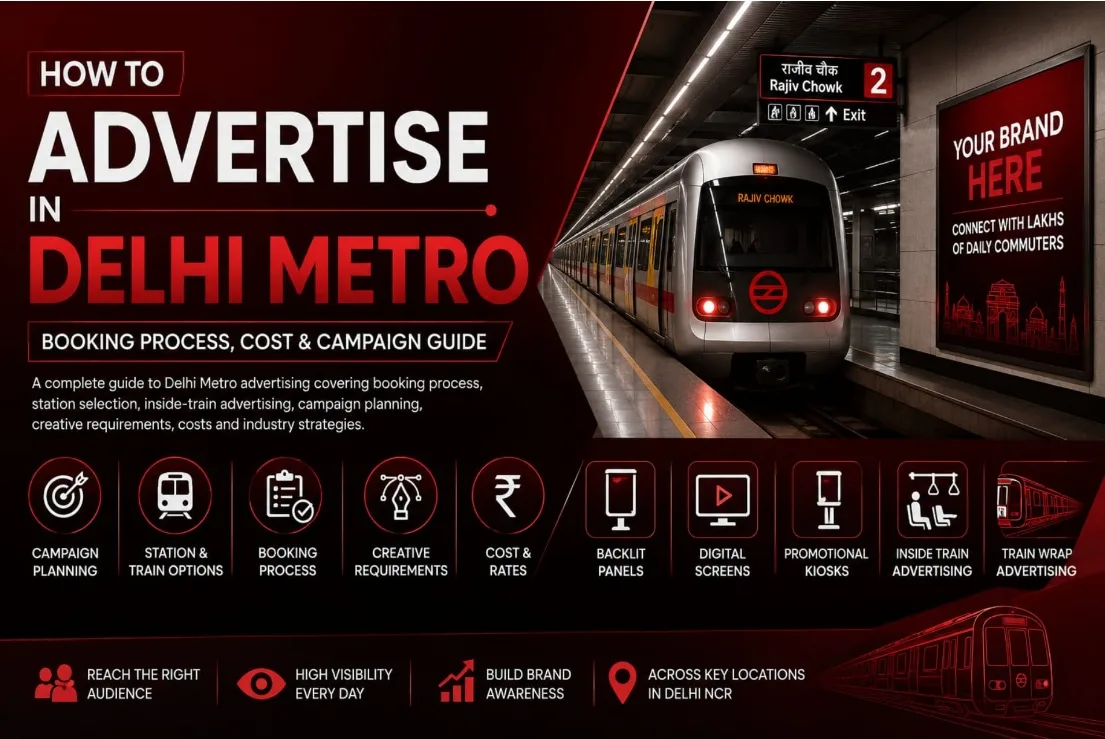
Delhi is a city that moves fast—and nowhere is that more visible than the Delhi Metro. Every day, millions of commuters travel through metro stations, platforms, concourses, corridors, escalators, and trains. For brands, this makes Delhi Metro advertising one of the most powerful ways to build visibility in a crowded urban market.
Unlike many digital ads that disappear with a swipe, metro advertising places a brand directly into the daily routine of its audience. A commuter may see the same campaign while entering a station, waiting for a train, travelling inside a coach, or walking toward an exit. That repeated exposure can make metro advertising particularly valuable for brands looking to increase awareness, recall, and local market penetration.
But choosing the right metro advertising format is not simply about buying the biggest available space. The real opportunity lies in matching the Delhi Metro station advertising, Delhi Metro train advertising, audience, route, campaign duration, creative format, and budget.
This guide explains how Delhi Metro advertising works, what formats brands can consider, how a Delhi Metro advertising agency can help, and what factors influence Delhi Metro advertising rates.
Why Delhi Metro Advertising Matters for Modern Brands
Delhi Metro advertising combines three things marketers constantly look for: scale, frequency, and contextual visibility.
Metro commuters are often exposed to advertising in environments where they have a few minutes to wait, walk, or travel. This creates multiple opportunities for a brand message to be noticed. A campaign positioned at a busy interchange, for example, can potentially reach a very different audience from one placed at a residential or corporate-area station.
The biggest advantage is repetition.
A commuter who travels the same route every day may encounter the same advertisement multiple times a week. Over time, that repeated exposure can contribute to stronger brand recognition.
This is why metro advertising can work particularly well for categories such as real estate, education, healthcare, retail, banking, automobiles, hospitality, consumer products, technology, entertainment, and local services.
For a brand launching a new product, expanding into Delhi-NCR, promoting a property, or building mass-market awareness, metro advertising can become an important part of an integrated outdoor advertising strategy.
Delhi Metro Station Advertising: Turn Commuter Traffic Into Brand Visibility
Delhi Metro Station Advertising is one of the most recognizable forms of metro OOH advertising.
Stations offer multiple advertising environments, including entry and exit areas, concourses, corridors, stairways, escalator zones, platform areas, and other approved advertising locations. The right placement depends heavily on the station, available inventory, campaign objective, and audience profile.
A brand focused on maximum visibility may look for high-footfall stations or major interchange locations. A company targeting professionals might prioritize stations serving important commercial districts. A real estate developer, meanwhile, may choose stations located close to a particular property market.
The key is not simply asking, “Which station gets the most traffic?”
A better question is: “Which station puts my message in front of the people most likely to respond?”
This distinction can significantly improve campaign efficiency.
Creative design also matters. Metro audiences are mobile and often exposed to advertisements for only a limited period. The headline needs to be readable quickly, the visual should communicate the core idea immediately, and the call to action should be simple.
For example, instead of presenting a long property advertisement, a real estate brand could use a strong location-based headline, a recognizable project image, a short benefit, and a QR code or website.
Delhi Metro Train Advertising: Take the Brand Inside the Journey
While station advertising captures attention before or around the journey, Delhi Metro Train Advertising brings the brand message inside the commuter's travel experience.
Train advertising can offer different creative possibilities depending on the inventory and approved formats. Interior placements can put advertisements directly within a commuter's field of view, while exterior branding can create strong visual impact when trains arrive at or depart from stations.
The major strength of train advertising is continuity.
A commuter may see a brand advertisement while waiting for a train and then encounter another version after boarding. When planned strategically, station and train advertising can reinforce one another and create a more connected campaign experience.
Train advertising can be particularly interesting for brands seeking broad awareness because the campaign travels across multiple parts of the network rather than remaining tied to a single physical location.
For a campaign with a strong visual identity, train branding can also generate substantial offline visibility. A distinctive design, memorable tagline, or bold brand color can help a campaign become recognizable even before commuters read every word.
Delhi Metro Advertising Agency: Why Professional Planning Matters
A Delhi Metro advertising agency can play an important role in converting a general advertising idea into an executable metro campaign.
Buying outdoor media is not simply about selecting a location. Brands need to consider inventory availability, station relevance, campaign duration, creative specifications, approvals, production, installation, monitoring, and campaign reporting.
An experienced agency can help a brand answer questions such as:
- Which stations are relevant to the target audience?
- Should the campaign focus on stations, trains, or both?
- What advertising format fits the campaign objective?
- How long should the campaign run?
- How should the media budget be distributed?
- What creative dimensions and production requirements apply?
- How can the campaign be monitored after installation?
This becomes particularly useful when a campaign covers multiple stations or requires coordinated execution across different advertising formats.
The best agency is not necessarily the one offering the lowest media quote. It is the one that can connect media planning, audience strategy, creative execution, and campaign measurement.
Delhi Metro Advertising Rates: What Determines the Cost?
One of the most searched questions by advertisers is: “What are Delhi Metro advertising rates?”
There is no single universal price because metro advertising costs can vary significantly according to several factors.
The most important factors typically include:
1. Station and Location
High-footfall and strategically important stations can command higher advertising value than lower-traffic locations. Interchange stations may also be particularly attractive because commuters transfer between lines.
2. Advertising Format
A standard advertising panel, large-format installation, digital display, train branding, station branding, and other specialized formats can have very different pricing structures.
3. Campaign Duration
Longer campaigns may have different commercial terms from short-duration campaigns. The duration also affects production, installation, and campaign management costs.
4. Inventory Availability
Advertising inventory is limited. Premium locations can become unavailable during high-demand periods, which can influence both planning and pricing.
5. Production and Installation
The media rental or advertising fee is not always the complete campaign cost. Creative production, printing, fabrication, installation, removal, taxes, and agency fees may need to be considered separately depending on the campaign arrangement.
6. Campaign Scale
A campaign covering several stations or multiple formats will naturally require a larger investment than a single-location placement.
Because of these variables, brands should request a customized quotation rather than relying on a generic “Delhi Metro advertising rate.”
How Much Should You Budget for Delhi Metro Advertising?
Instead of starting with a fixed number, advertisers should begin with their campaign objective and audience.
For example, a small local business may benefit from a highly targeted station campaign rather than attempting network-wide coverage. A national brand launching a new product could have a different strategy, combining multiple stations with train advertising for broader visibility.
A useful planning framework is:
Objective → Audience → Stations/Routes → Format → Duration → Production → Measurement
This approach prevents the common mistake of selecting media inventory first and figuring out the strategy later.
It is also worth separating the media budget from the execution budget. This makes it easier to understand where the investment is going and compare proposals from different agencies.
How to Choose the Right Delhi Metro Advertising Format
There is no single “best” metro advertising format.
The right choice depends on what the campaign needs to achieve.
If the goal is local visibility, station advertising around strategically selected locations may be highly relevant.
If the objective is mass awareness, train advertising or a wider station network may provide greater scale.
If the objective is premium brand positioning, large-format or high-impact station opportunities can create stronger visual presence.
If the goal is lead generation, the creative should make the next action extremely easy. QR codes, short URLs, WhatsApp prompts, or memorable calls to action can connect offline exposure with digital conversion.
This is where omnichannel thinking becomes important. A metro advertisement does not have to operate independently from a digital campaign.
A commuter can see an advertisement in the metro, search for the brand later, visit its website, watch a video, or scan a QR code. Combining OOH with search, social media, and retargeting can help turn visibility into measurable action.
Creating a High-CTR Metro Advertising Campaign
Metro advertising is traditionally an offline medium, but that does not mean it cannot support digital performance.
For a campaign designed to generate online action, the creative should have a clear CTA—call to action.
Instead of writing:
“Discover our complete range of premium residential solutions.”
A stronger approach could be:
“2 & 3 BHK Homes Near Noida Expressway — Scan to Book a Visit.”
The second message gives the audience something concrete to understand and a clear next step.
For trackable campaigns, brands can use unique landing pages, QR codes, campaign-specific URLs, or dedicated phone numbers.
The principle is simple: make the advertisement easy to notice, easy to understand, and easy to act on.
Common Mistakes Brands Make With Metro Advertising
One common mistake is trying to put too much information into a single advertisement.
A commuter does not have time to read a brochure while walking through a station. Strong metro creative generally prioritizes one central message.
Another mistake is choosing locations purely because they are popular. High footfall is useful, but audience relevance matters just as much.
Brands also sometimes underestimate the importance of consistency. If the station creative, digital campaign, website, and social media communication all look completely different, the audience may not immediately connect them.
Finally, advertisers sometimes focus heavily on buying media but spend too little time on creative development. A premium location cannot rescue an unclear advertisement.
How to Get Better ROI From Delhi Metro Advertising
A successful campaign should be planned around measurable business objectives.
Start by defining what success means. Is it brand awareness, website traffic, property inquiries, store visits, app downloads, registrations, or sales?
Then build the media strategy around that goal.
For awareness campaigns, prioritize reach and frequency.
For local campaigns, prioritize relevant stations.
For lead-generation campaigns, create a strong CTA and track responses.
For product launches, consider using multiple touchpoints so the audience encounters the same campaign message throughout the journey.
Most importantly, test and learn. If possible, use different creative messages or landing pages to understand which communication generates stronger engagement.
Final Thoughts: Is Delhi Metro Advertising Worth It?
For brands competing for attention in Delhi, metro advertising offers something that many other channels struggle to provide: physical presence within the daily movement of the city.
Whether you choose Delhi Metro station advertising, Delhi Metro train advertising, or a combination of formats, the campaign's effectiveness ultimately depends on strategy. The right station, the right audience, the right creative, and the right duration can make a significant difference.
And while Delhi Metro advertising rates are an important consideration, price should not be the only deciding factor. A cheaper placement that reaches the wrong audience may deliver less value than a strategically selected premium location.
For brands serious about metro advertising, working with a capable Delhi Metro advertising agency can simplify media planning, inventory selection, production, installation, and campaign execution.
The strongest campaigns do more than occupy advertising space. They become part of the commuter's journey—and, ideally, part of the brand's story.
Looking to plan a Delhi Metro advertising campaign? Start with your target audience, preferred areas, campaign objective, and approximate budget. From there, the right station, train, format, and media mix can be built around your actual business goals.