Diethylene Glycol Monobutyl Ether vs Butyl Glycol: Which Solvent Should You Choose?
Diethylene Glycol Monobutyl Ether and Butyl Glycol are glycol ether solvents used in industrial cleaners, paints, coatings, inks and specialty chemical formulations. Both offer compatibility with water and organic ingredients, but they differ in chemical structure, evaporation rate, boiling range and formulation performance.
Manufacturers can review this guide to selecting DEGBE for industrial solvent formulations before deciding between the two materials. Chemical Bull supplies Diethylene Glycol Monobutyl Ether, Butyl Glycol and other industrial solvents to cleaning-product manufacturers, coating companies, ink formulators, distributors and bulk buyers.
Neither solvent is automatically better for every application. Butyl Glycol may be considered where relatively faster evaporation is required, while Diethylene Glycol Monobutyl Ether is often selected when longer working time and slower evaporation are beneficial.
Quick Buyer Answer
Diethylene Glycol Monobutyl Ether is a higher-boiling, slower-evaporating glycol ether that can support extended cleaning contact time, coating flow and formulation stability. Butyl Glycol evaporates more quickly and is commonly used in cleaners and coatings requiring a different drying balance. The correct choice depends on solvency, evaporation, application method, drying time and the complete formulation.
What Is Diethylene Glycol Monobutyl Ether?
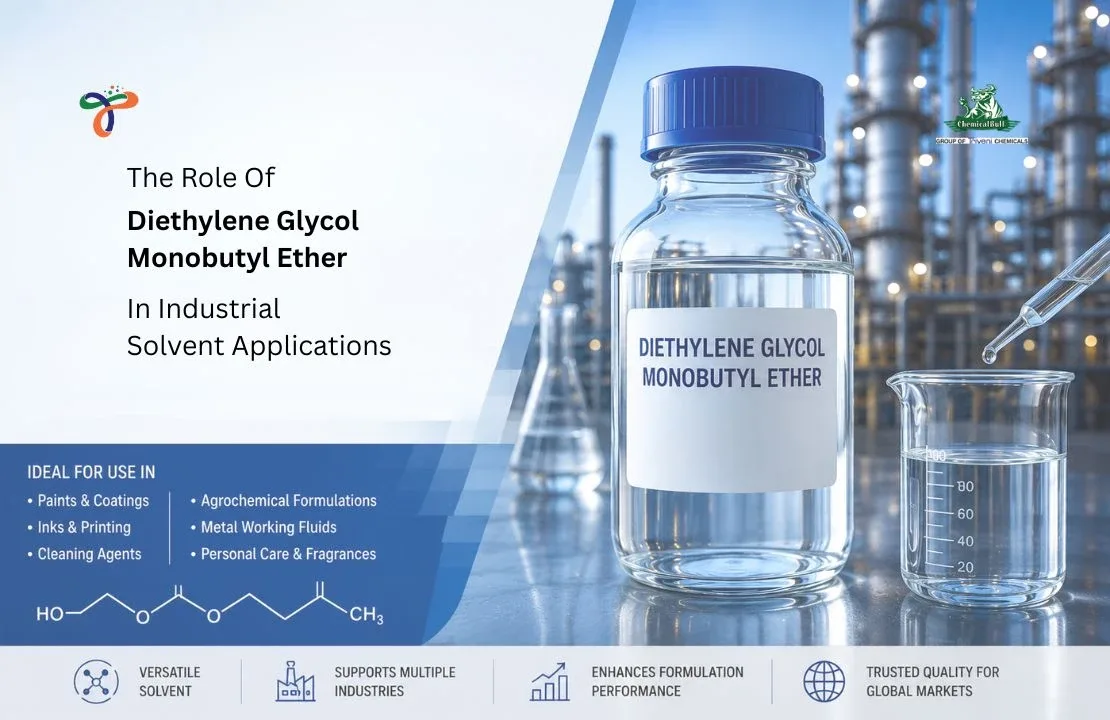
Diethylene Glycol Monobutyl Ether is identified by CAS number 112-34-5. It is commonly known as DEGBE, Butyl Diglycol or Butyl Carbitol.
The material is generally a clear, colourless liquid with a mild characteristic odour. Its molecular structure contains two ether groups and one alcohol group.
DEGBE offers compatibility with water and many organic materials. It can work as a solvent or coupling agent in formulations containing surfactants, oils, resins and water.
Its relatively slow evaporation makes it useful where a product needs additional time to wet, clean, level or form a film.
What Is Butyl Glycol?
Butyl Glycol is commonly known as 2-Butoxyethanol, Ethylene Glycol Monobutyl Ether or EGBE. Its CAS number is 111-76-2.
It is also a clear liquid used as a solvent and coupling agent. Butyl Glycol can support grease removal, ingredient compatibility and formulation performance in selected water-based and solvent-based products.
Compared with DEGBE, Butyl Glycol generally has a lower boiling range and evaporates more quickly. This difference can influence drying time, application behaviour and solvent retention.
Buyers should confirm the exact chemical identity because similar commercial names can create confusion during sourcing.
Key Differences Between DEGBE and Butyl Glycol
FactorDiethylene Glycol Monobutyl EtherButyl GlycolCommon abbreviationDEGBEEGBECAS number112-34-5111-76-2Common commercial nameButyl Diglycol or Butyl Carbitol2-ButoxyethanolEvaporationSlowerRelatively fasterWorking timeLongerShorterTypical selection reasonExtended wetting, flow and levellingCleaning power and faster drying balanceThe table provides general guidance. Actual performance depends on concentration, temperature and the other ingredients in the formulation.
Choosing a Solvent for Industrial Cleaners
Industrial cleaners must loosen and remove oil, grease and process residues. Both DEGBE and Butyl Glycol may be considered as part of a formulated cleaning system.
Butyl Glycol can provide useful solvency with a relatively faster evaporation profile. It may be selected for cleaners where extended surface wetness is not required.
DEGBE can provide longer contact time because it evaporates more slowly. This may help in heavy-duty cleaners where the formulation needs time to penetrate oily or stubborn residues.
Cleaning performance also depends on surfactants, alkalinity, builders, chelating agents, temperature and mechanical action. Manufacturers should test the complete formula on the intended soil and surface.
Selection for Paints and Coatings
Solvent choice can affect coating viscosity, flow, levelling, film formation and drying time. A balanced solvent system helps the applied coating develop a uniform surface.
DEGBE may support longer open time and smoother levelling in compatible formulations. Its slower evaporation can allow the coating more time to flow before the film becomes fixed.
Butyl Glycol may be chosen when a faster evaporation profile is required. It can also support resin compatibility and coalescence in selected water-based coatings.
The best solvent system may contain more than one solvent. A blend can balance application time, drying rate and final film properties.
Applications in Printing Inks
Printing inks require controlled viscosity and solvent release. A solvent that evaporates too quickly may cause drying on the printing equipment, while a solvent that remains too long may delay final drying.
DEGBE can help maintain workable viscosity and provide slower solvent release in suitable ink systems. Butyl Glycol may support formulations that require relatively faster drying.
The selected solvent must be compatible with the resin, pigment and printing substrate. Press speed, drying equipment and application thickness also influence performance.
Ink manufacturers should confirm laboratory results through controlled printing trials.
Coupling and Formulation Compatibility
Both solvents can help combine ingredients with different solubility properties. This coupling action is useful in products containing water, surfactants, fragrances, resins and organic components.
The amount required depends on the complete ingredient system. More solvent does not always provide better performance. Excessive use can change viscosity, drying time, odour or overall formulation cost.
Formulators should test several concentration levels and observe clarity, separation and storage stability.
Water quality, pH and electrolyte content may also influence how effectively the solvent supports formulation compatibility.
Drying Time and Working Time
Drying time is one of the most important differences between these solvents. Butyl Glycol generally leaves the formulation more quickly than DEGBE.
A slower solvent can provide additional working time in coatings, inks and industrial cleaning products. However, excessive solvent retention may be undesirable in products requiring rapid drying.
Environmental temperature, humidity, airflow and application thickness can also affect evaporation. The laboratory formulation should therefore be tested under conditions similar to actual manufacturing and use.
Quality Parameters Buyers Should Check
Commercial buyers should review the product specification before ordering either solvent. Important parameters may include appearance, purity, colour, water content, acidity and density.
Small differences in water content or purity may influence sensitive coating, ink or specialty formulations. The buyer should define acceptable limits based on the approved manufacturing process.
Applicable documents may include a Certificate of Analysis, Safety Data Sheet, Technical Data Sheet and product specification.
The exact chemical name and CAS number should appear clearly on the enquiry and purchase order to prevent product-selection errors.
Packaging and Bulk Sourcing
DEGBE and Butyl Glycol may be supplied in drums, containers or other commercial packaging. Available options depend on quantity, supplier and delivery requirements.
A complete enquiry should mention the chemical name, CAS number, required purity, quantity, application, packaging preference and delivery destination.
Buyers should compare technical suitability, specification consistency, packaging, documentation, lead time and price. Regular purchasers can also share their expected monthly or annual requirement to support supply planning.
Frequently Asked Questions
Are DEGBE and Butyl Glycol the same chemical?
No. They are separate glycol ether solvents with different CAS numbers, molecular structures and evaporation characteristics.
Which solvent evaporates more slowly?
Diethylene Glycol Monobutyl Ether generally evaporates more slowly than Butyl Glycol.
Which solvent is better for industrial cleaning?
The answer depends on the required solvency, contact time, drying rate and complete cleaning formulation.
Can DEGBE and Butyl Glycol be blended?
They may be used within a blended solvent system when technically suitable, but the combination should be confirmed through formulation testing.
What details should buyers provide when requesting a quotation?
Buyers should provide the exact chemical name, CAS number, purity, quantity, application, packaging, destination and required documents.
give meta data