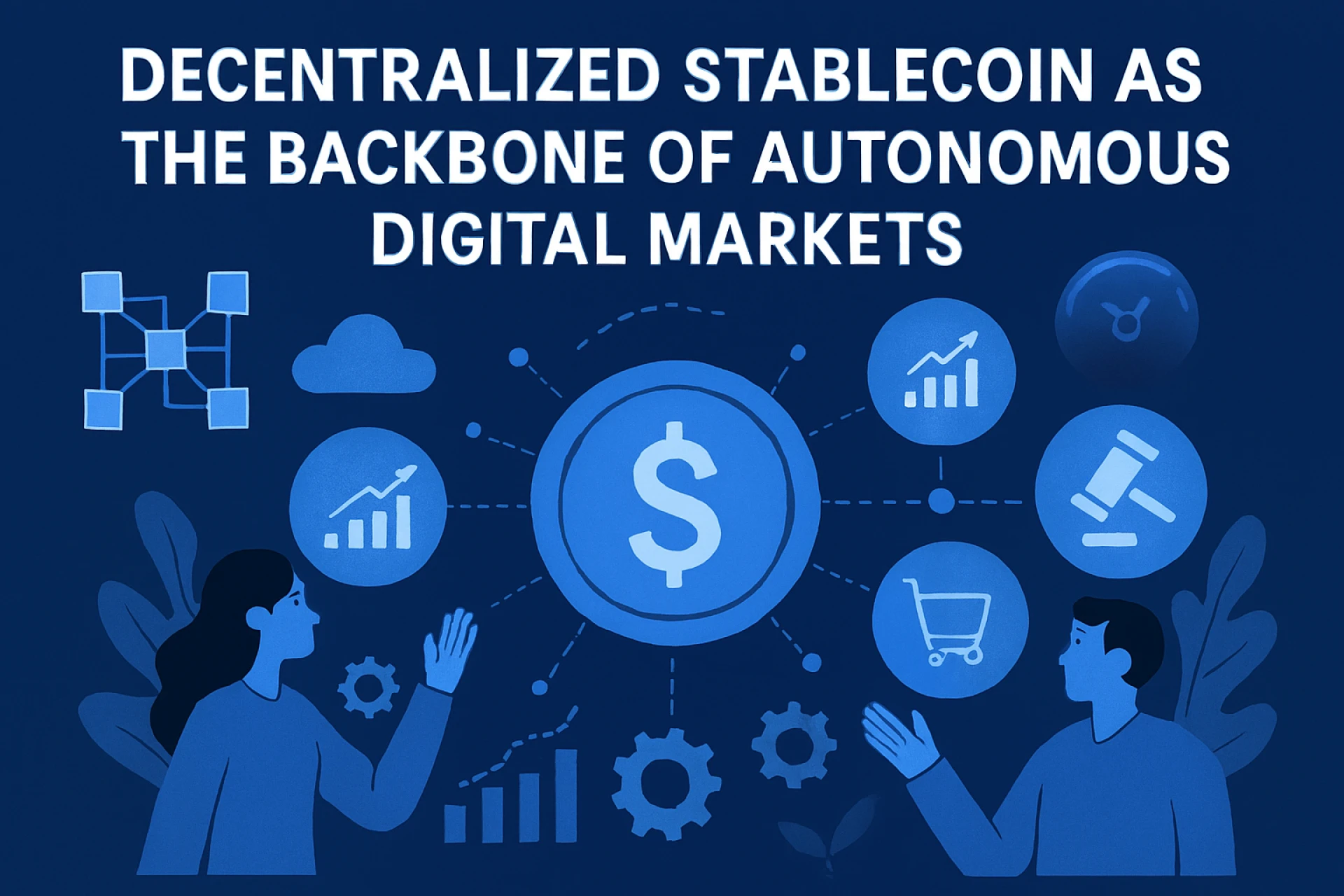
As decentralized ecosystems mature, the role of stable-value assets is being redefined. Stability is no longer just about minimizing volatility; it is about enabling coordination, automation, and trustless execution at scale. Within this shift, the decentralized stablecoin is emerging as a foundational layer for autonomous digital markets, enabling programmable value exchange without reliance on centralized intermediaries or discretionary control.
From Store of Value to Coordination Primitive
Early adoption of stablecoins focused on their ability to preserve purchasing power in volatile crypto markets. Today, decentralized stablecoins are evolving into coordination primitives—assets that enable multiple systems, agents, and protocols to interact predictably.
In decentralized applications, predictable value is essential for automation. Smart contracts require stable denominators to execute conditional logic, distribute rewards, and settle obligations. Decentralized stablecoins fulfill this role by offering deterministic behavior enforced through protocol rules rather than trust in issuers.
This evolution marks a shift from passive stability to active economic coordination.
Architecture of Trustless Monetary Systems
A decentralized stablecoin operates as a closed-loop economic system composed of smart contracts, collateral vaults, oracle feeds, and governance modules. Each component plays a role in preserving stability while maintaining decentralization.
Smart contracts handle issuance and redemption, ensuring that supply changes only occur under predefined conditions. Collateral vaults secure economic backing, while oracle networks provide external price signals. Governance layers enable adaptation without central authority.
Together, these components create a self-regulating monetary system where trust is replaced by verifiable execution.
Emerging Collateral Strategies
Collateral design is undergoing rapid innovation as decentralized stablecoins seek to improve scalability and resilience.
Volatility-Aware Collateral Allocation
Rather than treating all collateral equally, newer systems assess assets based on volatility profiles, liquidity depth, and correlation behavior. Higher-risk assets are assigned stricter parameters, while more stable assets receive preferential treatment.
This risk-weighted approach improves capital efficiency while preserving solvency.
Yield-Generating Collateral Models
Another emerging trend is the use of yield-bearing collateral. By integrating assets that produce on-chain yield, decentralized stablecoin systems can offset operational costs and reduce reliance on user incentives.
Yield-backed models introduce sustainability without compromising decentralization.
Algorithmic Stability Without Human Intervention
Stability in decentralized systems is enforced algorithmically, not administratively. Market participants interact with the protocol through incentives rather than instructions.
When prices deviate from target levels, arbitrage opportunities emerge. Rational actors mint or redeem stablecoins to capture profit, inadvertently restoring equilibrium. This incentive-driven process replaces centralized market-making with decentralized participation.
The result is a system where stability emerges organically from economic behavior.
Real-Time Risk Containment Mechanisms
As decentralized stablecoins grow in scale, managing systemic risk becomes increasingly complex.
Continuous Solvency Monitoring
Protocols continuously assess collateral health using automated checks. These systems operate at block-level granularity, enabling immediate responses to market changes.
Gradual Liquidation Frameworks
Rather than triggering abrupt liquidations, modern designs favor gradual liquidation curves. This reduces market impact, improves price discovery, and prevents cascading failures during volatile periods.
These mechanisms reflect a shift toward resilience-focused engineering.
Interoperability as a Core Requirement
The future of decentralized stablecoins is inherently multi-chain. Users and applications increasingly operate across multiple networks, requiring stablecoins that function seamlessly in diverse environments.
Native interoperability frameworks enable decentralized stablecoins to be issued, redeemed, and transferred across chains without centralized bridges. This reduces fragmentation and enhances liquidity efficiency.
Interoperability transforms decentralized stablecoins into universal settlement assets.
Stablecoins and Autonomous Organizations
Decentralized autonomous organizations rely heavily on stable-value assets to function effectively. Budgeting, payroll, and governance incentives require predictable units of account.
Decentralized stablecoins enable DAOs to operate transparently without relying on centralized treasuries. Smart contracts automate fund distribution, enforce spending limits, and execute governance outcomes directly on-chain.
This tight integration between governance and money accelerates organizational autonomy.
Privacy-First Monetary Infrastructure
As on-chain activity increases, privacy concerns are becoming more prominent. Decentralized stablecoins are beginning to incorporate cryptographic privacy layers that protect transaction details while preserving system integrity.
Selective disclosure techniques allow users to prove compliance or solvency without exposing sensitive financial data. These capabilities are particularly relevant for enterprise use cases and institutional participation.
Privacy-enhanced stablecoins expand adoption without sacrificing transparency.
Market Neutrality and Global Accessibility
Decentralized stablecoins operate independently of national borders and monetary policy decisions. This neutrality makes them attractive in regions with unstable currencies or restricted access to banking infrastructure.
By providing permissionless access to stable digital value, decentralized stablecoins support global participation in digital markets, remote work economies, and decentralized trade networks.
Their neutrality positions them as foundational tools for global digital inclusion.
Forward Momentum and Industry Adoption
Institutional interest in decentralized stablecoins is increasing as infrastructure matures. Improved auditing practices, formal verification, and conservative risk models are reducing adoption barriers.
Enterprises are exploring decentralized stablecoins for automated settlements, programmable escrow, and real-time accounting. This shift indicates growing confidence in decentralized monetary systems.
Conclusion
The decentralized stablecoin is evolving beyond its original purpose into a core component of autonomous digital markets. By combining algorithmic enforcement, interoperable design, and adaptive risk management, it enables stable value exchange without centralized control. As decentralized economies expand, decentralized stablecoins are poised to serve as the monetary backbone supporting coordination, automation, and global participation in the digital financial future.