I have watched more than one team pick a DDoS provider based purely on a big capacity number on a marketing page, only to get genuinely caught out months later by a smaller, faster attack that number was never protected against. Capacity matters, but it is not the whole story, and providers spend a lot of effort making sure that headline figure is the first thing you see.
Let me walk through how the major providers actually compare once you look past the marketing numbers, across capacity, how fast they actually respond once an attack starts, and what you genuinely pay across the market in 2026.
What is a DDoS attack, and why does the provider you pick actually matter?
If you are not entirely sure what is DDoS attack behavior actually looks like in practice, here is the short version. An attacker floods a target with overwhelming traffic or malicious requests, aiming to exhaust its resources so real users cannot get through. The provider sitting in front of your infrastructure is what decides whether that flood ever reaches your servers at all.
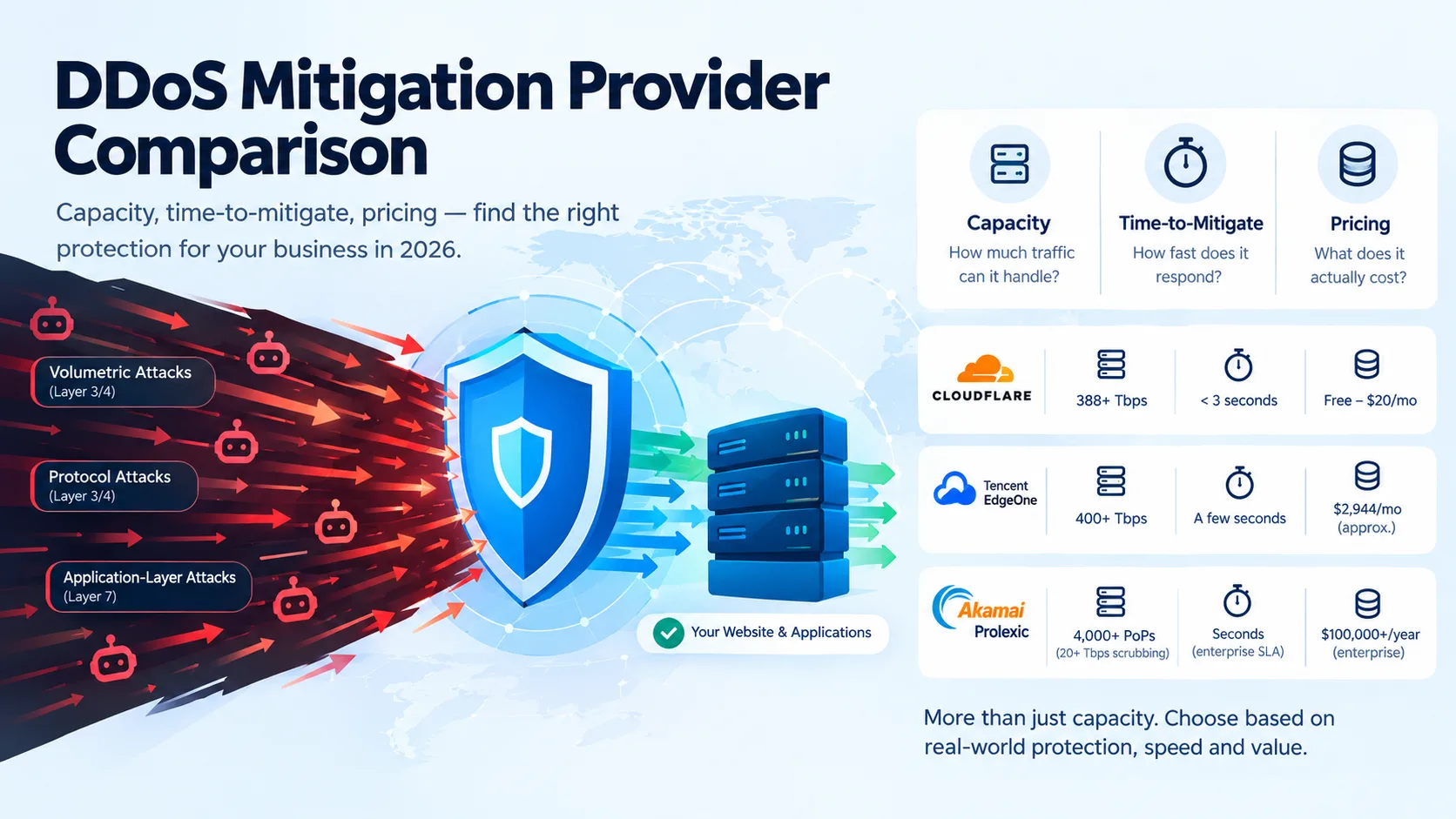
- Volumetric attacks (Layer 3/4), which flood raw bandwidth capacity
- Protocol attacks, which exploit weaknesses in how connections are established and maintained
- Application-layer attacks (Layer 7), which mimic legitimate traffic to exhaust application resources directly
Why can't you just look at network capacity and call it done?
Because a service that can absorb an enormous volumetric attack is not automatically well protected against a fast, low-volume application-layer attack that behaves like real user traffic. Detection speed and behavioral analysis matter more for these attacks than raw absorption capacity, and providers increasingly compete on that speed, not just their headline Tbps figure.
How do the biggest providers compare on raw capacity?
Here is where things stand across the market's main players.
ProviderNetwork capacityDedicated DDoS scrubbing capacityCloudflare388+ TbpsDistributed across the entire anycast networkTencent EdgeOne400+ Tbps25+ Tbps dedicatedAkamai ProlexicPart of a 4,000+ PoP platform20+ Tbps dedicated scrubbingThe architecture differs meaningfully behind these numbers. Cloudflare absorbs attack traffic at every point of presence simultaneously through its anycast network. Akamai's Prolexic routes traffic through dedicated scrubbing centers instead, which supports very high sustained scrubbing capacity but involves a more complex traffic path than absorbing everything at the edge.
Does a bigger headline capacity number always mean better protection?
Not necessarily. You cannot realistically outbuy the largest botnets on capacity alone, so the more useful buying principle is choosing a provider whose capacity comfortably dwarfs any attack you could plausibly face, rather than sizing your choice to your own current traffic levels. Beyond that threshold, detection speed and how well a provider handles application-layer attacks usually matter more day to day than an even larger capacity number.
How fast do these providers actually mitigate an attack once it starts?
In 2026, always-on edge mitigation with no detection delay has become the baseline expectation, and the strongest providers now measure mitigation in seconds rather than minutes.
- Some edge providers report initiating mitigation in under 3 seconds on average
- Cloudflare's anycast model absorbs volumetric attacks across its entire network simultaneously, without a separate detection step
- Akamai's Prolexic scrubbing center model can sustain extremely large attacks, though the more complex traffic path can mean a marginally different response profile compared to at-the-edge absorption
Does time-to-mitigate matter more for some attack types than others?
Yes, significantly. For a pure volumetric flood, sheer absorption capacity often determines the outcome regardless of a few seconds of detection time. For a fast, low-volume application-layer attack designed to look like normal traffic, detection speed and behavioral analysis quality matter far more than how large the provider's network is on paper.
What does this actually cost across the market in 2026?
The spread here is genuinely wide, from completely free to well into six figures annually.
Provider or tierTypical costCloudflare Free / AWS Shield StandardFreeCloudflare ProAround $20 per monthAWS Shield AdvancedAround $3,000 per month, sold as a committed annual contractAzure DDoS ProtectionAround $2,944 per monthAkamai ProlexicEnterprise contract, commonly $100,000 or more per yearA basic small-business protection stack can realistically run under $30 a month. A large enterprise contract with dedicated security operations support can run well past six figures annually.
Why is there such a massive gap between the cheapest and most expensive options?
Because the price is not just buying bandwidth. Entry-level and free tiers cover baseline volumetric protection well, but behavioral Layer 7 protection and active response, the pieces that matter most against sophisticated, adaptive attacks, are frequently sold as paid add-ons even on plans that advertise unmetered DDoS absorption. Enterprise contracts at the top end are paying for dedicated security operations teams actively tuning defenses in real time, along with contractual mitigation guarantees, not simply a bigger pipe.
So which provider actually fits which kind of business?
The right answer depends heavily on your scale and how much a successful attack would actually cost you.
- Small to mid-market sites wanting fast setup and low cost are usually well served by Cloudflare's lower tiers
- Large enterprises where downtime carries real contractual or revenue consequences tend to land on Akamai Prolexic for its SOC-led, actively tuned defense
- Organizations with compliance requirements often need a provider offering a written, contractual mitigation SLA, which narrows the field considerably
- Teams already running on AWS or Azure frequently choose the native option for tighter integration, even at a premium over third-party alternatives
- Businesses serving both global and China-based audiences often look toward providers like EdgeOne, which bundle CDN, WAF, and DDoS protection with genuine mainland China presence
What should a smaller team actually prioritize when picking a provider?
Always-on protection included at the base tier, and a clear understanding of what is actually included versus sold separately. Read the fine print on behavioral Layer 7 protection specifically, since it is one of the most common places where an "unmetered" or "unlimited" DDoS plan quietly excludes the protection that matters most against modern attacks.
Where this leaves you
Capacity numbers make for an easy comparison on a pricing page, but they answer the wrong question for most buyers. The better questions are how fast a provider actually detects and responds to an attack, and what is genuinely included at your price point versus sold as a separate add-on later. Get clear on both before signing anything, and the provider that looks most impressive on paper is not always the one that will actually protect you at 3 a.m.