
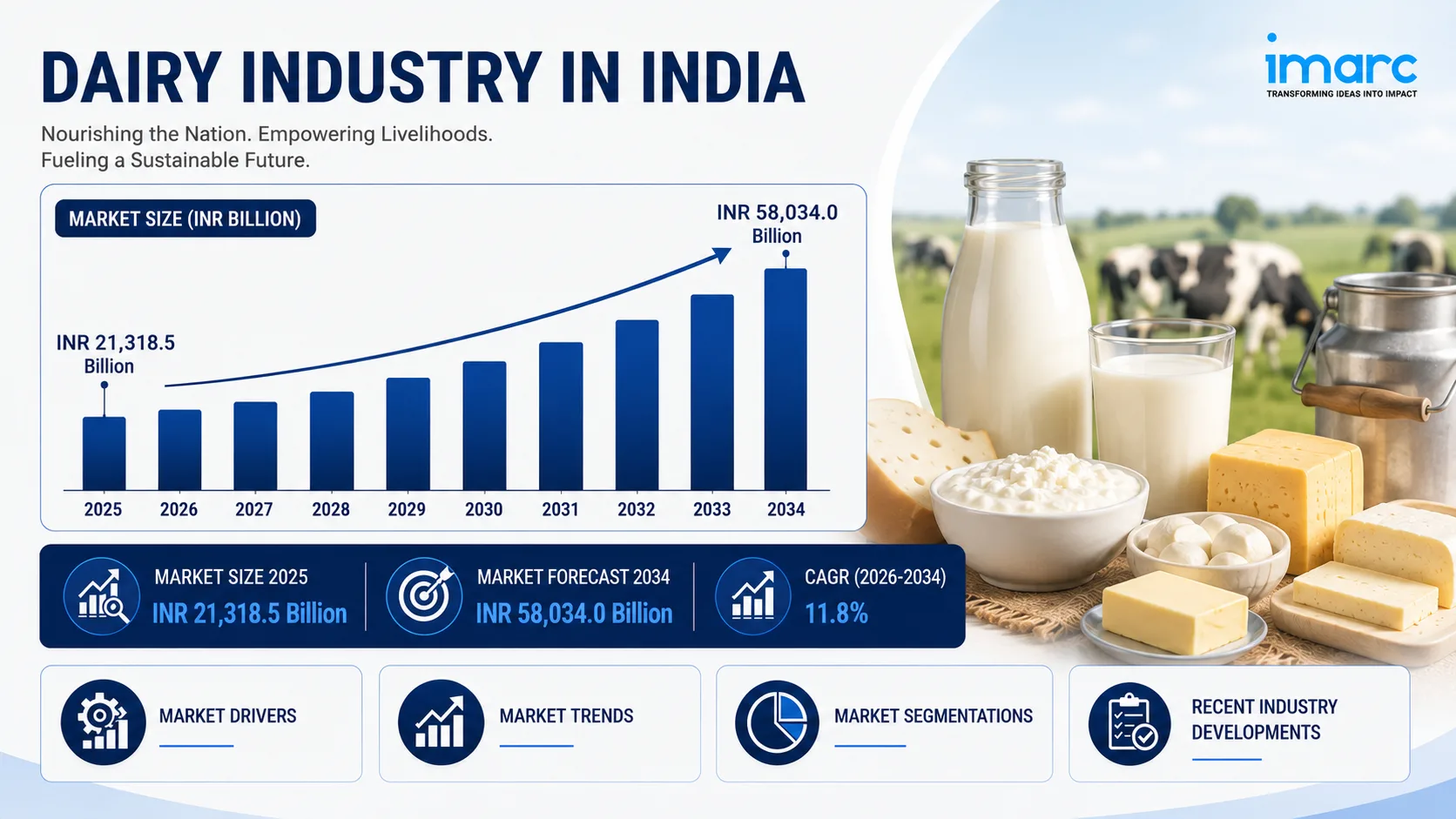
According to IMARC Group's report titled "Dairy Industry in India Size, Share, Trends and Forecast by Product and Region, 2026-2034", the report offers a comprehensive analysis of the industry, including industry growth, trends, share, and regional insights.
The dairy industry in India was valued at INR 21,318.5 Billion in 2025 and is projected to reach INR 58,034.0 Billion by 2034, growing at a CAGR of 11.8%. Backed by India's position as the world's largest milk producer with annual output exceeding 248 million metric tonnes, rising health consciousness, government cooperative modernization, and digital distribution expansion, the sector represents one of the country's most structurally sound agricultural investment opportunities.
- Market scale: INR 21,318.5 Billion in 2025 → INR 58,034.0 Billion by 2034 at 11.8% CAGR.
- Production leadership: Milk production rose 63.56% from 146.30 million tonnes in 2014-15 to 239.30 million tonnes in 2023-24 dairy industry in India statistics that confirm supply-side confidence for long-term investment planning.
- Policy backing: The revised Rashtriya Gokul Mission with INR 3,400 Crore (March 2025) and the National Dairy Plan drive productivity and supply-chain modernization across cooperative networks.
- Amul revenue milestone: Amul's turnover crossed INR 90,000 crore in FY2024-25, maintaining its position as India's most sold FMCG brand and the world's largest farmer-owned dairy organization.
- Manufacturing investment: Mother Dairy is developing a greenfield plant in Nagpur with approximately Rs 525 crore investment and 6 lakh litres per day processing capacity signaling sustained private and cooperative sector capital commitment.
The Strategic Market Challenge: Navigating the Dairy Industry in India
Cold-chain bottlenecks remain the most significant structural constraint causing milk losses, limiting reach to remote rural markets, and restricting organized-sector volume capture from the large informal dairy base. Feed cost volatility and fodder shortages compress farmer margins and contribute to erratic supply during lean seasons, creating procurement cost unpredictability for processors. Livestock disease outbreaks and monsoon-related seasonal variability further create supply disruptions, while strict quality standards in potential export markets constrain full realization of India's export potential despite its competitive production economics.
India's Strategic Vision for the Dairy Industry:
- Revised Rashtriya Gokul Mission (INR 3,400 Crore, March 2025):
Government commitment to livestock productivity, breeding programs, and farmer income stability is sustaining cooperative infrastructure with 190,000+ village cooperative societies and state federations across Gujarat, Maharashtra, Punjab, and Karnataka forming the backbone of India's dairy supply chain.
- National Dairy Development Board programs:
NDDB-led initiatives including the Dairy Entrepreneurship Development Scheme (DEDS) provide structural policy support enabling farmers and processors to access capital, technology, and market linkages that strengthen the organized dairy sector.
- E-commerce and quick-commerce infrastructure:
Platforms like Blinkit and Zepto now deliver short-shelf-life dairy products within 10-15 minutes in urban areas extending organized dairy access to Tier-2 cities that historically lacked reliable cold-chain reach.
- Export development toward Middle East and Southeast Asia:
Government aspirations supported by policy incentives and infrastructure investment are creating long-term incremental revenue opportunities for organized processors leveraging India's competitive production cost advantage.
➤ Access Industry-Focused Insights and Future Forecasts - Request Sample Report
Why Invest in the Dairy Industry in India:
- Structural supply foundation with global production leadership:
Dairy industry in India statistics confirm a robust supply foundation annual milk output exceeding 248 million metric tonnes, accounting for roughly 23% of global production, with OECD projecting 3.6% per annum Indian milk production growth through 2034, the highest for any country globally. This supply depth reduces raw material risk for processors investing in value-added product expansion.
- Liquid milk at 65.30% anchoring predictable volume demand:
Liquid milk's commanding share reflects deeply embedded daily dietary consumption patterns across all socio-economic segments, with per-capita milk availability growing at approximately 3.1% annually. This category provides a stable high-volume revenue floor that value-added premiumization layers can build upon without cannibalizing the foundational demand base.
- Value-added product premiumization creating high-margin growth:
A2 milk, organic dairy, Greek yogurt, probiotic beverages, specialty cheese, and functional fortified products are experiencing rapid consumer adoption among health-conscious urban consumers with organic milk projected to grow at approximately 20% annually, the fastest segment in the market and a direct premium margin opportunity.
- Technology-driven efficiency creating competitive differentiation:
Automated milking systems, IoT-enabled farm management, AI-driven demand forecasting, and blockchain traceability are enabling organized players to reduce waste, improve quality consistency, and capture informal-sector volume. Nestlé India's INR 7,500 crore India capacity expansion across 2023-2025 and technology-led startup activity from Country Delight, Sid's Farm, and Stellapps validate this investment thesis commercially.
Dairy Industry in India: Key Trends & Future Outlook:
- A2 and organic dairy at ~20% CAGR the fastest product segment driven by clean-label consumer preference, glass bottle premium packaging (Farmery's November 2024 A2 milk launch), and growing urban willingness to pay for certified healthy sourcing.
- Quick-commerce dairy distribution via Blinkit and Zepto is reshaping short-shelf-life product reach enabling cooperatives and D2C brands to serve Tier-2 markets without proportional cold-chain infrastructure investment.
- Value-added product mix expansion cheese, UHT milk, probiotic drinks, flavored milk, and specialty desserts is shifting revenue composition toward higher-margin categories that improve overall market economics beyond liquid milk volume growth.
- Blockchain and IoT traceability adoption is accelerating supply chain transparency critical for both export market compliance and domestic premium consumer trust in authentic A2 and organic product claims.
- Regional market expansion in Madhya Pradesh (4.60%), West Bengal (3.80%), and Bihar (2.80%) is expected to post above-average growth as cooperative infrastructure investment and organized retail expansion unlock previously unserved demand.
Regulatory Landscape & Policy Catalysts:
- Revised Rashtriya Gokul Mission (INR 3,400 Crore, March 2025) directly supports livestock breeding, farmer income stability, and cooperative network development sustaining the primary production base that underpins all downstream processing and value-added product manufacturing.
- FSSAI compliance requirements for dairy product quality, labeling, and safety are progressively shifting consumer volume from informal to organized channels creating regulatory demand tailwinds for certified organized processors and branded cooperatives.
- National Dairy Plan programs driving supply-chain modernization are enabling cold-chain investment, processing plant expansion, and farmer linkage programs that improve procurement reliability for organized processors.
- E-commerce policy infrastructure expanding digital payment access and logistics reach into Tier-2 and Tier-3 cities is enabling online dairy channels to serve previously unreachable premium consumer segments with subscription models and quick-commerce delivery reshaping distribution economics.
- Export policy development supporting India's dairy export aspirations toward the Middle East and Southeast Asia through standards alignment, trade agreements, and export credit is creating long-term incremental revenue opportunities for organized processors with compliant product quality systems.
- GDP growth projections of 6.3-6.8% for FY2026 and India's population exceeding 1.5 billion provide the macroeconomic foundation that sustains per-capita dairy expenditure growth ensuring structural demand expansion independent of policy cycle variations.
By the IMARC Group, the Top Competitive Landscape & their Positioning:
- GCMMF
- Mother Dairy Fruits & Vegetables Pvt. Limited
- Nestlé S.A. (India)
- Parag Milk Foods Ltd.
- Heritage Foods Ltd.
- Hatsun Agro Product Ltd.
- Karnataka Co-operative Milk Producers Federation Ltd.
- Tirumala Milk Products Pvt. Ltd.
- COMFED Bihar Sudha
- Prabhat Dairy (Sunfresh Agro Industries Pvt. Ltd.)
Covering an in-depth analysis of the competitive landscape, market structure, key player positioning, competitive dashboards, top winning strategies, and detailed profiles of all major industry participants you will gain access to all these exclusive insights within the full research report.
Market Segmentation Breakdown and Share Analysis:
Analysis by Product Type:
- Liquid Milk (65.30% market share)
- Ghee (8.42% market share)
- Curd (6.84% market share)
- Paneer (4.62% market share)
- Others (4.56% market share)
- UHT Milk (3.28% market share)
- Ice Cream (2.46% market share)
- Table Butter (1.86% market share)
- Cheese (1.42% market share)
- Flavoured Milk (1.24% market share)
Regional Insights:
- Uttar Pradesh (18.70% market share)
- Maharashtra (12.40% market share)
- Gujarat (10.80% market share)
- Rajasthan (9.60% market share)
- Punjab (8.40% market share)
- Haryana (7.60% market share)
- Andhra Pradesh & Telangana (6.80% market share)
- Karnataka (5.80% market share)
- Tamil Nadu (5.20% market share)
- Madhya Pradesh (4.60% market share)
- West Bengal (3.80% market share)
- Bihar (2.80% market share)
- Delhi (1.40% market share)
- Kerala (1.20% market share)
- Orissa (0.90% market share)
Uttar Pradesh anchors the dairy industry in India with the largest single-state share of 18.70% in 2025.
Regulatory Landscape & Policy Catalysts in India
- Rashtriya Gokul Mission (Ministry of Animal Husbandry, Dairying and Fisheries): The revised INR 3,400 crore mission targets indigenous breed development and cooperative modernization, directly supporting both supply-side productivity and organized-sector infrastructure investment.
- National Dairy Development Board (NDDB): The NDDB provides policy guidance, technical support, and capital facilitation for cooperative dairy federations across states, underpinning the cooperative model that anchors India's milk procurement at the village level.
- Dairy Entrepreneurship Development Scheme (DEDS): DEDS provides subsidized loans and capital support for dairy infrastructure investment, lowering the capital barrier for mid-scale private and cooperative processors to expand cold-chain and processing capacity.
- FSSAI Food Safety Standards: Tightening FSSAI standards for dairy product quality, labelling, and adulteration testing are structurally shifting consumer procurement toward branded, certified organized-sector products and away from unregulated informal supply.
- PM Gati Shakti and Cold Chain Infrastructure: Government investment in cold chain logistics infrastructure under national infrastructure programs is gradually improving the distribution environment for branded fresh dairy products in non-metro geographies.
- National Dairy Plan (Ministry of Animal Husbandry): The National Dairy Plan drives productivity enhancement and supply-chain modernization at the primary production level, targeting higher milk yield per animal and more organized procurement infrastructure across major dairy states.
Note: If you need specific information that is not currently within the scope of the report, we can provide it to you as a part of the customization.
➤ Tailor the Research to Your Exact Business Needs - Request Customization:
Frequently Asked Questions (FAQs):
Q1: What is the current value and projected growth of the dairy industry in India?
According to IMARC Group, the dairy industry in India was valued at INR 21,318.5 Billion in 2025 and is projected to reach INR 58,034.0 Billion by 2034, growing at a CAGR of 11.8%, driven by rising health consciousness, government cooperative support, value-added product demand, and digital distribution expansion.
Q2: What products and regional segments lead the market?
Liquid milk leads product segmentation at 65.30% share in 2025, reflecting its essential daily consumption role. Uttar Pradesh leads regionally at 18.70%, followed by Maharashtra (12.40%) and Gujarat (10.80%) states with large dairy animal populations, established cooperative networks, and strong organized processing infrastructure.
Q3: What dairy industry in India statistics confirm the sector's investment case?
Key dairy industry in India statistics include: milk production growth of 63.56% from 146.30 to 239.30 million tonnes between 2014-15 and 2023-24; annual output exceeding 248 million metric tonnes representing approximately 23% of global production; OECD projecting 3.6% per annum growth through 2034; and Amul's turnover exceeding INR 90,000 crore in FY2024-25 all confirming robust supply-side and commercial-scale fundamentals.
Q4: What are the fastest-growing segments within the dairy market?
Organic milk is projected to grow at approximately 20% annually the fastest segment. UHT milk is benefiting from Tier-2 and rural adoption through improving cold-chain reach. Probiotic and functional dairy products are emerging as a high-growth premium niche driven by gut-health and immunity-focused consumer demand among urban health-conscious households.
Q5: What are the primary challenges and opportunities through 2034?
Key opportunities include A2 and organic premium segment growth, quick-commerce distribution expansion into Tier-2 cities, export development toward the Middle East and Southeast Asia, and technology-led efficiency gains from IoT and AI adoption. Primary challenges are cold-chain infrastructure gaps causing milk losses, feed cost volatility compressing farmer margins, livestock disease supply disruptions, and export market quality compliance complexity.
Strategic Insight & Verdict
The dairy industry in India combines the world's largest milk production base with an accelerating consumer premiumization trend, robust government cooperative support, and technology-enabled distribution innovation creating a multi-decade, structurally anchored investment thesis. Based on our analysis, we at IMARC Group have observed that processors and brands combining value-added product portfolios, cold-chain investment, digital distribution, and cooperative farmer linkages are best positioned to capture disproportionate value as the market scales toward INR 58,034.0 Billion by 2034.
Verified Data Source: Dairy Industry in India Report by IMARC Group