
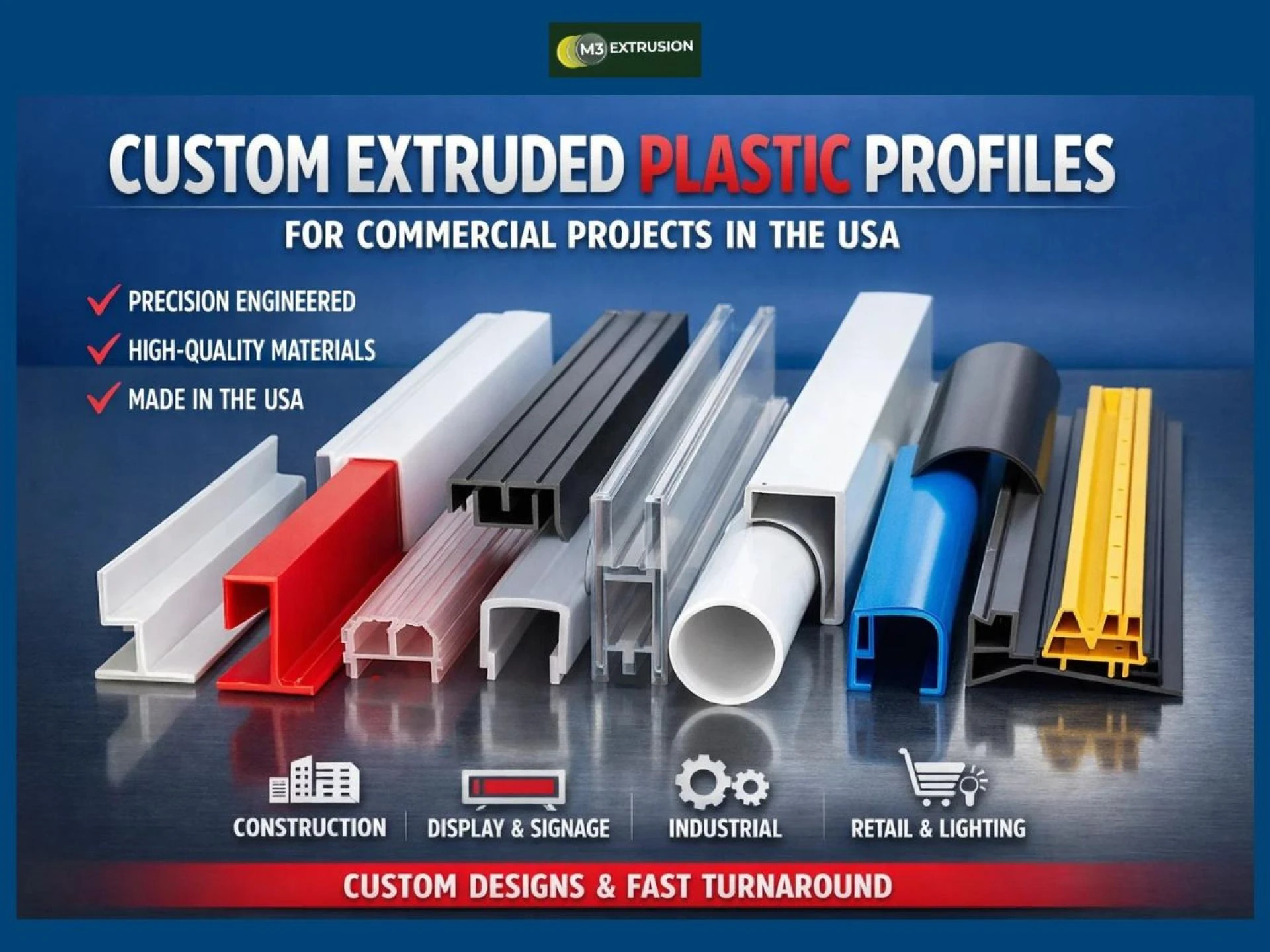
Commercial construction and industrial manufacturing depend on components that fit accurately, perform consistently, and last for years. Many project delays and failures start with small profile mismatches or material issues. This is why demand for custom extruded plastic in the USA continues to grow across sectors such as refrigeration, façades, glazing systems, lighting, and equipment housing. Custom plastic profiles allow buyers to control design, tolerance, and performance instead of adjusting projects around standard parts.
This guide explains how custom plastic extrusion supports commercial projects, what buyers should evaluate before ordering, and why consistency matters for long-term use.
What Are Custom Extruded Plastic Profiles?
Custom extruded plastic profiles are plastic components produced by pushing molten polymer through a specially designed die. The die shape defines the final profile, allowing manufacturers to create parts based on drawings and technical requirements.
Direct answer:
Custom extruded plastic profiles are made to specific shapes, sizes, and material properties required for commercial or industrial use, rather than off-the-shelf designs.
These profiles are supplied in continuous lengths and cut as per project needs.
Why Commercial Projects Need Custom Profiles
Standard profiles rarely match exact project requirements. Commercial applications often need precise dimensions, stable performance, and repeat supply.
Custom extrusion helps when projects require:
- Tight dimensional tolerances
- Long production runs with identical output
- Special material properties such as impact resistance or UV stability
- Integration with metal, glass, or lighting systems
Using custom designs reduces on-site adjustments and installation errors.
Common Commercial Applications in the USA
Custom plastic extrusion is widely used in commercial and industrial projects, including:
- Commercial refrigerator doors and cold storage systems
- Curtain wall and façade window profiles
- LED diffuser covers and lighting housings
- Glass spacer systems and support profiles
- Equipment enclosures and protective trims
Each application demands different polymers, wall thicknesses, and internal structures.
Materials Commonly Used in Plastic Extrusion
Selecting the right polymer is critical for performance and service life.
PVC (Rigid and Modified)
Used for window profiles, shutters, and structural trims. It offers good strength, chemical resistance, and cost control.
Polycarbonate
Chosen for transparent or impact-resistant applications such as lighting covers and guards.
ABS and HIPS
Used where surface finish, impact strength, and moderate heat resistance are needed.
Direct answer:
Material choice affects strength, flexibility, heat resistance, and long-term durability of extruded profiles.
Design Factors Buyers Should Finalise Early
Poor design clarity is a common cause of delays. Before ordering, buyers should confirm:
- Final cross-section drawing with tolerances
- Required length and cutting method
- Surface finish and colour
- Expected load and exposure conditions
Early design approval helps manufacturers produce stable dies and consistent output.
Reliability of Custom Extruded Plastic in Long Projects
For phased construction or repeat manufacturing, consistency is essential. The reliability of custom extruded plastic depends on controlled tooling, material formulation, and process stability.
Reliable extrusion ensures:
- Uniform fit across multiple project stages
- No variation between early and later batches
- Reduced rejection during installation
- Predictable performance under daily use
This reliability is especially important for commercial refrigerator manufacturers and façade contractors.
Bulk Supply and Repeat Production Advantages
Commercial buyers often need thousands of metres of the same profile over time. Custom extrusion supports bulk orders without compromising uniformity.
Benefits include:
- Lower per-unit cost at scale
- Consistent profile geometry
- Easier inventory planning
- Fewer installation issues
Manufacturers such as M3 Extrusion support bulk and repeat production based on approved drawings, which helps large projects maintain quality across sites.
Quality Control and Tolerance Management
Quality control starts at tooling and continues through production.
Key checks include:
- Dimensional measurement at regular intervals
- Visual inspection for surface defects
- Material property verification
- Fit testing with mating components
Direct answer:
Consistent quality in extrusion comes from controlled tooling, stable material flow, and regular inspection.
These checks help avoid costly rework later.
Environmental and Compliance Considerations
Many commercial projects now require materials that meet environmental and safety standards.
Buyers should ask about:
- RoHS or REACH compliance where applicable
- Recyclability of materials
- Flame-retardant options if required
- Low-maintenance surface finishes
These factors are increasingly important in public and large-scale developments.
Lead Time and Planning for Custom Extrusion
Custom extrusion involves tooling development before production begins. Typical steps include:
- Design review and approval
- Die manufacturing and testing
- Sample validation
- Full-scale production
Planning lead time early helps align extrusion output with construction or manufacturing schedules.
Cost Factors Buyers Should Understand
The cost of custom extruded plastic profiles depends on:
- Die complexity
- Material type and additives
- Order volume
- Secondary operations such as drilling or co-extrusion
While tooling has an upfront cost, it becomes economical over long production runs.
Frequently Asked Questions
How is custom extruded plastic different from standard profiles?
Custom profiles are made specifically to your drawing and performance needs, while standard profiles follow generic dimensions. Custom extrusion improves fit, reduces installation issues, and supports consistent supply for large or repeat projects.
Is custom extruded plastic suitable for outdoor commercial use?
Yes, when the right material and additives are selected. UV stabilisers, impact modifiers, and weather-resistant formulations help profiles maintain shape and appearance under outdoor exposure.
What information should buyers share before ordering?
Buyers should provide drawings, material expectations, tolerance limits, and estimated volumes. Clear technical input helps manufacturers produce accurate tooling and stable profiles from the first batch.
Can custom profiles be supplied in bulk for ongoing projects?
Yes. Once the die is approved, profiles can be produced repeatedly with consistent dimensions. This supports phased construction, multi-site projects, and long-term manufacturing contracts.
How long does custom extrusion tooling last?
With proper maintenance, extrusion dies can last for many production cycles. Tool life depends on material type, profile complexity, and production volume.
Final Thoughts
Custom extruded plastic profiles play a key role in the success of commercial projects across the USA. By focusing on design clarity, material choice, and production consistency, buyers can reduce risk and improve long-term performance. Careful planning and the right manufacturing partner ensure profiles that meet both technical and operational needs.