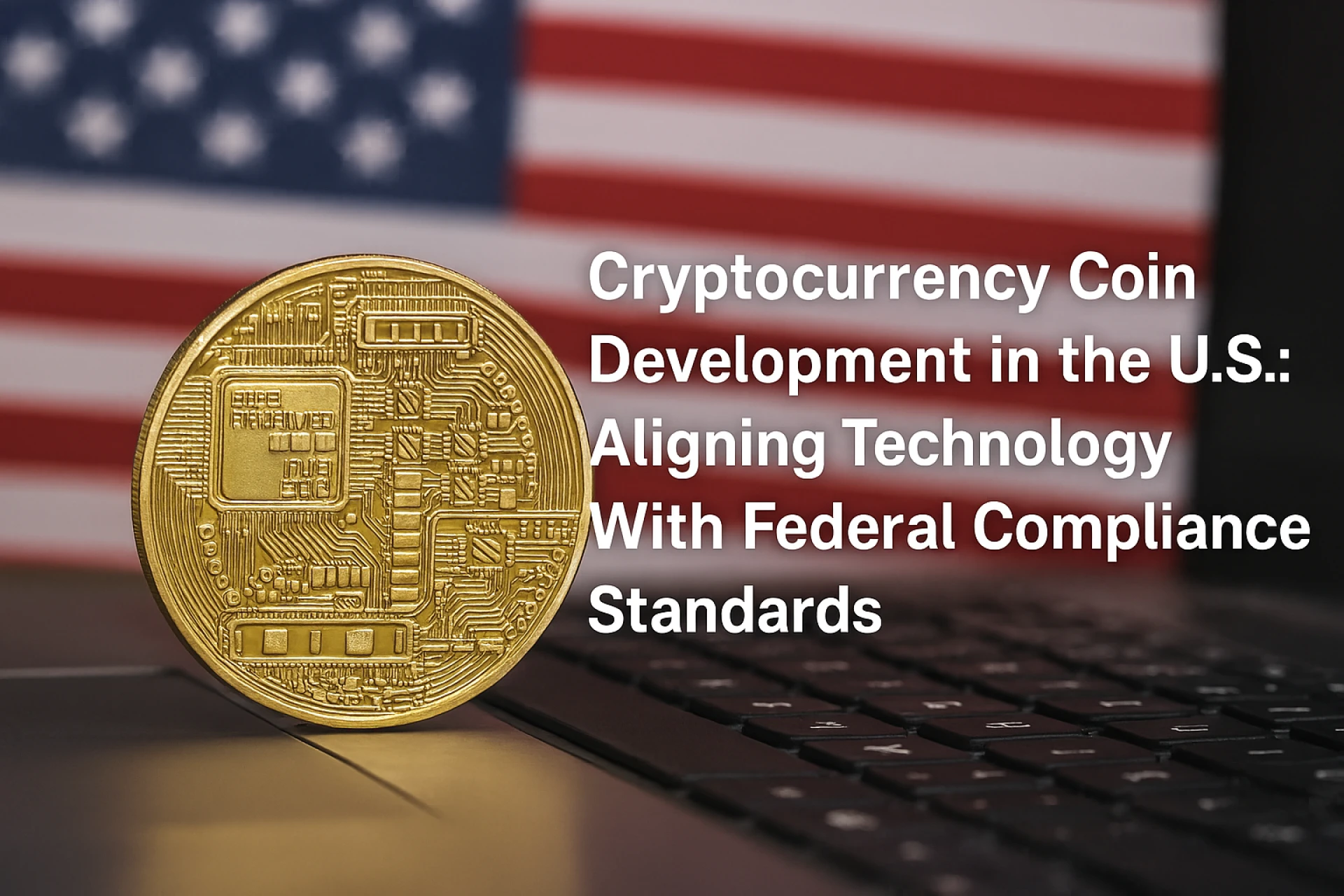
Cryptocurrency Coin Development in the U.S. is no longer a purely technical exercise centered on tokenomics and distributed systems engineering. It has evolved into a multidisciplinary undertaking that intersects with federal securities law, anti–money laundering controls, tax reporting obligations, and supervisory expectations from multiple regulatory bodies. In 2026, any project initiating Cryptocurrency Coin Development in the U.S. must architect compliance into the protocol stack from inception rather than treating it as an afterthought.
The regulatory climate in the United States is characterized by functional oversight. Different agencies assert jurisdiction depending on the nature of the asset, the rights embedded within the token, and the economic reality of the offering. As a result, Cryptocurrency Coin Development in the U.S. requires legal classification analysis parallel to protocol design and smart contract deployment.
Federal Regulatory Architecture and Legal Characterization
The legal treatment of a crypto coin depends primarily on whether it qualifies as a security, a commodity, or a payment instrument. The Securities and Exchange Commission (SEC) applies the Howey test to determine whether a digital asset constitutes an investment contract. If a coin represents an expectation of profit derived from the efforts of others, it may trigger registration requirements under the Securities Act of 1933. In contrast, tokens functioning primarily as decentralized commodities may fall under the Commodity Futures Trading Commission (CFTC) jurisdiction.
In practice, Cryptocurrency Coin Development in the U.S. involves a layered compliance analysis that includes:
- Securities classification assessment: Evaluating governance rights, revenue-sharing structures, staking rewards, and promoter involvement to determine potential SEC exposure.
- Money transmission analysis: Assessing whether token issuance or custody mechanisms trigger FinCEN registration as a Money Services Business (MSB).
- Tax reporting architecture: Embedding transaction traceability features compatible with IRS reporting requirements and digital asset broker obligations.
- Sanctions and AML controls: Integrating screening mechanisms aligned with OFAC guidelines and Bank Secrecy Act standards.
These considerations directly influence technical design choices. For example, governance token distribution models may need vesting smart contracts and transfer restrictions to mitigate securities risk. Similarly, wallet infrastructure must integrate Know Your Customer (KYC) modules when tokens interface with fiat on-ramps.
An entity positioning itself as a crypto coin developer in usa must therefore demonstrate not only proficiency in blockchain frameworks such as Ethereum Virtual Machine compatibility or Layer-2 scaling, but also familiarity with Reg D exemptions, Reg A+ offerings, and safe harbor interpretations. Regulatory literacy becomes a core engineering competency rather than a peripheral advisory function.
Technical Design Patterns for Compliance-Integrated Coins
Compliance-aligned Cryptocurrency Coin Development in the U.S. increasingly follows design patterns that harmonize decentralization with regulatory accountability. Rather than fully permissionless systems at launch, many projects adopt phased decentralization models.
Two core technical adaptations are frequently implemented:
- Programmable compliance layers: Smart contracts incorporating transfer whitelists, jurisdiction-based restrictions, and automated transaction monitoring hooks. These mechanisms allow tokens to enforce holding limits, lock-up periods, or investor accreditation status at the protocol level.
- On-chain auditability frameworks: Transparent ledger analytics interfaces enabling regulators, auditors, and institutional partners to verify supply metrics, treasury movements, and staking yields without compromising user privacy through zero-knowledge proofs or selective disclosure protocols.
From an infrastructure standpoint, custody architecture also requires careful planning. Institutional-grade coins often rely on multi-signature treasury controls, hardware security modules (HSMs), and SOC 2–aligned operational processes. Additionally, disaster recovery, key rotation, and incident response playbooks are expected by enterprise stakeholders.
Another critical factor in Cryptocurrency Coin Development in the U.S. is stable governance. Decentralized Autonomous Organization (DAO) structures must clarify voting rights, proposal thresholds, quorum definitions, and dispute resolution mechanisms. Ambiguity in governance may increase regulatory scrutiny if token holders exert economic control similar to shareholders.
Tokenomics modeling is equally important. Supply issuance schedules, inflation curves, and staking incentives must be evaluated for potential classification risks. Excessively promotional yield promises or guaranteed return narratives may heighten enforcement exposure. Therefore, whitepapers and technical documentation should prioritize factual protocol disclosures over speculative financial projections.
Interoperability considerations also intersect with compliance. Cross-chain bridges introduce additional custodial and counterparty risks, while liquidity pool integrations with decentralized exchanges may complicate AML traceability. Developers must evaluate whether permissioned liquidity frameworks or compliance-enabled automated market makers are appropriate for U.S.-focused deployments.
Ultimately, Cryptocurrency Coin Development in the U.S. requires convergence between blockchain engineering, regulatory analysis, and cybersecurity governance. The development lifecycle must integrate legal reviews at milestone checkpoints, including token minting events, exchange listings, and protocol upgrades.
As federal agencies continue refining digital asset guidance, forward-compatible architecture becomes essential. Designing upgradeable smart contracts, modular compliance adapters, and adaptable governance frameworks allows projects to respond to evolving rulemaking without disrupting network integrity.
In this environment, success depends less on rapid token issuance and more on sustainable infrastructure alignment. Cryptocurrency Coin Development in the U.S. is best understood as compliance-engineered innovation: building distributed systems that can withstand both technical stress tests and regulatory examination. Projects that embed federal standards into their core architecture position themselves for institutional adoption, long-term viability, and operational resilience in an increasingly structured digital asset ecosystem.