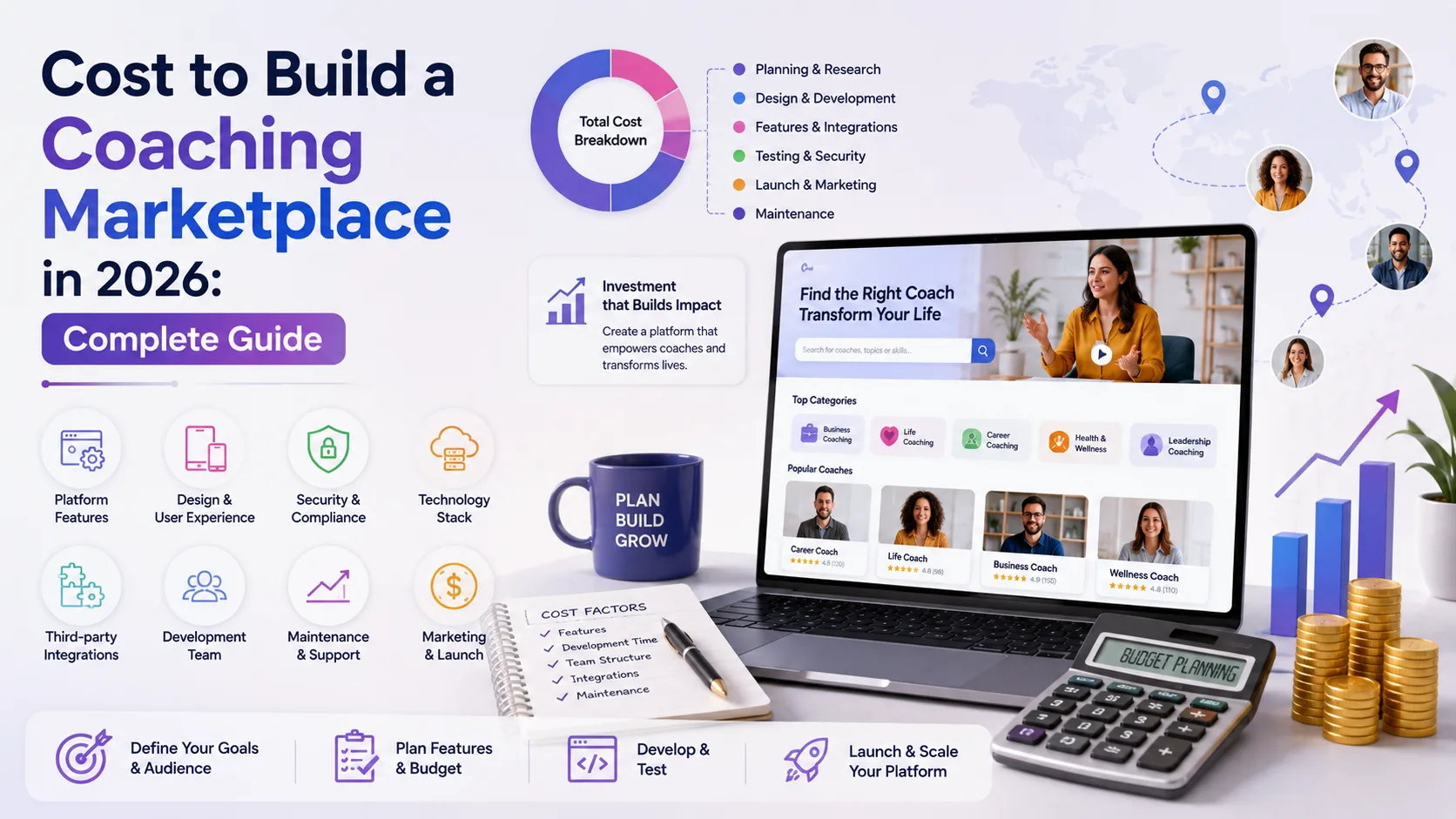
A coaching marketplace needs separate experiences for clients, coaches, and administrators. It may also require coach discovery, scheduling, video sessions, payments, commissions, reviews, messaging, subscriptions, notifications, and reporting.
That is why the cost to build a coaching marketplace can vary significantly from one project to another.
Recent 2026 estimates for coaching marketplace development put a typical marketplace build in the $60,000–$150,000+ range, while more complex coaching platforms can go considerably higher depending on the functionality and technology stack.
So, what determines the actual cost?
What Is a Coaching Marketplace?
A coaching marketplace is a multi-provider digital platform where coaches create profiles, offer coaching services, and connect with clients.
Unlike a basic coaching website, a marketplace typically has multiple coaches operating through the same platform. The marketplace owner manages the overall ecosystem while coaches manage their own services and clients.
A typical platform may include:
- Coach registration and profiles
- Coach search and filtering
- Service listings
- Availability calendars
- Session booking
- Online payments
- Commission management
- Video sessions
- Messaging
- Reviews and ratings
- Notifications
- Client dashboards
- Coach dashboards
- Admin management
The more sophisticated these workflows become, the higher the development investment.
How Much Does It Cost to Build a Coaching Marketplace?
There is no fixed price for developing a coaching marketplace because requirements differ considerably.
A useful way to think about the budget is by platform complexity:
Marketplace TypeEstimated Development CostBasic MVP$30,000–$50,000Standard Coaching Marketplace$60,000–$100,000Advanced Marketplace$100,000–$150,000+Enterprise Platform$150,000–$250,000+These are planning ranges rather than fixed market prices. The actual quote depends on features, development location, technology, integrations, design complexity, testing, and post-launch requirements.
For context, a recent 2026 coaching marketplace cost guide estimates $60,000–$150,000+ for a marketplace with multiple coaches, dashboards, commissions, advanced search, and marketplace administration.
Major Factors That Affect Coaching Marketplace Development Cost
1. Number of User Types
A coaching marketplace usually needs at least three user roles:
Clients: Search for coaches, book sessions, pay, communicate, and leave reviews.
Coaches: Create profiles, define services, manage availability, communicate with clients, and track earnings.
Administrators: Manage users, coaches, commissions, payments, content, disputes, and platform settings.
Each role requires its own workflows and permissions.
2. Coach Discovery and Search
The discovery experience is one of the most important parts of a coaching marketplace.
Clients may want to search coaches by:
- Coaching category
- Expertise
- Language
- Location
- Price
- Availability
- Experience
- Ratings
Advanced search and recommendation functionality can increase development complexity.
3. Booking and Scheduling
Coaching marketplaces often need more than a simple appointment form.
The platform may need to synchronize coach availability, prevent double bookings, handle cancellations, manage time zones, and send reminders.
If integrations with external calendars are required, additional development may be necessary.
4. Video Coaching
If sessions happen directly inside the platform, video functionality becomes another major development component.
A marketplace can integrate third-party video services rather than developing video infrastructure from scratch.
The choice between an external video API and a more customized video solution can significantly affect the budget.
5. Payments and Coach Payouts
Marketplace payments are more complex than standard eCommerce payments.
The platform may need to:
- Collect payment from the client.
- Calculate the marketplace commission.
- Allocate the coach's earnings.
- Handle refunds or cancellations.
- Process the coach payout.
- Maintain transaction records.
The exact payment architecture depends on the target country, payment provider, business model, and regulatory requirements.
6. Messaging and Notifications
Clients and coaches may need to communicate before and after a session.
This could include:
- In-app messaging
- Email notifications
- Push notifications
- Booking reminders
- Payment notifications
- Session reminders
Real-time communication generally requires additional backend infrastructure compared with a basic contact form.
7. Mobile Applications
A web-based marketplace can reduce the initial development scope.
However, if you want dedicated iOS and Android apps, the development budget increases.
Mobile apps may include separate experiences for clients and coaches, or one application with role-based functionality.
Push notifications, mobile payments, video sessions, chat, and calendar functionality can further increase development effort.
Coaching Marketplace Cost by Development Stage
Instead of looking at the project as one large expense, it can be divided into development stages.
Discovery and Planning
This stage covers requirements gathering, user journeys, technical planning, marketplace rules, and feature prioritization.
A detailed discovery process can help prevent expensive changes later.
UI/UX Design
The design team creates the experience for clients, coaches, and administrators.
A coaching marketplace normally requires multiple dashboards and workflows, making UX planning particularly important.
Development
This is where frontend, backend, APIs, databases, authentication, payments, booking systems, dashboards, and other functionality are developed.
Testing
Testing should cover different user roles, devices, browsers, payments, bookings, notifications, security, and edge cases.
Deployment
Deployment includes configuring hosting, production environments, app stores where applicable, analytics, monitoring, and other launch requirements.
Custom Development vs Ready-Made Coaching Marketplace Software
One of the biggest cost decisions is whether to build everything from scratch or start with existing marketplace software.
Custom Development
Custom development is appropriate when you need a highly differentiated marketplace.
You have greater control over:
- Architecture
- User experience
- Features
- Integrations
- Business rules
- Data structure
- Future development
However, custom development normally requires a larger initial investment.
Ready-Made Marketplace Software
A ready-made solution provides existing marketplace functionality that can be configured and customized.
This can reduce the initial development effort and help businesses launch faster.
For example, existing marketplace software can already provide functionality such as vendor dashboards, commission management, automated payouts, product or service listings, and marketplace administration.
The trade-off is that customization depends on the platform's architecture and licensing model.
How to Reduce Coaching Marketplace Development Costs
Reducing cost does not necessarily mean removing important features. It means prioritizing them.
Start With an MVP
Your first version might only need:
- Coach profiles
- Search
- Service listings
- Booking
- Payments
- Messaging
- Reviews
- Basic dashboards
- Admin management
Advanced AI recommendations, complex analytics, native mobile apps, and sophisticated automation can be introduced later.
Use Third-Party APIs
Instead of building every service internally, integrate established providers for video calls, payments, email, maps, analytics, and notifications where appropriate.
This can reduce development time and maintenance requirements.
Choose the Right Technology Stack
Your technology stack should reflect the expected scale and product roadmap.
Overengineering an MVP can increase the initial budget unnecessarily, while choosing technology that cannot support future growth can create expensive migration work later.
Prioritize the User Experience
A marketplace with hundreds of features can still fail if clients cannot quickly find the right coach or complete a booking.
Focus first on the workflows that directly affect marketplace activity: discovery, trust, booking, payment, coaching delivery, and repeat engagement.
Hidden Costs to Consider
The initial development quote is not the complete cost of operating a coaching marketplace.
You should also budget for:
- Cloud hosting
- Payment processing fees
- Video API usage
- SMS and email services
- App store fees
- Domain and security services
- Software licenses
- Maintenance
- Bug fixes
- Security updates
- Marketing
- Customer support
If the marketplace grows significantly, infrastructure and third-party service costs can also increase.
How Long Does It Take to Build a Coaching Marketplace?
The timeline depends on the scope.
A basic MVP may take several months, while an advanced marketplace with mobile apps, video coaching, complex payments, AI, integrations, and multiple dashboards can take considerably longer.
A realistic development plan should include time for:
- Planning
- UI/UX design
- Development
- API integrations
- Testing
- Security checks
- Deployment
- Post-launch fixes
Trying to launch too quickly by skipping testing can create problems once real clients and coaches begin using the platform.
Is Building a Coaching Marketplace Worth the Investment?
It can be, provided there is a clear marketplace business model.
The technology itself does not guarantee success. The platform also needs enough quality coaches and clients to create marketplace liquidity.
Before investing heavily in development, validate:
- Who your target clients are
- Which coaching categories you will offer
- How coaches will earn
- How the marketplace will generate revenue
- What commission structure you will use
- How you will acquire coaches
- How you will acquire clients
- What makes your marketplace different
A smaller MVP can be useful for validating these assumptions before committing to a large technology investment.
Final Thoughts
The cost to build a coaching marketplace in 2026 can range from tens of thousands of dollars for a focused MVP to well over $150,000 for an advanced or enterprise-grade platform.
The biggest cost drivers are not simply the number of screens. They include marketplace complexity, user roles, booking, payments and payouts, video coaching, messaging, mobile apps, integrations, security, and scalability.
For many businesses, the most practical approach is to start with a focused MVP, validate the marketplace model, and then invest in advanced functionality based on actual user demand.
The goal should not be to build the biggest coaching platform on day one. It should be to build the right platform for your coaches and clients, with enough flexibility to grow as the marketplace gains traction.