
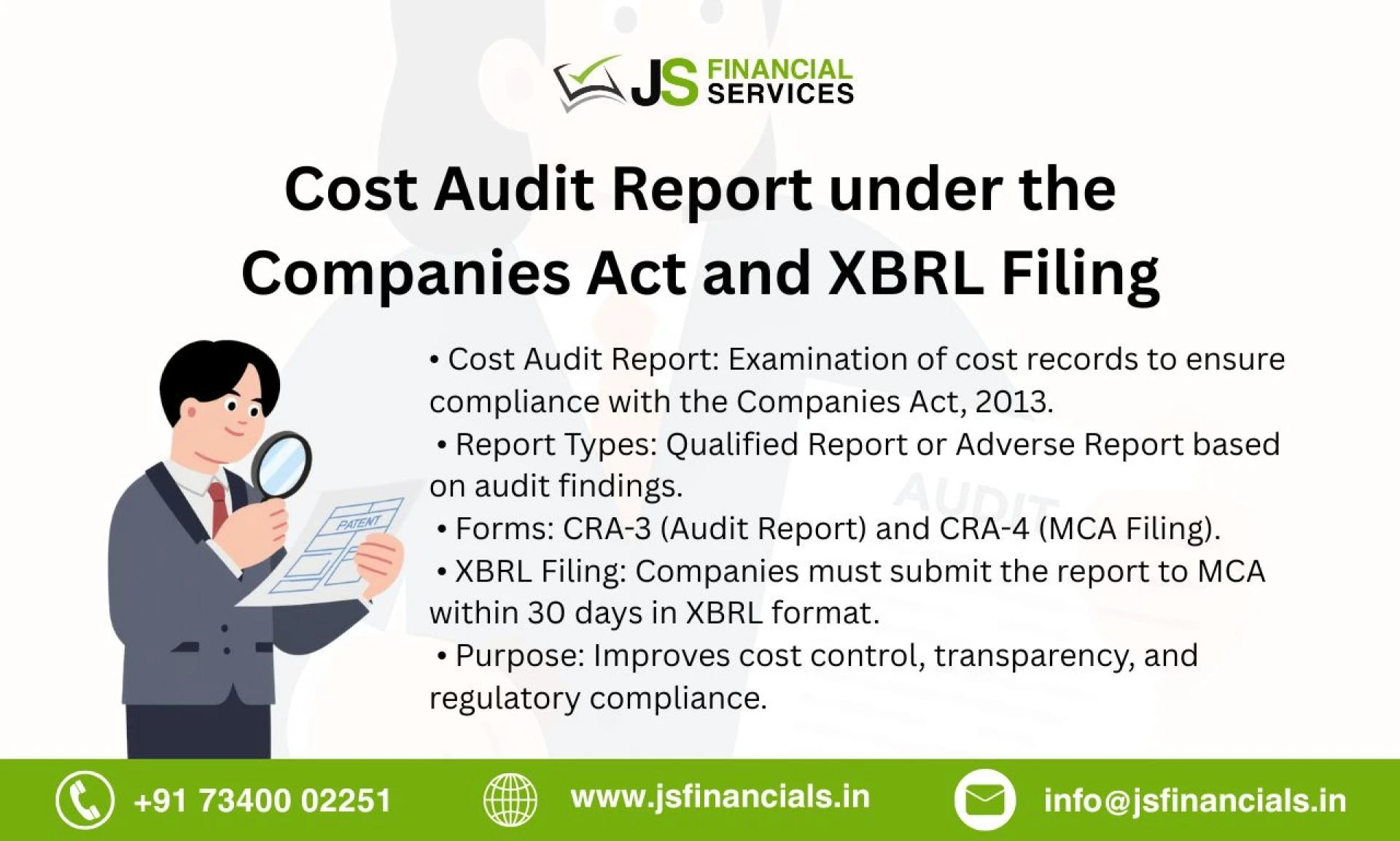
A Cost Audit Report is an official report issued by a cost auditor after examining a company’s cost accounting records, cost statements, and related financial data. The objective is to ensure that the company maintains proper cost records in accordance with applicable standards and the provisions of the Companies Act, 2013.
Cost audit plays a vital role in improving transparency, cost control, and operational efficiency within an organisation.
Introduction to Cost Audit
The responsibility for preparing cost statements and annexures lies with the company. However, these documents are prepared in consultation with the cost auditor to ensure compliance with statutory rules and cost accounting standards.
During the audit, the cost auditor carefully reviews the company’s books of accounts, cost reports, and supporting documents. If any material discrepancies or deficiencies are found, the auditor may highlight them in the report.
The observations and recommendations provided by the cost auditor are based on verified data and supporting evidence, ensuring reliability and accuracy.
Key Elements of a Cost Audit
A Cost Audit primarily involves the verification of:
- Cost accounting records and cost statements
- Production and operational cost data
- Cost reports and costing techniques
- Inventory and raw material utilisation
The purpose is to ensure that the company follows accepted cost accounting principles and maintains accurate records.
A cost audit helps management in:
- Detecting errors and irregularities
- Improving operational efficiency
- Controlling production costs
- Identifying opportunities for cost reduction
The prescribed format for cost audit reporting (Form CRA-3) includes several analytical sections such as:
- Product or service-wise cost statements
- Profitability analysis
- Profit reconciliation
- Value addition and distribution of earnings
- Financial ratios and performance analysis
Cost auditors may also review operational issues like idle capacity, excessive raw material inventory, wastage in manufacturing processes, and rising production costs.
Qualified Cost Audit Report
A Qualified Cost Audit Report is issued when the auditor identifies specific deviations or limitations in the cost records that materially affect the cost statements but are not significant enough to invalidate the entire report.
Common reasons for a qualified report include:
- Non-compliance with cost accounting standards
- Incomplete or inaccurate cost records
- Material errors or omissions in cost statements
- Non-availability of necessary information or documentation
- Differences between financial statements and cost records
In such cases, the auditor provides a qualified opinion explaining the issues and their impact on the cost statements.
Adverse Cost Audit Report
An Adverse Cost Audit Report is issued when the cost auditor concludes that the cost statements are materially incorrect and unreliable.
This type of opinion indicates serious issues such as:
- Major misstatements in cost of production
- Incorrect cost allocation or reporting
- Significant inconsistencies in cost records
An adverse report means that the company’s cost data does not present a true and fair view of its cost structure and operational performance.
Filing of Cost Audit Report with MCA
Companies required to conduct a cost audit must submit the report to the Ministry of Corporate Affairs (MCA).
As per the Companies (Cost Records and Audit) Rules, 2014, companies must file the cost audit report through Form CRA-4 within 30 days from the date of receiving the audit report.
The report must be filed in Extensible Business Reporting Language (XBRL) format, which is a digital reporting standard used globally for financial and business data.
Understanding XBRL Filing
XBRL (Extensible Business Reporting Language) is an international standard for electronic business reporting. It enables companies to present financial and cost information in a structured and easily analysable format.
XBRL reporting allows regulators and stakeholders to access, compare, and analyse financial data efficiently.
Key advantages of XBRL filing include:
- Improved accuracy and transparency in reporting
- Standardised reporting format
- Faster analysis of financial and cost data
- Better integration of financial and operational information
Through XBRL tagging, each data element in the cost audit report is mapped to predefined taxonomy structures, making it easier for regulators to interpret and analyse the data.
Benefits of XBRL for Businesses
Adopting XBRL-based reporting offers several benefits for companies, including:
- Efficient regulatory compliance
- Improved internal financial analysis
- Better data management and reporting accuracy
- Enhanced transparency for stakeholders
It also helps regulators and policymakers analyse industry-wide cost data to support economic and sectoral policy decisions.
Conclusion
A Cost Audit Report is an essential tool for ensuring accurate cost reporting, operational transparency, and regulatory compliance. Proper maintenance of cost records and timely filing of cost audit reports help companies meet the requirements of the Companies Act, 2013.
Businesses covered under cost audit provisions must ensure that their reports are prepared correctly, verified by cost auditors, and filed with the MCA in XBRL format within the prescribed timeline.
For professional assistance with cost audit compliance, accounting, and regulatory filings, businesses can rely on JS Financial Services for expert guidance and seamless compliance support.