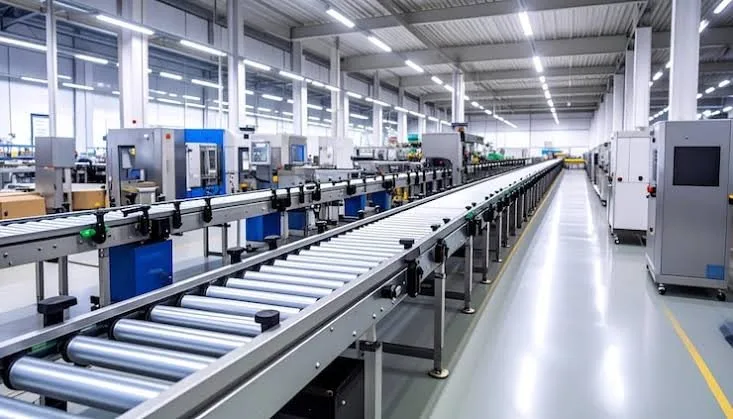
If you've ever been to a busy shipping hub or factory, you might have noticed one machine running in the background, carrying raw materials, parts, and boxes from one point to another without a break. That quiet workhorse is a belt conveyor, a handling piece of equipment that is responsible for moving large amounts of products each day across the world.
What makes it so popular is that it doesn't try to be clever. You take a looped surface, stretch it over two pulleys, hook up a motor, and that's about it. Set something on top, and it goes for the ride. People have been running assembly lines on that one idea for more than a hundred years now, and honestly, not much about it has needed to change. It still holds up most of what we call modern material handling.
How The Design Works
At its heart, you've got a loop. One pulley at the far end spins freely, and the other one, the driven one, is hooked to the motor. The motor turns, the drive pulley pulls, and the surface slides forward with whatever you've loaded onto it. Nothing dramatic, just a steady, even pull from one spot to the next. Strip away the bells and whistles and every belt conveyor still comes back to that one simple motion.
The clever part is really how much it can bend to fit the job. Flat run? Fine. Up a slope? No problem. Need it to turn a corner because the building wasn't laid out with you in mind? It'll do that too. And the surface itself isn't one-size-fits-all. Small loose bits sit happily on a smooth top, but the second you tilt things uphill, you'll want some grip, which is where a rough or cleated surface comes in.
Where It Earns Its Keep.
- Distribution centers run long stretches to move parcels from the receiving door over to sorting.
- Food plants lean on washable surfaces, since the hygiene rules there don't leave much wiggle room.
- Airports push thousands of suitcases an hour through those sorting tunnels behind the scenes.
- Recycling sites run sorted material slowly past the workers and scanners that pick through it.
Matching The Line To The Load
Before anything else, look at what you're actually moving. A padded envelope and a cast engine block won't take the same machine. The width, the surface, how much motor you need- all of it depends on the product type.
Also consider speed. Fragile goods that might tip over or bruise require a slow, patient pace. A high-volume operation needs the opposite, something that keeps the whole floor moving. Get these right, and you can reduce wear-out from jams, spills, and belts. That's why it pays to sort this out at the design stage, before anyone cuts steel.
Caring For The System Over Time
Anything with moving parts requires a bit of care, and these are no exception. Three things typically decide how long a surface holds up: tracking, tension, and keeping it clean. A loop that starts wandering to one side may rub on the frame and fray before its time.
The upside is that staying ahead of it isn't hard. Take a look at the rollers now and then. Listen for any sounds. Wipe the surface. Well-cared for, conveyor belts keep running for years. Left alone, they tend to quit at the worst possible moment, usually with a full line stacked up behind them.
The Cost Picture
A short manual section barely dents the budget. A long-powered line with sensors and controls is a different sort of commitment altogether. The thing to do is hold the sticker price up against the labor it's taking off your hands.
Think about it. Moving goods by hand is slow, and it pins down people who could be doing something that actually matters to the business. A well-chosen line pays itself back by freeing those folks up and speeding up everything downstream. Seen in that light, it stops looking like money going out and starts looking like a tool that keeps earning after the install crew drives off.
Built To Keep Things Flowing
It comes back to the product. Whether short manual runs or fully automated lines of quality conveyor belts, the machine has to be sized to the load, the distance, and how much of it moves in a day. That's the line between gear that earns its spot on the floor and gear that just collects dust in a corner.