Walk into most workplaces and you will find organisations full of intelligent, well-intentioned people who are quietly struggling to communicate with each other effectively. Not because they lack the desire to connect, but because nobody has ever taught them how. Communication in most professional environments is treated as a given, something people are expected to have figured out by the time they arrive. The result is a persistent background hum of misunderstanding, misalignment, and missed opportunity that most organisations have simply learned to accept as normal.
It does not have to be normal. And increasingly, the organisations that recognise this and do something about it are gaining a measurable advantage over those that do not.
Why Communication Breaks Down at Work
Workplace communication fails for reasons that are usually structural rather than personal. People are under time pressure and cut corners on clarity. They assume shared context that does not actually exist. They avoid difficult conversations until small issues become significant ones. They give feedback that is too vague to act on and receive feedback the same way. They sit in meetings where the real agenda is never surfaced and leave with different understandings of what was decided.
None of these are failures of intelligence or goodwill. They are failures of skill, and they are exactly the kind of failures that targeted development can address. A well-designed communication skills workshop creates a structured environment where these patterns can be named, examined, and replaced with more effective habits.
What a Workshop Environment Offers
There is something specific about learning communication skills in a group setting that individual coaching or self-directed learning cannot fully replicate. You are practising with real people who respond in real and sometimes unpredictable ways. You are watching others work through challenges that look exactly like your own, which is both instructive and normalising. You are receiving feedback not just from a facilitator but from peers who are experiencing your communication from the outside.
The peer dimension of a communication coaching environment is consistently underestimated. Hearing how your message lands with actual colleagues, discovering that your directness reads as aggression or that your diplomacy reads as evasiveness, creates a quality of self-awareness that no amount of theoretical instruction produces. And doing this in a safe, facilitated environment means the learning happens without the professional consequences that would attach to discovering the same things in a real meeting.
Core Skills That Transfer Immediately
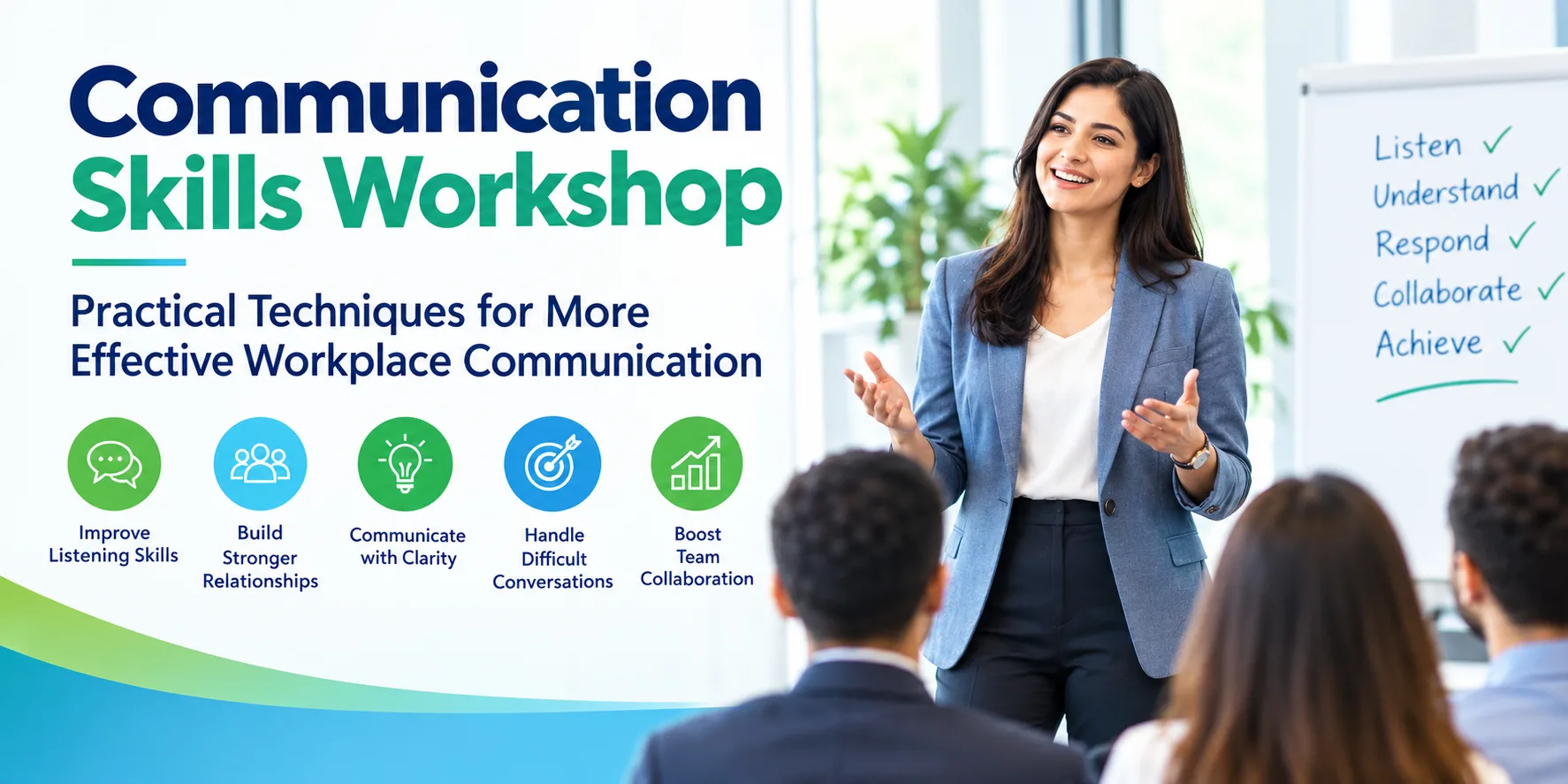
A well-structured workshop does not spend time on abstract principles of communication theory. It focuses on practical skills that participants can apply the following day. How to structure a message so the key point lands first rather than emerging at the end. How to give feedback that is specific enough to be useful without being so blunt that it triggers defensiveness. How to listen actively rather than simply waiting for a pause. How to handle disagreement in a way that keeps the conversation productive rather than personal.
These are not soft skills in the dismissive sense that phrase sometimes implies. They are the operational infrastructure of effective teamwork, and improving them has direct effects on output quality, decision speed, and team cohesion.
Communication Coaching at the team level also addresses the interpersonal dynamics that formal training programmes rarely touch. The habitual patterns between specific people in a team: who dominates, who withdraws, who gets talked over, who sets the emotional temperature of a room. A skilled facilitator can surface these dynamics in a way that creates insight without blame, and begin to shift them in a direction that serves the whole team.
Building the Habit, Not Just the Skill
One of the risks with any form of professional development is the shelf life problem. People leave a workshop energised and full of intention, and six weeks later the old habits have reasserted themselves. Good workshop design anticipates this and builds in mechanisms for the learning to stick: follow-up practice, accountability structures, tools that people can use independently in the weeks that follow.
Communication skills workshop programmer that are designed for durability do not treat the session itself as the endpoint. They treat it as the beginning of a practice, and they give participants the frameworks and habits they need to continue developing after the formal learning ends. The goal is not an isolated improvement but a genuine shift in how a team or an individual communicates day to day.
The Organizational Case for Communication Development
Leaders who are sceptical about investing in communication development tend to frame it as a nice-to-have rather than a business priority. The evidence suggests otherwise. Teams with strong communication have shorter decision cycles. They surface problems earlier, which means they resolve them at lower cost. They retain people more effectively because employees who feel genuinely heard are significantly less likely to leave. They execute on strategy more reliably because alignment at the top translates into aligned action further down.
A communication skills workshop is not a retreat or a morale exercise. It is an investment in the quality of thinking, decision-making, and collaboration that an organisation is capable of. When the people inside an organisation can communicate with each other clearly, honestly, and constructively, everything they are trying to achieve becomes considerably more possible.