
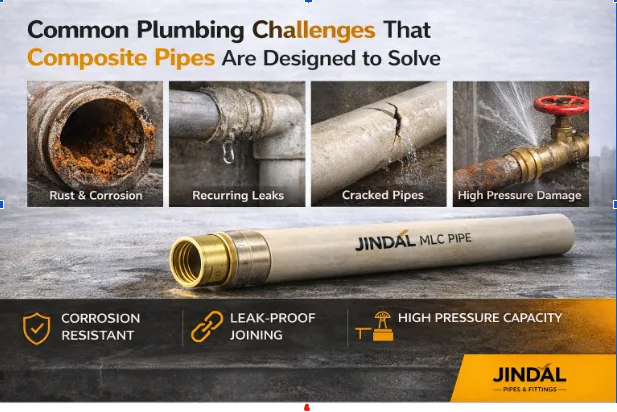
Plumbing systems are expected to operate efficiently for decades, yet many buildings experience issues such as leakage, corrosion, pressure-related failures, and costly maintenance long before their expected lifespan. In many cases, these problems are linked to the limitations of traditional piping materials.
Modern composite pipes have been developed to address these common challenges by combining the flexibility of polymers with the strength of aluminium. As a result, they are increasingly being used in residential, commercial, and industrial projects where long-term reliability is a priority.
Why Plumbing Problems Continue to Affect Modern Buildings
Even well-designed buildings can experience plumbing issues over time. Water pressure fluctuations, temperature changes, ageing materials, and joint failures can all contribute to system deterioration.
Common consequences include:
- Water leakage
- Reduced water flow
- Pipe replacement costs
- Property damage
- Increased maintenance expenses
This is why builders are paying greater attention to piping materials that can deliver long-term performance rather than simply meeting short-term budget requirements.
According to the National Institute of Building Sciences (NIBS), lifecycle performance is becoming a major factor in infrastructure and building system design.
Challenge 1: Corrosion and Rust Formation
Corrosion is one of the most common causes of plumbing failure, particularly in metal pipe systems.
Over time, corrosion can lead to:
- Internal rust deposits
- Restricted water flow
- Pipe weakening
- Water quality concerns
- Leakage
Traditional metal pipes are especially vulnerable in environments where they remain exposed to water for extended periods.
How Composite Pipes Help
A composite water pipe uses corrosion-resistant inner layers that prevent water from coming into contact with metal surfaces.
Benefits include:
- No internal rust formation
- Reduced scaling
- Improved water quality
- Longer service life
The World Health Organization (WHO) water infrastructure guidance emphasizes the importance of durable water delivery systems for maintaining long-term reliability.
Challenge 2: Leakage at Pipe Joints
Many plumbing failures do not occur within the pipe itself but at the connection points.
Common causes of joint leakage include:
- Poor installation
- Material movement
- Pressure stress
- Ageing seals
Even small leaks can result in significant repair costs if left undetected.
How Composite Pipes Help
Modern composite piping systems are often paired with advanced connection technologies designed to improve joint reliability.
Advantages include:
- Better sealing performance
- Reduced leakage risks
- Consistent connections
- Improved long-term stability
This helps reduce one of the most common maintenance issues found in plumbing systems.
Challenge 3: Pressure Fluctuations
Water pressure can vary significantly depending on building height, demand levels, and system design.
Over time, pressure fluctuations can place stress on pipes and fittings.
Potential issues include:
- Cracks
- Joint failures
- Reduced system lifespan
- Unexpected maintenance
How Composite Pipes Help
The aluminium layer within a composite plumbing pipe improves structural stability while maintaining flexibility.
This combination helps:
- Absorb pressure variations
- Reduce stress on joints
- Improve system durability
- Support high-rise applications
For this reason, composite pipes are increasingly used in large residential and commercial projects.
Challenge 4: Thermal Expansion and Contraction
Hot and cold water systems expose pipes to continuous temperature changes.
Many conventional plastic pipes expand and contract significantly as temperatures change.
Over time, this movement can lead to:
- Joint stress
- Pipe deformation
- Support system strain
- Increased maintenance
How Composite Pipes Help
A composite pipe for hot water applications benefits from an aluminium core that helps reduce thermal expansion.
Key advantages include:
- Better dimensional stability
- Reduced movement
- Improved joint protection
- Greater long-term reliability
This makes composite pipes suitable for both hot and cold water systems.
Challenge 5: High Maintenance Costs
Maintenance expenses often increase as plumbing systems age.
Recurring problems can include:
- Leakage repairs
- Corrosion treatment
- Pipe replacement
- Water damage restoration
These costs can accumulate significantly over the lifespan of a building.
How Composite Pipes Help
Composite pipes are designed to minimize many of the issues that drive maintenance expenses.
Benefits include:
- Corrosion resistance
- Reduced leakage risks
- Long service life
- Improved operational reliability
This is one reason many developers now evaluate plumbing systems based on lifecycle value rather than purchase cost alone.
Why Composite Pipes Are Becoming More Popular in India
The Indian construction industry is increasingly focused on durable infrastructure and low-maintenance building systems.
Growing demand for:
- High-rise housing
- Commercial developments
- Smart buildings
- Sustainable infrastructure
has increased interest in composite pipe India solutions.
Manufacturers such as Jindal Tubes have helped expand awareness of advanced composite pipe systems that are designed to address common plumbing challenges while supporting long-term building performance.
Professionals evaluating a jindal composite pipe often prioritize factors such as durability, pressure resistance, and reduced maintenance requirements.
Composite Pipes vs Common Plumbing Challenges
Plumbing ChallengeHow Composite Pipes HelpCorrosionCorrosion-resistant inner layersLeakageImproved joint reliabilityPressure FluctuationsBetter dimensional stabilityThermal ExpansionReduced expansion and contractionMaintenance CostsLonger lifespan and fewer repairsWater Quality IssuesNo rust or internal scaling
FAQs
What are the most common plumbing problems in buildings?
Leakage, corrosion, pressure-related failures, scaling, and thermal expansion are among the most common plumbing issues.
Why are composite pipes more durable?
Composite pipes combine multiple materials to improve corrosion resistance, pressure handling, and dimensional stability.
Can composite pipes be used for hot water systems?
Yes. Many composite pipe systems are designed specifically for both hot and cold water applications.
Why are composite pipe brands in India becoming more popular?
Builders and consultants increasingly seek plumbing solutions that offer long-term reliability and lower maintenance requirements.
Final Insight
Many plumbing failures can be traced back to material limitations rather than installation mistakes. Corrosion, leakage, pressure fluctuations, and thermal movement continue to be major challenges in modern buildings.
This is why composite pipes are gaining attention across the construction industry. By addressing multiple plumbing challenges within a single system, they offer a practical solution for projects focused on durability, efficiency, and long-term infrastructure performance. As expectations for building reliability continue to rise, composite piping technology is becoming an increasingly important part of modern plumbing design.