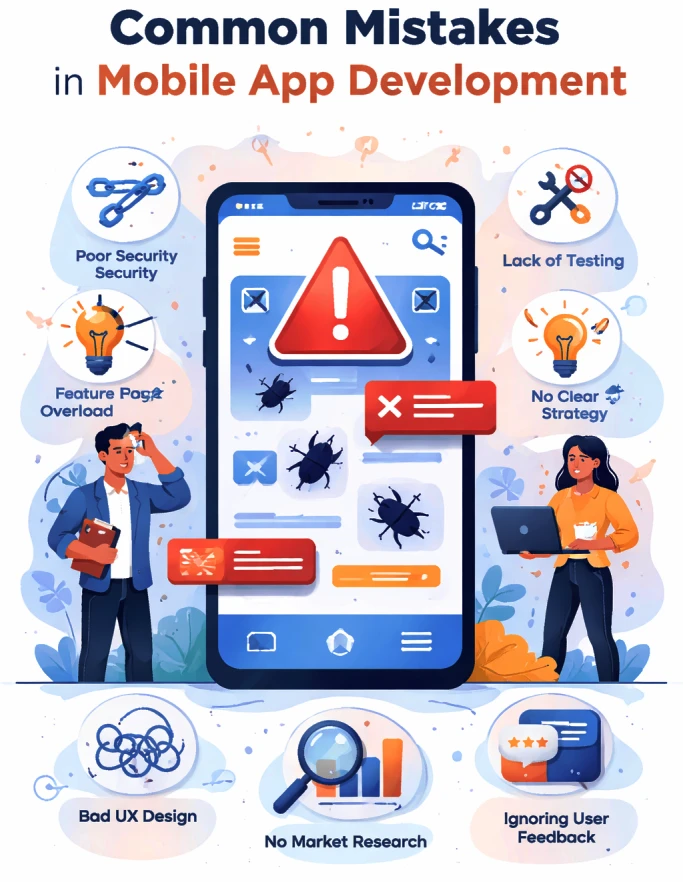
Mobile app development has become a cornerstone of modern business strategy. With billions of smartphone users worldwide, companies view mobile apps as essential tools for customer engagement, brand visibility, and revenue generation. However, building a successful mobile app is far more complex than simply having a great idea. Many projects fail due to avoidable mistakes made during planning, design, development, or post-launch stages. Understanding these common pitfalls can help businesses and developers save time, reduce costs, and improve the chances of success. Common mistakes to avoid in mobile app development? Below are some of the most frequent mistakes in mobile app development and how to avoid them.
1. Lack of Clear Objectives and Strategy
One of the biggest mistakes is starting development without clearly defined goals. Some organizations rush into building an app because competitors have one or because it seems trendy, without understanding what they want to achieve.
Without a clear purpose, teams may struggle with decision-making, feature prioritization, and measuring success. Before development begins, it is crucial to answer questions such as:
- What problem does the app solve?
- Who is the target audience?
- What metrics will define success?
- How does the app align with business goals?
A well-defined strategy ensures that every development decision supports the overall vision.
2. Ignoring User Experience (UX) Design
Even a technically flawless app can fail if users find it difficult or frustrating to use. Poor navigation, confusing layouts, cluttered interfaces, and slow performance often drive users away quickly.
Developers sometimes focus heavily on features and functionality while overlooking usability. However, users prioritize convenience and simplicity. Investing in user experience research, wireframing, and usability testing is essential to create intuitive interactions.
Remember: users will abandon an app within seconds if it does not meet their expectations.
3. Overloading with Features
Many teams believe that adding more features increases value. In reality, feature overload often leads to complexity, longer development time, higher costs, and user confusion.
A better approach is to start with a Minimum Viable Product (MVP) that focuses on core functionality. Once the app is validated in the market, additional features can be introduced based on user feedback.
Simplicity often leads to better adoption.
4. Neglecting Platform Guidelines
Each mobile platform has its own design principles, user interface standards, and development requirements. Ignoring these guidelines can result in inconsistent user experiences or even rejection during the app review process.
For example, navigation patterns, gestures, and interface elements may differ across platforms. Users expect apps to behave according to the conventions of their device ecosystem. Following platform-specific guidelines ensures familiarity and trust.
5. Poor Performance Optimization
Performance issues such as slow loading times, crashes, battery drain, and laggy animations can destroy user satisfaction. Performance problems often arise when developers fail to optimize code, manage memory efficiently, or test under real-world conditions.
Users expect apps to be fast and responsive. Even a delay of a few seconds can lead to abandonment.
Performance testing should include:
- Different devices and screen sizes
- Various network conditions
- Heavy usage scenarios
- Background processing
Optimization should be an ongoing priority, not an afterthought.
6. Inadequate Testing
Skipping thorough testing is a critical mistake that can lead to bugs, security vulnerabilities, and poor user reviews after launch. Some teams rely only on basic functional testing and ignore other essential aspects.
Comprehensive testing should include:
- Functional testing
- Usability testing
- Performance testing
- Security testing
- Compatibility testing
- Regression testing
Beta testing with real users is particularly valuable because it reveals issues that internal teams may miss.
7. Ignoring Security Considerations
Security breaches can severely damage user trust and brand reputation. Mobile apps often handle sensitive data such as personal information, payment details, and login credentials.
Common security mistakes include:
- Storing sensitive data insecurely
- Weak authentication mechanisms
- Lack of encryption
- Poor API security
Implementing strong security practices from the beginning is far more effective than trying to fix vulnerabilities later.
8. Not Planning for Scalability
Some apps perform well initially but struggle when the user base grows. Lack of scalability planning can lead to server crashes, slow performance, and system failures during peak usage.
Developers should design architecture that supports growth by considering:
- Cloud infrastructure
- Load balancing
- Efficient database design
- Modular code structure
Scalability ensures that the app can handle increasing demand without major rework.
9. Poor Communication Within the Team
Mobile app development often involves designers, developers, project managers, testers, and stakeholders. Miscommunication between these groups can lead to misunderstandings, delays, and inconsistent results.
Common communication problems include:
- Unclear requirements
- Frequent scope changes
- Lack of documentation
- Misaligned expectations
Using collaborative tools, maintaining clear documentation, and conducting regular meetings can significantly improve coordination.
10. Underestimating Maintenance and Updates
Launching the app is not the end of the journey—it is just the beginning. Many organizations fail to allocate resources for ongoing maintenance, bug fixes, and updates.
Mobile operating systems evolve constantly, and user expectations change over time. Without regular updates, apps can become outdated, incompatible, or vulnerable to security risks.
Post-launch planning should include:
- Continuous monitoring
- User feedback analysis
- Performance improvements
- Feature enhancements
- Security updates
Sustainable success depends on long-term commitment.
11. Ignoring User Feedback
User feedback is one of the most valuable resources for improving an app. Some teams ignore reviews, ratings, and user suggestions, missing opportunities to enhance the product.
Listening to users helps identify:
- Pain points
- Desired features
- Usability issues
- Performance concerns
Engaging with users also builds trust and loyalty.
12. Weak Monetization Strategy
If revenue generation is a goal, monetization should be planned early. Relying on ads, subscriptions, or in-app purchases without understanding user behavior can result in poor financial performance.
A successful monetization strategy considers:
- Target audience preferences
- Value proposition
- Competitive analysis
- User willingness to pay
Balancing revenue generation with user experience is essential.
13. Skipping Market Research
Developing an app without researching competitors and market demand is risky. Some apps fail simply because there is no real need for them or because existing solutions already dominate the market.
Market research helps identify:
- Unique selling points
- Target audience needs
- Pricing strategies
- Market gaps
Understanding the competitive landscape increases the chances of differentiation.
Conclusion
Mobile app development is a complex process that requires careful planning, user-focused design, strong technical execution, and ongoing improvement. Many failures occur not because of lack of talent, but due to avoidable mistakes such as unclear objectives, poor user experience, inadequate testing, and neglecting maintenance.
By recognizing and avoiding these common pitfalls, businesses and development teams can significantly improve their chances of creating successful, scalable, and user-friendly mobile applications.
Ultimately, the most successful apps are those that prioritize user needs, maintain high performance standards, and evolve continuously based on feedback and technological advancements.