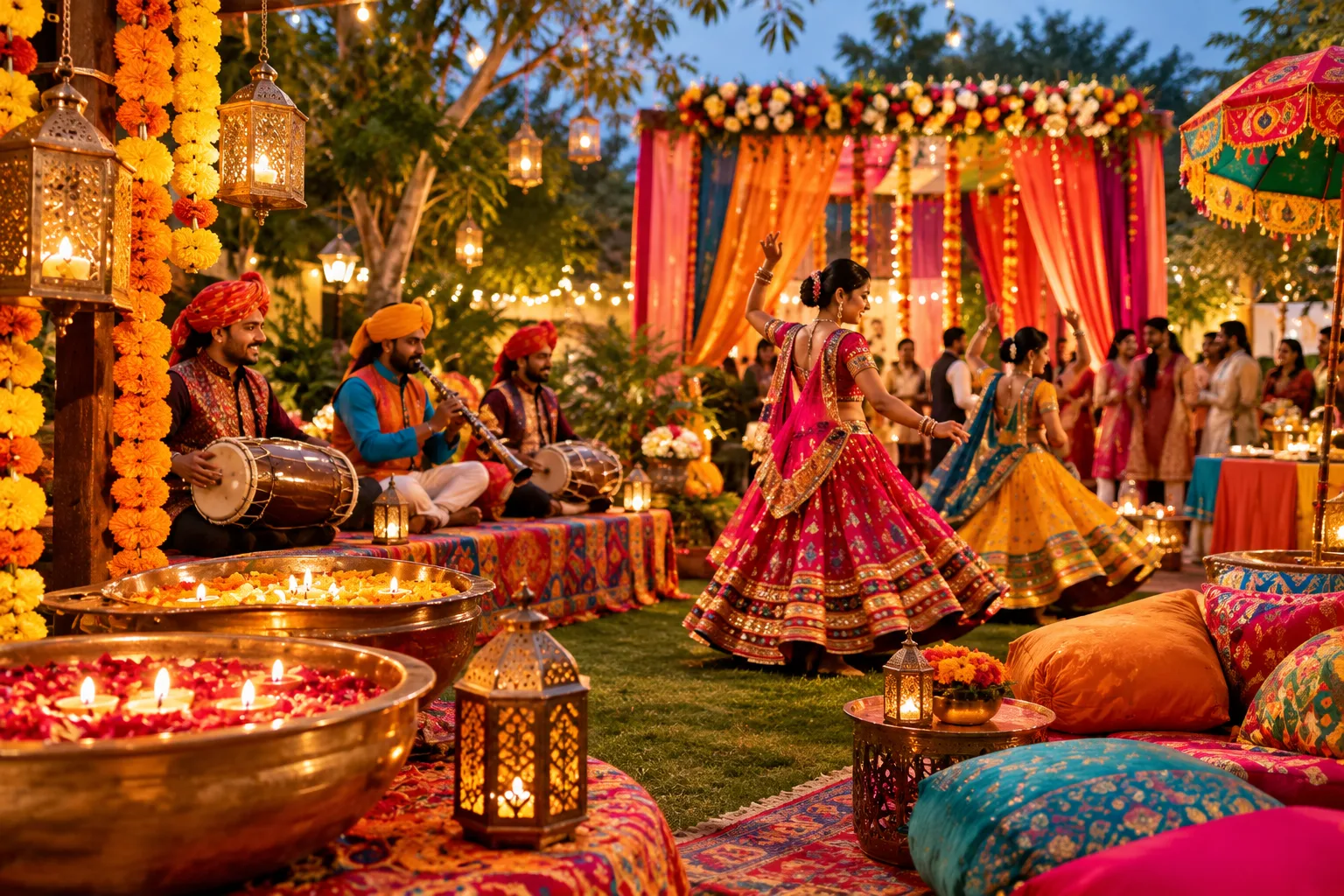
Close your eyes and think of Diwali, and the memory that surfaces first is rarely a single object. It's a blur of sensations - the crackle of diyas being lit one after another, the smell of fresh marigold garlands mixing with incense, the distant thump of dhol drums announcing that celebration has officially begun. Indian festivals have never been quiet, understated affairs. They are full-body experiences, built on colour, rhythm and ritual layered so thickly together that they seem to seep into memory rather than simply pass through it. Designing a festival celebration today means trying to recreate that same layered magic - not as a performance for guests to watch, but as a world for them to step into.
This is precisely the shift happening in how families, communities and organisations approach festival celebrations now. Choosing the right festival event venue has become less about square footage and more about atmosphere – about finding a space capable of holding colour, sound and sacred ritual all at once, without any of it feeling diluted. Ambrosia Palace has built its festival hosting philosophy around this exact idea: that a Navratri night, a Diwali gathering, or a Holi celebration deserves to feel less like an event and more like a homecoming to something ancestral.
Colour as the First Language of Celebration
Before a single note of music plays, colour has already begun telling the story. Every Indian festival carries its own unmistakable palette – the deep reds and golds of Diwali, symbolising prosperity and the triumph of light; the riotous, joyful chaos of Holi's pinks, yellows and greens; the nine vibrant hues of Navratri, each dedicated to a different form of the goddess across nine transformative nights. Designing an immersive festival space means treating these colours as sacred vocabulary rather than decorative choice.
At a well-designed festival celebration, colour doesn't stay confined to banners and backdrops. It moves through rangoli patterns stretching across entryways, through strings of marigold and rose woven into ceiling installations, through the deliberate choice of lighting that shifts from warm amber during Diwali to bold, saturated hues during Navratri. Ambrosia Palace's design teams often begin festival planning with colour first, building every other element of the celebration – seating, lighting, even menu presentation – around the emotional register a specific festival calls for.
Music That Moves Through the Body, Not Just the Room
If colour is the first language of an Indian festival, music is undoubtedly the second – and arguably the more urgent one. Few things unite a room faster than the first beats of a dhol during a Navratri garba circle, or the swelling strings of a bhajan during a Diwali puja. Music at these celebrations isn't background ambience; it's an invitation to participate, to move, to sing along even when the words are only half-remembered from childhood.
Immersive festival design increasingly treats sound as spatial rather than singular – live dhol players moving through the crowd rather than staying fixed on a stage, folk musicians performing acoustic sets near entrance areas to set the tone before guests even reach the main celebration space, and dedicated garba or dandiya zones where music builds in intensity as the night progresses. At festival celebrations hosted at Ambrosia Palace, sound design is treated with the same seriousness as lighting or décor, because a Navratri night without room to dance, or a Diwali evening without space for devotional music to breathe, loses something essential to what makes these nights unforgettable.
Ritual as the Emotional Anchor
Amid all the colour and music, it's easy to forget that most Indian festivals are, at their core, deeply spiritual occasions. A Diwali celebration without a proper Lakshmi puja corner, thoughtfully lit and treated with reverence, feels incomplete no matter how elaborate the rest of the décor. A Navratri celebration needs space for the aarti to happen without interruption, a moment where music pauses and the room turns, almost instinctively, toward devotion.
Designing around ritual means protecting these moments rather than rushing past them for the sake of entertainment. It means building in quiet corners for prayer even within a large, lively festival event venue, ensuring that grandparents lighting diyas for the family puja feel just as considered as younger guests waiting for the dance floor to open. This balance – between celebration and sanctity – is often what separates a festival gathering that feels authentic from one that feels like a party wearing festival decorations as a costume.
Food, Fragrance and the Memory of Home
No immersive festival experience is complete without food that carries its own emotional weight – the specific sweetness of gujiya during Holi, the richness of kaju katli boxes exchanged during Diwali, the comforting spread of faral that appears without fail during Navratri fasting breaks. Live counters preparing these delicacies fresh, filling the air with familiar aromas, do as much to transport guests back to childhood memories as any decorative element could. Fragrance, in fact, often becomes the most powerful and least discussed design tool – the smell of ghee-laden sweets or fresh marigold can pull a guest back to their grandmother's kitchen faster than any visual cue ever could.
A Celebration That Feels Like Belonging
What makes Indian festivals so emotionally resonant isn't any single element – not the colour, not the music, not even the ritual on its own. It's the way all of these things converge to create a feeling that's difficult to name but instantly recognisable: belonging. A well-designed festival celebration doesn't just entertain guests for an evening; it reminds them, even briefly, of exactly who they are and where they come from.
This is the quiet intention behind every festival hosted at Ambrosia Palace – to build not just an event, but an experience layered with enough colour, sound and sincerity that guests leave feeling like they've touched something ancestral. Because in the end, the truest measure of a festival celebration isn't how beautiful the photographs turn out. It's whether, for just a few hours, a room full of people felt completely, unmistakably at home.