
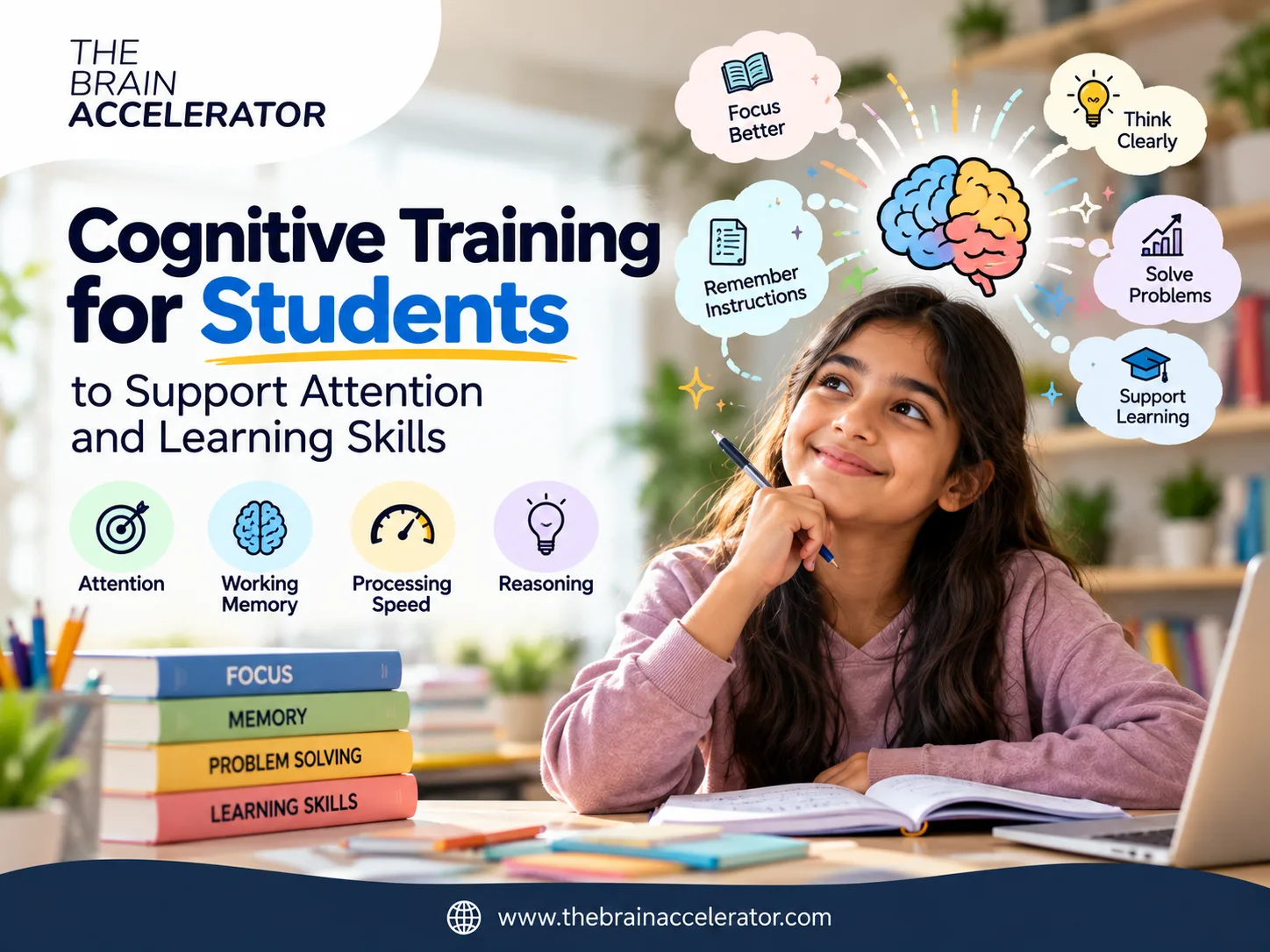
Students rely on several cognitive skills when listening to lessons, remembering instructions, understanding information, and solving problems. These skills include attention, working memory, processing speed, and reasoning. Cognitive training for students involves structured activities designed to practise specific thinking skills used in everyday learning.
Understanding these skills can help parents and educators identify areas where students may benefit from additional practice or support.
What Cognitive Skills Do Students Use?
Different cognitive skills contribute to classroom activities and independent study.
- Attention: Helps students focus on instructions and relevant information.
- Working memory: Helps students hold and use information while completing a task.
- Processing speed: Relates to how efficiently information is processed.
- Reasoning: Helps students recognise patterns, understand relationships, and approach unfamiliar problems.
These skills work together during learning. A student’s difficulties may have different causes, so it is important to consider their individual needs rather than assume that every learning challenge is the same.
5 Cognitive Training Exercises for Students
1. Organise Lesson Information
After a lesson, ask students to arrange their notes under headings, key points, and supporting details. They can also create a mind map showing connections between ideas. This activity encourages them to identify and organise relevant information.
2. Practise Focused Reading
Ask students to read a short passage and identify its main idea and supporting details. Older students can compare two viewpoints or explain how an author reaches a conclusion. These tasks involve attention, comprehension, and reasoning.
3. Recall Important Information
After a lesson, ask students to recall three important points without looking at their notes. They can then check their answers and fill in missing information. This activity provides practice in retrieving and organising what they have learned.
4. Try Sorting and Classification Tasks
Provide a group of words, numbers, or pictures and ask students to sort them according to a rule. Then introduce a different rule and ask them to reorganise the items. This encourages attention to detail and flexible thinking.
5. Solve Problems Step by Step
When working on a maths question or another challenging task, ask students to explain each step. Encourage them to identify the problem, choose an approach, and review their answer. This makes their reasoning process more organised and easier to evaluate.
These cognitive training exercises can be adapted to suit different ages, subjects, and levels of difficulty.
How Can Students Use Cognitive Skills in Schoolwork?
Students use attention when listening to lessons, working memory when following instructions, and reasoning when tackling unfamiliar questions. Processing speed also relates to how efficiently they work with information.
Age-appropriate cognitive development exercises can be included in classroom routines, revision sessions, and homework. Brain training for students may include structured activities that practise particular cognitive skills.
For younger learners, brain training activities for kids might include sequencing, sorting, and recall tasks. Older students may try more complex brain exercises for teens, such as planning assignments, comparing information, and explaining different approaches to a problem.
The Brain Accelerator offers structured cognitive training programmes focused on skills such as attention, working memory, processing speed, and reasoning. Students and parents can explore its cognitive training programmes to learn more.
Practising a particular activity does not guarantee improvements across every academic subject. Activities should be selected according to the student’s needs, and progress should be considered within their wider learning experience.
When Might a Student Need Additional Support?
Some students regularly forget instructions, struggle to maintain attention, or find it difficult to complete assignments. If these difficulties persist and affect everyday learning, parents can discuss their observations with teachers.
Where appropriate, a qualified professional can help determine whether further assessment or support may be useful. Identifying the specific difficulty is more helpful than assuming that every student needs the same type of training.
Conclusion
Cognitive skills are involved in how students process information, remember instructions, and approach schoolwork. Organising notes, recalling lesson information, focused reading, sorting activities, and step-by-step problem-solving provide practical opportunities to practise these skills.
Choose activities that suit the student’s age and needs. If persistent difficulties interfere with schoolwork, consider discussing appropriate support options with teachers or a qualified professional.
Frequently Asked Questions
What is cognitive training for students?
Cognitive training involves structured activities designed to practise skills such as attention, working memory, processing speed, and reasoning.
Which activities help students practise cognitive skills?
Organising notes, recalling lesson information, focused reading, sorting tasks, and step-by-step problem-solving are useful examples.
Is cognitive training suitable for teenagers?
Activities can be adapted for teenagers through more complex reasoning, planning, information analysis, and problem-solving tasks.
Does cognitive training guarantee better academic results?
No. Outcomes vary between students, and practising cognitive skills does not guarantee better grades or improved performance in every subject.
When should parents consider additional learning support?
If a student consistently struggles with attention, remembering instructions, processing information, or completing assignments, parents can discuss their concerns with teachers or a qualified professional.