Every business starts somewhere. For most, that somewhere is shared hosting — cheap, simple, and good enough for a site that's just getting started. The problem isn't starting there. The problem is staying there long after your business has outgrown it.
Cloud hosting vs shared hosting is a comparison that matters more at the growth stage than the launch stage. Understanding the difference between the two—not just in price, but in performance, reliability, and scalability—is what separates businesses that grow smoothly from ones that rebuild their infrastructure under pressure.
What Is Shared Hosting?
Shared hosting puts your website on a physical server alongside dozens—sometimes hundreds — of other websites. Everyone shares the same CPU, RAM, storage, and bandwidth. The hosting provider manages the infrastructure; you manage your site.
Shared hosting benefits are real and shouldn't be dismissed. It's genuinely affordable; shared hosting pricing typically runs between $3 and $15 per month, making it accessible for businesses that are just starting out or running low-traffic informational sites. Setup is simple, management is minimal, and the technical barrier to entry is low.
For a personal blog, a local business brochure site, or a side project with modest traffic, shared hosting is entirely appropriate. The economics make sense and the limitations don't matter at that scale.
What Is Cloud Hosting?
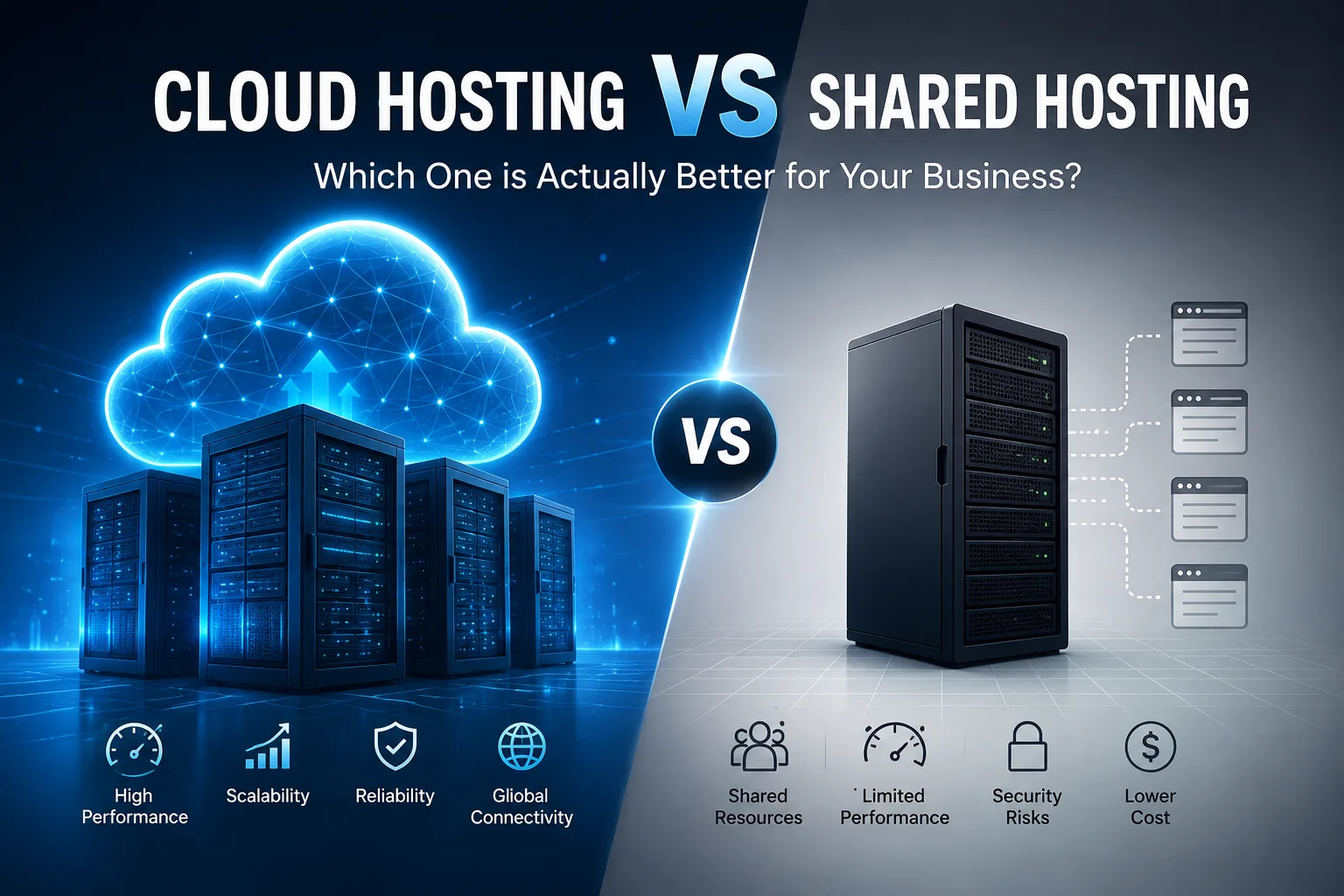
Cloud hosting generally distributes your big site across a fully dedicated network of several interconnected servers instead of a single shared machine. Resources are virtualised, redundant, and elastic—meaning they scale with your demand rather than capping at a fixed allocation.
The difference between cloud hosting and shared hosting is architectural. Shared hosting is one physical server, many tenants, fixed resources. Cloud hosting is distributed infrastructure, isolated resources, and the ability to expand capacity without migrating to a new environment.
Cloud hosting benefits consist of advanced performance, built-in redundancy, and cloud hosting scalability that supports traffic growth without the manual interventions that shared environments need. You're not waiting for a plan upgrade or a migration window — resources expand as your site needs them.
Performance: Cloud vs Shared Hosting
This is where cloud vs shared hosting separates most visibly for end users.
On shared hosting, your site's performance is directly affected by what other tenants on the same server are doing. A neighbouring site experiencing a traffic spike consumes shared resources—CPU, RAM, I/O bandwidth—and your site slows down as a consequence. You have no control over this, no visibility into it, and no recourse beyond contacting support after the fact.
Cloud hosting eliminates the noisy-neighbour problem. Your resources are isolated. What happens on other parts of the infrastructure doesn't affect your performance. Response times are consistent because your allocation is consistent.
For e-commerce sites, service businesses where the website is a primary sales channel, or any site where performance directly affects conversion rates, the difference between cloud hosting and shared hosting on this dimension alone often justifies the switch.
Shared Hosting Limitations You'll Eventually Hit
Shared hosting limitations aren't theoretical — they're thresholds that traffic growth makes inevitable.
Traffic limits — most shared hosting plans cap your monthly visitors or bandwidth. Exceed the limit and your site gets throttled or suspended. The timing is usually the worst possible moment: when a campaign performs well, when a press mention lands, when your product goes viral.
Security exposure—sharing server infrastructure with hundreds of other sites means a security vulnerability on one site can affect others. Shared hosting environments have a larger attack surface by nature, and the hosting provider's security posture is your security posture whether you choose it or not.
Limited configuration—shared hosting usually limits what you can install, modify, etc. If your application requires specific PHP versions, custom server software, or non-standard configurations, shared hosting frequently can't accommodate it.
Cloud Hosting Scalability vs Shared Hosting Caps
Cloud hosting scalability is the characteristic that matters most as businesses grow. The ability to handle a 5x traffic spike without manual intervention, without a support ticket, and without downtime is what keeps growing businesses from infrastructure-related crises.
Shared hosting vs cloud hosting on this dimension is a ceiling vs no ceiling. Shared hosting has a hard limit baked into the infrastructure. Cloud hosting has an elastic limit that expands with demand — automatically, in most cases, without your team needing to do anything.
For best hosting for a small business that's actively growing—a business that added 30% more customers last year and expects similar growth next year—cloud hosting is the more sensible foundation even if shared hosting costs less today. The migration cost when you eventually outgrow shared hosting is always higher than starting on cloud from the right moment.
Pricing: Shared Hosting vs Cloud Hosting
Shared hosting pricing wins on headline cost. There's no disputing that $5/month is cheaper than $20–$40/month for entry-level cloud hosting.
The honest comparison adds a few columns to that calculation. What's the cost of downtime during a traffic spike? What's the cost of migration when you outgrow shared hosting? What's the cost of slower page load times on conversion rates over six months?
Infinitive Host positions cloud hosting at pricing that's competitive for what you're getting — reliable infrastructure, scalable resources, and managed options that remove the operational burden from your team. When you factor total cost rather than sticker price, the gap between cloud hosting vs shared hosting narrows considerably.
Shared hosting benefits make it the right starting point for many businesses. It's the right starting point—not the right permanent home.
Which Is Better for Your Business?
The cloud vs shared hosting decision comes down to where your business is and where it's heading.
Go for shared hosting if: you are launching a new website with modest traffic expectations, you are just running a low-traffic informational website, or budget constraints are the key constraint and growth is not imminent.
Choose cloud hosting if: your business is actively growing, your site is a primary revenue channel, you've experienced performance problems on shared hosting, or you need reliability that shared infrastructure can't guarantee.
For best hosting for small businesses with growth ambitions — which covers most businesses reading a comparison like this—cloud hosting is the right foundation. The cloud hosting benefits of scalability, performance, and reliability compound over time in ways that shared hosting limitations actively prevent.
Infinitive Host offers both—honest shared hosting pricing for businesses at the right stage, and cloud hosting built for the stage after that. The switch between them is straightforward on the same platform, which means you're not locked into a decision that doesn't fit a year from now.
Conclusion
Cloud hosting vs shared hosting is ultimately a question about what your business needs today versus what it will need as it grows. Shared hosting is cheap, simple, and appropriate for early-stage or low-traffic sites. Cloud hosting is reliable, scalable, and appropriate for businesses where the website actually matters to revenue.
Infinitive Host makes both options available with transparent pricing and a clear path between them. Start where your business is. Build on infrastructure that can go where your business is heading. And don't let shared hosting vs cloud hosting inertia keep you on a platform that your business has already outgrown.