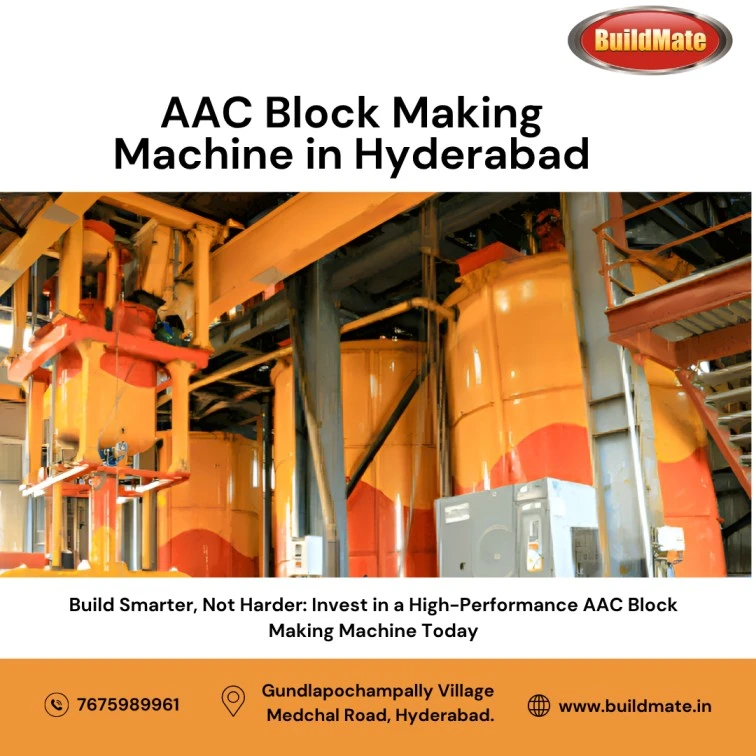
As the demand for AAC Blocks (Autoclaved Aerated Concrete blocks) grows across residential, commercial, and industrial construction sectors, entrepreneurs and builders are increasingly investing in AAC Block Plants. Central to the success of these plants is choosing the right AAC Block Machinery. One key decision that impacts your production flexibility, capacity, and operational efficiency is selecting between stationary and mobile AAC Block Making Machines.
In this article, we help you compare these two types of AAC Machines so you can make an informed choice that suits your business goals and budget.
What Are AAC Blocks?
AAC Blocks in India are known for their lightweight, thermal insulation, and eco-friendly properties. Manufactured using fly ash, lime, cement, and aluminum powder, these blocks are produced in specialized AAC Plants using advanced AAC Plant Machinery.
Whether you’re setting up a Small AAC block plant or a large-scale facility, understanding your machinery options is essential.
Stationary AAC Block Making Machines: An Overview
Stationary AAC Machines are fixed installations designed for continuous, high-capacity production. These machines form the core of permanent AAC Block Plants and are best suited for:
- Large-scale commercial production
- Consistent supply to urban construction projects
- Long-term manufacturing operations
Advantages:
- High production volumes
- Full-scale automation and precision
- Lower long-term AAC block plant cost per unit
- Easy integration with silos, conveyors, and autoclaves
Disadvantages:
- Requires significant upfront investment
- Fixed location – relocation is costly and complex
- Needs substantial land and infrastructure
Stationary AAC Plant Machine setups are ideal for manufacturers focused on supplying AAC Blocks consistently to large markets.
Mobile AAC Block Making Machines: A New-Age Solution
Mobile AAC Machines are compact and semi-portable solutions designed for flexibility and modular setups. These are growing in popularity among small-scale producers and startups.
Benefits:
- Flexibility to relocate near construction sites
- Lower initial AAC block plant cost
- Quick setup and dismantling
- Suitable for on-demand, localized block production
Limitations:
- Limited production capacity compared to stationary systems
- Requires manual processes in some stages
- May lack advanced automation
Mobile AAC Block Plants are excellent for temporary or project-specific needs, especially in rural areas or for infrastructure contractors.
Key Comparison Factors
Criteria
Stationary AAC Machine
Mobile AAC Machine
Production Capacity
High (Ideal for large-scale production)
Moderate to low (Ideal for small batches)
Automation Level
Fully automated
Semi-automated to manual
Setup Cost
Higher (Capital-intensive investment)
Lower (Affordable for startups)
Operational Flexibility
Fixed location
Relocatable and modular
Manpower Requirement
Minimal (automation reduces labor)
Higher (due to manual processes)
Ideal For
Long-term urban production plants
Remote projects, small AAC block plants
AAC Block Plant Cost Considerations
Whether you’re setting up a Small AAC block plant or an industrial facility, your choice between stationary and mobile systems will impact your overall AAC Block Plant Cost. While stationary systems are more expensive initially, they offer greater scalability and lower per-block production costs. Mobile systems require less investment upfront but may have higher operating costs over time due to manual processes.
Consulting reputed AAC Plant Suppliers can help assess your production goals, raw material availability, and market demand to select the optimal setup.
Ideal Scenarios
- Choose Stationary AAC Machines if:
- You’re serving large-scale projects, have consistent demand, and want a long-term production facility with automated operations.
- Choose Mobile AAC Machines if:
- You need on-site production capabilities, operate in remote areas, or wish to start a Small AAC block plant before scaling up.
Conclusion
Both stationary and mobile AAC Block Making Machines have their unique strengths. Your choice should depend on your project scale, operational goals, budget, and long-term growth strategy. For quality production and reliable equipment, working with experienced AAC Plant Suppliers ensures you get machinery tailored to your needs.
If you're planning to invest in AAC Block Plants, whether stationary or mobile, explore advanced solutions from Buildmate. As one of India’s leading manufacturers of AAC Block Machinery and AAC Plant Machinery, Buildmate offers complete, turnkey solutions—including plant setup, machinery supply, and technical support—to help businesses establish efficient, high-output AAC production units across India and beyond.