Every owner has been tempted by the cheaper quote. One supplier is a few dollars under the rest, the saving looks obvious, and the order goes in. Then, a few months later, the fitted sheets are thinning at the corners, the whites have turned dull, and housekeeping is quietly binning stock that was barely paid off.
The price on the invoice is only the start of what linen costs you. The number that actually matters is what each sheet costs per wash, and that changes how you compare linen suppliers Australia wide. A sheet that survives twice as many cycles isn’t twice the price. It’s half the cost. Here’s how to think about it, and what to check before your next order.
The real cost of a sheet
Divide what you pay for a sheet by the number of washes it lasts. That’s your cost per use, and it’s the only fair way to compare two products.
Take a queen fitted sheet at $63.95. If it lasts 100 washes, you’re paying about 64 cents each time it goes through the laundry. If a cheaper sheet at $45 gives up after 50, that’s 90 cents a wash, and you’ve also paid for replacement, freight and the time spent reordering. These figures are only an illustration, because yours will depend on your laundry and how hard the linen is worked. But the pattern holds in nearly every property: the lower price tag is rarely the lower cost.
Most owners never run this calculation, because the purchase price is right there and the wash count isn’t. It’s worth doing once, with your own numbers, before you approve the next order.
Where cheap linen lets you down
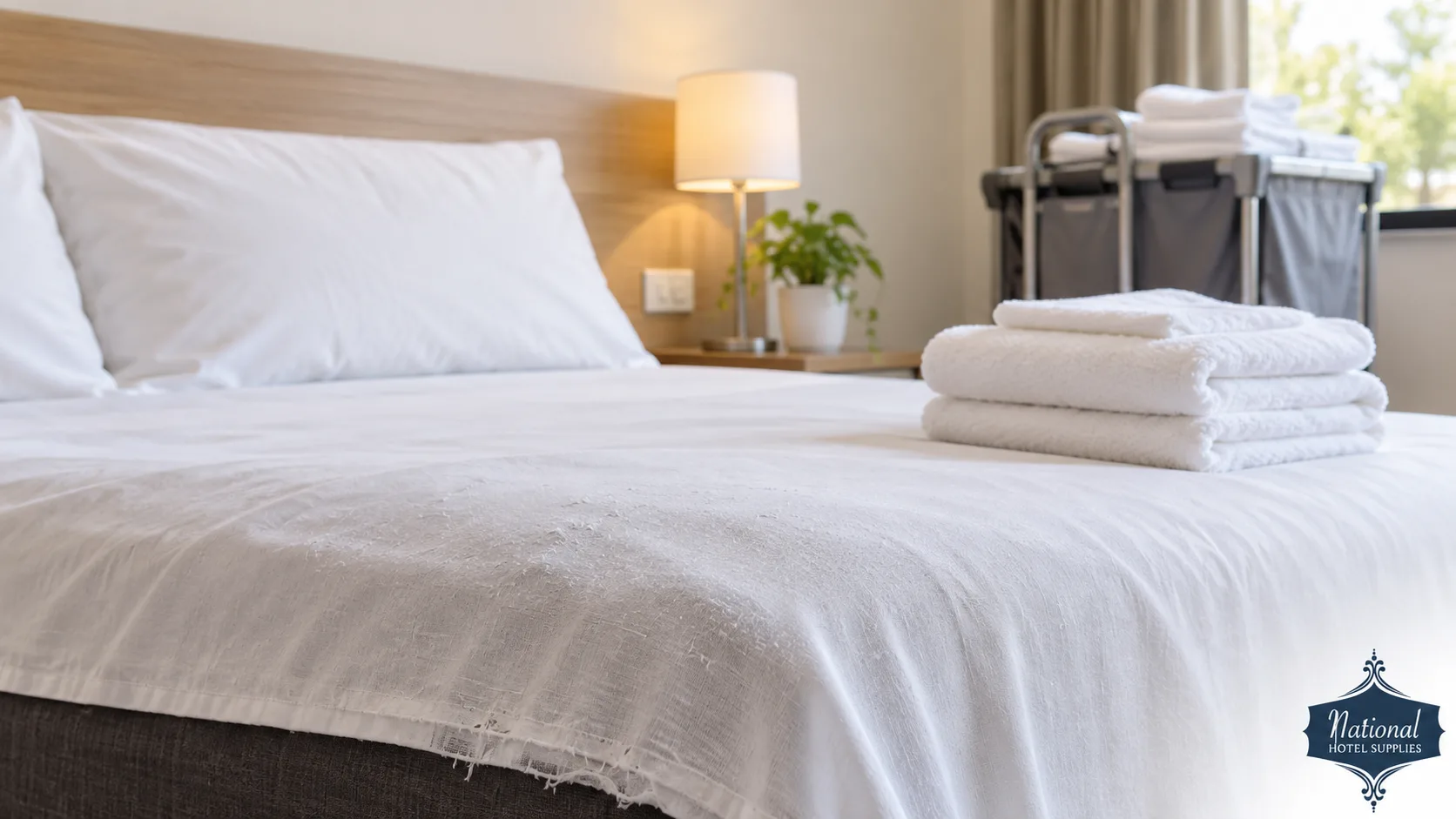
It wears in the wrong places. Fitted sheets take the worst of it, stretched over mattress corners and pulled off hard at every turnover. Low-grade fabric thins or splits at exactly those points, and one bad corner retires the whole sheet.
It looks old before it is. Guests have no idea how many washes a sheet has had. They see dull colour, bobbling, or a stain that never fully lifted. A clean bed that looks tired still drags down the room.
It slows your team. Sheets that crease badly or don’t fit the mattress properly take longer to make up. Over a full week across a few dozen rooms, those extra minutes turn into real wages.
It doesn’t come back the same. Budget ranges change fabric and sizing often. When you reorder, the new batch doesn’t quite match the old one, and mismatched linen in a single room is the kind of detail that ends up in reviews.
For a property relying on motel linen supplies, this matters even more. Turnover is high, margins are tight, and there’s no room in the budget for linen that has to be replaced twice a year.
What “commercial” actually means
There’s a real difference between commercial bed linen Australia properties can depend on and retail bedding sold in bulk. Retail sheets are made to look good in a shop and feel nice at home. Commercial linen is made for hot washes, strong detergents, heavy extraction, fast drying and daily changeovers.
That shows up in how it’s made. The fabric holds its shape, resists pilling and keeps its colour through cycle after cycle. Sizing is also consistent, so a queen fitted sheet fits a commercial queen mattress the same way every time, which is what lets housekeeping work fast.
Here’s a quick test when comparing products: does the listing tell you the fabric content and the exact sizes? If it doesn’t, keep looking. A proper hotel linen supplier will be specific about both, because they know you’ll be buying the same thing again.
Choosing between 50/50 and 100% cotton
Once you’ve decided to buy proper commercial stock, the next decision is fabric. The Actil range gives you two options.
The 50/50 poly-cotton blend is the workhorse. The polyester helps it resist wrinkling, dry quickly and keep its shape through frequent hot washing. For busy motels, and for properties that send linen to an outside laundry, it usually offers the best balance of durability and cost per wash. It also needs less ironing, which saves housekeeping time.
The 100% cotton range has the softer, more breathable feel many guests link with a higher-end stay. It suits boutique hotels, lodges and serviced apartments where the bed is part of the experience. Cotton is a little more particular about how it’s laundered, but for the right property it’s worth it.
Neither is better in every situation. Plenty of owners use cotton in premium rooms and the blend in standard rooms, which works because sizing is consistent across the range. The point is to choose the fabric to suit your laundry and your guests, not just the price.
Treat linen as a system
Linen lasts longest when it’s managed, not just bought. A few habits that protect your investment:
- Hold three sets per bed. One on the bed, one in the wash, one on the shelf. Properties using an off-site laundry often move to four.
- Rotate evenly, so your best sets aren’t doing all the work.
- Count fitted sheets and pillowcases a little higher. They wear fastest and need the biggest buffer.
- Stick to one range, so sizes and finish match across every room.
- Retire linen on schedule. Moving tired sheets to back-of-house use keeps guest rooms looking sharp.
None of this costs extra. It simply makes every dollar of linen work harder, and it’s the difference between replacing stock gradually and re-outfitting a whole property at once.
Sizes that suit Australian rooms
Sizing is half the battle with commercial bed linen Australia wide. The Actil Commercial collection covers single, king single, long/zip single, double, queen and king. You’ll find flat sheets, fitted sheets, complete standard sheet sets and pillowcases in standard and king, plus white doona covers in the 50/50 line.
That’s the spread most motels, hotels and serviced apartments actually run, so you can cover all your motel linen supplies from one range. Buying individual pieces gives you flexibility to restock fitted sheets as they wear. Buying sets keeps things simple for smaller properties that just want to order and make beds. Either way, everything is cut for commercial beds, not scaled-down retail products.
One supplier for the whole bed
Sheets are only one layer. Pillows, protectors, doona inserts and covers all wear at different rates and all change how the bed looks and feels. Working with one hotel bedding supplier means everything is sized to work together, and reordering is one conversation rather than five.
It’s also worth asking who you’re dealing with. National Hotel Supplies is an Australian owned, family run business supplying the accommodation industry Australia wide. Alongside the Actil range you can order towelling, bathrobes, pillows, mattress protectors and guest amenities through the same account. Many hotel bedding suppliers only cover part of the room, which leaves you chasing the rest elsewhere.
When you shortlist linen suppliers Australia has available, ask whether the product will still be there next year. A reliable hotel linen supplier keeps ranges consistent, and that’s what keeps rooms uniform and costs predictable. It’s the same test for any hotel bedding supplier you’re considering: can you buy exactly this again in twelve months?
Before you place your next order
Before you approve the next linen purchase, ask three things. How many washes will this realistically last in my laundry? Will it still look good in a guest room at the end of its life? Can I get exactly the same thing again when I need to top up?
If the answers are solid, the slightly higher price is almost always the cheaper decision.
Browse the Actil Commercial range above, filter by bed size, and compare the 50/50 and 100% cotton options. If you’re fitting out a new property or planning a larger order, our team can help you work out quantities. Whether you’re sourcing commercial bed linen Australia wide for several sites, or topping up one motel before peak season, it’s easier to start with a range that’s built for the job.
The best linen suppliers Australia has to offer are the ones that help you spend less over time, not just less today. Compare a few hotel bedding suppliers, ask the questions above, and the difference shows up quickly.