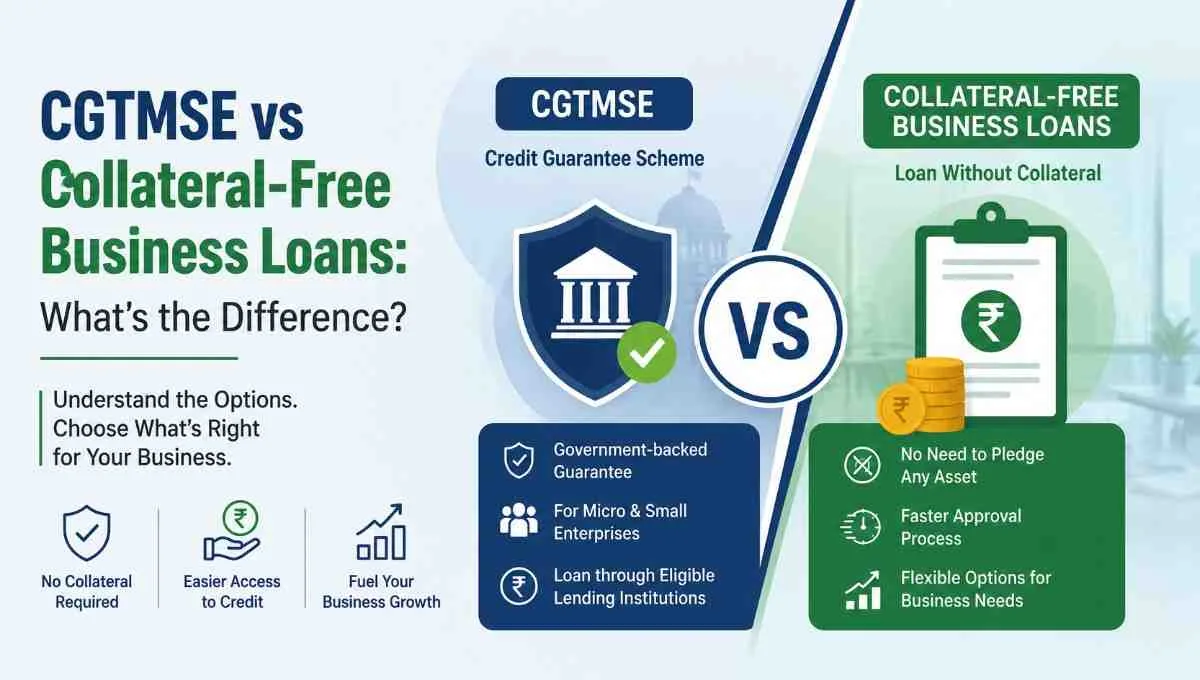
For many MSMEs, getting business funding without pledging property or other assets can be difficult. Collateral free loans offer one way to access funds without putting an asset up as security. CGTMSE-backed loans are another option that can help eligible Micro and Small Enterprises get credit without traditional collateral.
But CGTMSE and collateral-free business loans are not the same.
CGTMSE is a credit guarantee scheme, while a collateral-free business loan is a type of loan that does not require collateral. Knowing the difference can help MSMEs compare financing options based on their funding needs.
What is CGTMSE?
CGTMSE stands for Credit Guarantee Fund Trust for Micro and Small Enterprises. It was established by the Government of India and SIDBI to support access to institutional credit for eligible Micro and Small Enterprises.
CGTMSE does not provide loans directly to businesses. Instead, it provides credit guarantee cover to eligible Member Lending Institutions (MLIs), including banks and other eligible financial institutions.
An MSME applies for a loan through a participating lender. The lender assesses the business, financial position, creditworthiness and repayment capacity. If the loan meets the applicable CGTMSE requirements, the lender can obtain guarantee coverage under the scheme.
Under the current CGTMSE Credit Guarantee Scheme, eligible credit facilities can be covered up to ₹10 crore per eligible borrower, subject to the applicable conditions.
What is a Collateral-Free Business Loan?
A collateral-free business loan is a loan where the borrower does not have to pledge property, machinery, fixed deposits or another asset as security.
Banks, NBFCs and other lenders may assess the application based on factors such as:
- Business turnover
- Credit history
- Banking transactions
- Profitability
- Business vintage
- Existing liabilities
- Cash flow
- Repayment capacity
The loan amount, interest rate, tenure and eligibility criteria depend on the lender.
Simply put, collateral-free describes a loan product, whereas CGTMSE is a credit guarantee mechanism that can support eligible loans.
CGTMSE vs Collateral-Free Business Loans: Key Differences
1. What do they represent?
CGTMSE:
It is a credit guarantee scheme that supports eligible credit facilities provided by participating lenders to eligible Micro and Small Enterprises.
Collateral-free business loan:
It is a loan facility that does not require the borrower to provide collateral.
2. Who provides the money?
CGTMSE does not disburse money to MSMEs. The loan comes from an eligible lending institution, while CGTMSE provides guarantee support to the lender as per the scheme.
In the case of a regular collateral-free loan, the bank, NBFC or other lender directly provides the funds.
3. Is collateral required?
Eligible facilities under the CGTMSE Credit Guarantee Scheme can be covered without collateral security and third-party guarantees, subject to scheme conditions.
CGTMSE also has a Hybrid Security product, where collateral can be taken for part of the facility and the remaining eligible portion can receive guarantee cover.
A regular collateral-free loan does not require collateral by definition. However, the lender may have other requirements, such as personal guarantees or additional documentation.
4. Who can apply?
CGTMSE is mainly intended for eligible Micro and Small Enterprises that meet the applicable scheme conditions. The lender and type of credit facility must also qualify.
For a regular collateral-free business loan, eligibility depends on the lender. Different banks and NBFCs may have different requirements related to turnover, credit history, business age and repayment capacity.
5. Who approves the loan?
The lending institution makes the lending decision in both cases.
CGTMSE does not approve loans directly. The lender evaluates the MSME and decides whether to sanction the facility.
6. Does CGTMSE cover the entire loan?
No.
CGTMSE guarantee coverage is based on the applicable percentage and borrower category. For many categories, coverage may be 75%, while higher coverage can apply to certain eligible categories.
Therefore, businesses should not assume that CGTMSE provides a 100% guarantee for the loan amount.
7. Is every collateral-free loan covered by CGTMSE?
No.
A lender can offer a collateral-free business loan under its own lending policy without CGTMSE coverage.
This is why MSMEs should confirm whether a particular loan is actually covered by CGTMSE instead of assuming that every collateral-free loan has government guarantee support.
How Does a CGTMSE-Backed Loan Work?
The process generally takes place through the lender.
- Approach an eligible lender: The MSME applies to a participating Member Lending Institution.
- Submit the application: The business provides financial, business and KYC documents.
- Credit assessment: The lender checks the business, repayment capacity and loan proposal.
- Loan sanction: If the application meets the lender's requirements, the credit facility is sanctioned.
- Guarantee coverage: Where applicable, the lender completes the process for obtaining CGTMSE guarantee coverage.
The borrower still has to repay the loan according to the agreed terms. CGTMSE does not remove the borrower's repayment obligation.
How Does a Collateral-Free Business Loan Work?
The process varies by lender but usually involves:
- Selecting a suitable lender.
- Submitting the loan application and documents.
- Providing business and financial information.
- Credit assessment by the lender.
- Loan approval based on eligibility and repayment capacity.
- Disbursal after completing the required formalities.
- Repayment through the agreed schedule.
Unlike CGTMSE-backed financing, a regular collateral-free loan does not need to have a government credit guarantee attached to it.
Similarities Between CGTMSE and Collateral-Free Loans
Although they are different, both options can help MSMEs that do not want to pledge traditional assets.
Reduced need for collateral
Eligible CGTMSE facilities can be provided without collateral security, subject to scheme conditions. Collateral-free loans are also designed without collateral.
This can be useful for businesses that have limited assets but need access to formal finance.
Support different business needs
Depending on the lender and loan product, funds may be used for:
- Working capital
- Inventory
- Equipment
- Business expansion
- Operating expenses
- Other eligible business requirements
Repayment is still required
Neither option means free money. The borrower remains responsible for repaying the principal, interest and applicable charges according to the loan agreement.
Important Points MSMEs Should Know
CGTMSE is not a loan provider
This is the biggest difference to remember. CGTMSE does not lend money directly to MSMEs. It provides guarantee support to eligible lending institutions.
Not every MSME automatically qualifies
Businesses must meet the applicable CGTMSE conditions, while the lender also has its own credit assessment and eligibility requirements.
CGTMSE does not guarantee a lower interest rate
The interest rate is determined by the lending institution according to its lending policy and applicable regulatory requirements. A CGTMSE-backed loan does not automatically mean cheaper borrowing.
Guarantee fees may apply
CGTMSE follows an Annual Guarantee Fee structure. Whether the lender passes this cost to the borrower depends on the Member Lending Institution.
Therefore, borrowers should check all applicable charges before accepting the loan.
Benefits of CGTMSE-Backed Financing
For eligible MSMEs, CGTMSE-backed financing can offer several advantages:
- Less dependence on collateral: Eligible facilities can be covered without traditional collateral and third-party guarantees, subject to scheme conditions.
- Access to institutional credit: The scheme supports lending to Micro and Small Enterprises through eligible financial institutions.
- Higher eligible credit limit: Eligible credit facilities can receive coverage up to ₹10 crore per borrower, subject to applicable conditions.
- Working capital and term finance: Eligible working capital and term loan facilities can be covered under the scheme.
Benefits of Collateral-Free Business Loans
Regular collateral-free business loans can also be useful when an MSME needs funds without pledging assets.
No asset pledge
Businesses can access financing without putting property or other assets up as security.
More lending options
MSMEs can compare products from banks, NBFCs and other lenders based on their funding requirements.
Flexible business uses
Depending on the product, funds may be available for working capital, inventory, expansion, equipment and other business needs.
Digital application options
Some lenders offer online application and credit assessment processes, which may make borrowing more convenient. Approval time depends on the lender and the borrower's profile.
Which is Better: CGTMSE or a Collateral-Free Loan?
There is no single answer for every business.
A CGTMSE-backed loan may suit an eligible Micro or Small Enterprise looking for institutional credit without traditional collateral.
A regular collateral-free loan may be suitable when a business meets a lender's unsecured lending criteria and finds better pricing, repayment terms or processing timelines.
Before choosing, compare:
- Loan amount
- Purpose of funding
- Interest rate
- Processing fee
- Loan tenure
- Repayment schedule
- Prepayment charges
- Other fees
- Business eligibility
- Credit history
- Repayment capacity
- Collateral requirements
- CGTMSE coverage, where applicable
The key is to compare the complete cost and terms instead of choosing a loan only because it is advertised as "collateral-free."
CGTMSE vs Collateral-Free Business Loans: Final Takeaway
CGTMSE and collateral-free business loans are related but different.
CGTMSE is a credit guarantee scheme. A collateral-free business loan is a loan that does not require collateral.
CGTMSE helps eligible lending institutions provide qualifying credit facilities to eligible Micro and Small Enterprises without traditional collateral and third-party guarantees, subject to scheme conditions.
The lender still evaluates the business, decides whether to sanction the loan and determines the applicable loan terms.
For MSMEs, the key point is simple: CGTMSE is not a lender or loan provider. It is a credit guarantee mechanism that supports eligible loans provided by participating lenders.
Before taking any loan, compare the interest rate, fees, repayment period, loan amount, eligibility and other terms to find financing that fits the business's cash flow.