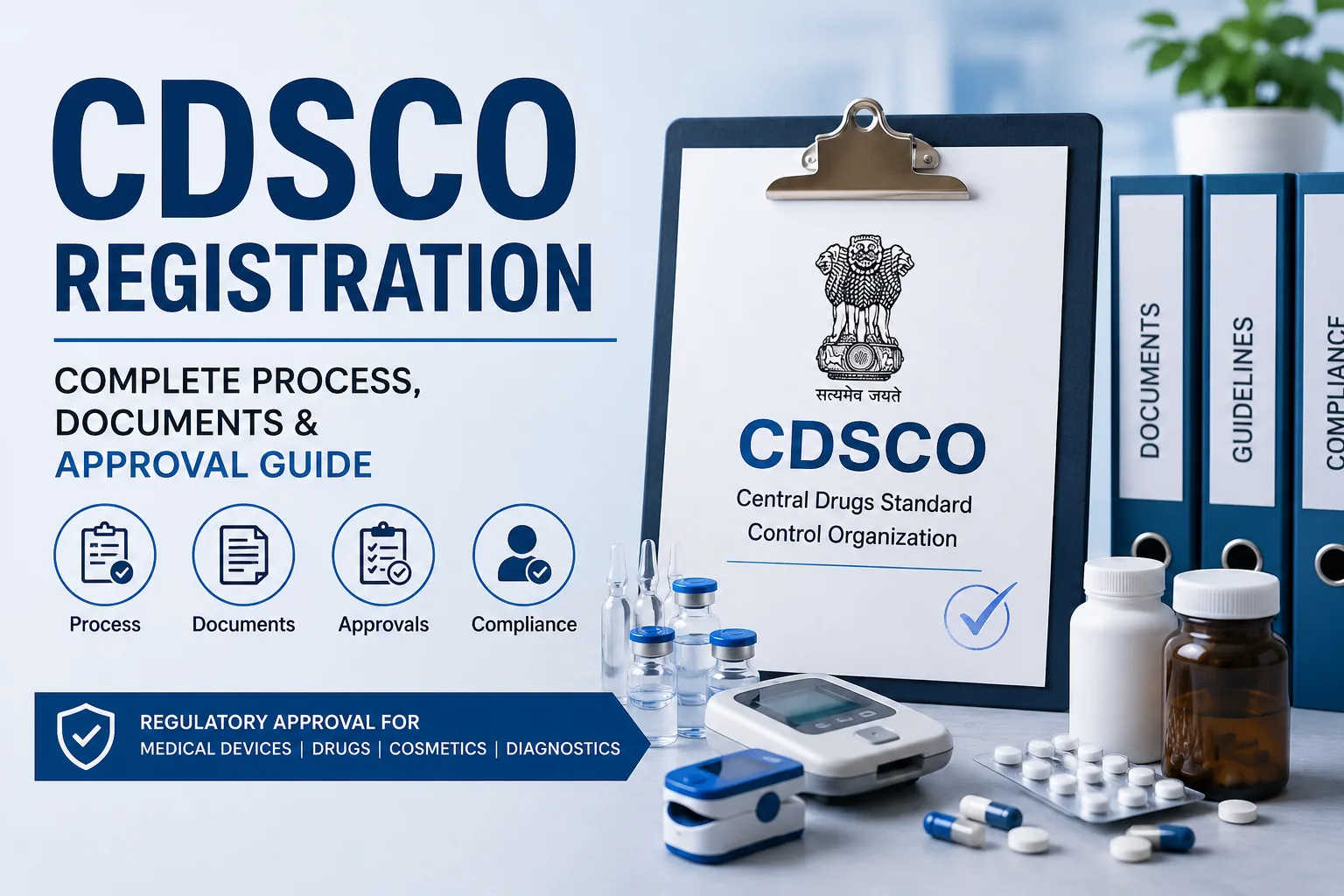
- DSCO registration is mandatory for regulated medical devices, drugs, cosmetics and diagnostics to be legally imported, manufactured or sold in India.
- The process is dependent on: product classification, risk category, application form, technical documents and licensing authority.
- Proper application reduces risk of query, customs delay, distributor rejection and regulatory penalties.
- How To Register With CDSCO India
Introduction
A medical device importer from Mumbai once contacted our compliance team after receiving interest from hospitals for a patient monitoring device. The product was technically sound, the pricing was competitive, and the supplier had already shipped samples. Still, the sales discussion stopped at one point: the hospital procurement team asked for valid CDSCO registration.
That is when the importer realised that product quality alone is not enough in India’s healthcare market.
In the case of medical devices, diagnostics, drugs, and cosmetics, getting the regulatory approval is not an afterthought document; rather, it determines the very existence of your product in terms of its importation, stocking, distribution, sale, and application in the market. Lack of regulatory approval may lead to shipment delays, tender cancellations, and disrupt your plans.
In this document, you will find out how to go about registering your products under CDSCO regulations in consultant-like language that is meant for business persons.
What Is CDSCO Registration?
CDSCO registration is the regulatory approval or licence required from the Central Drugs Standard Control Organization for applicable healthcare products in India.
It applies to categories such as:
- Medical devices
- In-vitro diagnostic devices
- Drugs
- Cosmetics
- New drugs
- Biological products
- Imported healthcare products
- Testing and evaluation products
Put simply, CDSCO registration demonstrates that the product has adhered to the Indian regulation path necessary. It will ensure that the product is deemed fit for the purpose, whether that is importing, manufacturing, selling, distributing, or conducting clinical trials.
For a business, CDSCO registration works like a market-entry gate. Without the correct approval, even a high-quality product can face commercial and legal problems.
Why CDSCO Registration Is Important in India
India’s healthcare sector is becoming more compliance-driven. Hospitals, distributors, e-commerce platforms, diagnostic chains and government buyers now ask for approval documents before onboarding products.
A few years ago, many small importers treated compliance as paperwork. That approach is risky now. Buyers want evidence. Customs officers review documents. Regulators expect traceability. Even private hospitals are cautious because patient safety is involved.
CDSCO registration helps businesses:
- Import products legally
- Manufacture regulated products in India
- Sell to hospitals, clinics and distributors
- Avoid customs clearance issues
- Participate in tenders
- Build trust with healthcare buyers
- Reduce inspection and enforcement risk
- Maintain long-term compliance records
For healthcare products, approval is not only about law. It is also about market acceptance.
CDSCO Registration for Medical Devices
Medical devices are regulated based on risk classification. The risk class decides the documentation level, application form, review process and licensing authority.
Device ClassRisk LevelCommon ExamplesClass ALow riskSurgical dressings, basic non-invasive devicesClass BLow to moderate riskCannulas, diagnostic devicesClass CModerate to high riskMonitoring devices, implantsClass DHigh riskLife-supporting devices, high-risk implantsThe most common mistake in CDSCO registration for medical devices is wrong classification. A product may look simple, but its intended use can place it in a higher risk category.
For example, a basic-looking diagnostic device may fall under a stricter class if it influences clinical decisions. Similarly, a product used inside the body cannot be judged only by its size or design.
Before filing, the company must check:
- Intended use
- Duration of contact
- Invasiveness
- Energy source
- Patient risk
- Measuring function
- Sterility
- Software role, if applicable
A correct classification saves time during review.
CDSCO Registration for Imported Medical Devices
For imported medical devices, the Indian authorised agent or importer generally files the application. In many cases, Form MD-14 is used for application and Form MD-15 is issued as the import licence.
The importer must ensure that manufacturer documents, product details, labels and technical files match perfectly. Even minor differences in manufacturer name, address or model number may create queries.
Common documents include:
- Covering letter
- Form MD-14
- Fee challan
- Power of attorney
- ISO 13485 certificate
- Free sale certificate
- Device master file
- Plant master file
- Product labels
- Undertaking from authorised agent
- Product specification
- Regulatory approval from country of origin, where applicable
For imported products, documentation should be checked before commercial shipment planning. Many businesses first place orders and later check compliance. That sequence often creates cost pressure.
CDSCO Registration for Drugs
Drug-related CDSCO registration can involve registration certificates, import licences, manufacturing permissions, new drug approval, clinical trial permissions or other regulatory routes.
The exact route depends on the product type.
Important factors include:
- Active ingredient
- Dosage form
- Therapeutic category
- New drug status
- Import or domestic manufacturing
- Schedule applicability
- Labelling claim
- Stability data
- Manufacturing site approval
Drug approval is more technical than ordinary product registration. A small error in composition, label claim or document format can create serious delays.
For drug businesses, the first task is not form filling. The first task is regulatory mapping.
CDSCO Registration for Cosmetics
Cosmetic importers also need regulatory approval before placing products in the Indian market. This applies to products such as creams, lotions, shampoos, perfumes, make-up items, hair care products and skin care products.
For cosmetics, many delays happen because of label and ingredient issues.
A cosmetic label must be checked for:
- Product name
- Manufacturer details
- Importer details
- Batch details
- Net quantity
- Manufacturing date
- Expiry or best-before details
- Ingredient declaration
- Claims and warnings
- Country of origin
Cosmetic brands often focus heavily on packaging design. That is useful for marketing, but compliance review must happen before final printing.
Process for Registering Products with CDSCO in India
The process for registering products with the CDSCO varies according to the type of product, but here are the general steps involved.
Step 1: Product Examination and Classification
Firstly, the product has to be examined to determine whether it belongs to the class of medical device, drugs, cosmetics, or something else.
Medical devices require risk classification. Drugs need an examination based on their composition and therapeutic effect. Cosmetics require a review of ingredients and claims.
Step 2: Selection of Correct Application Form
After classification, the correct form is selected.
Indicative examples:
PurposeCommon Form / LicenceImport medical deviceMD-14 application, MD-15 licenceImport for testing or evaluationMD-16 application, MD-17 licenceManufacture Class A/B deviceMD-3 application, MD-5 licenceLoan licence for Class A/B deviceMD-7 application, MD-9 licenceMedical device testing laboratoryMD-39 application, MD-40 registrationThe final form should always be selected after checking the product and business activity.
Step 3: Document Preparation
Documentation is the strongest part of a CDSCO registration file. A file should not look like a random folder of certificates. It should clearly explain the product, manufacturer, quality system, safety profile and regulatory responsibility.
Key documents may include:
- Company registration proof
- Applicant details
- Authorised agent details
- Power of attorney
- Product master file
- Device master file
- Plant master file
- ISO certificate
- Free sale certificate
- Test reports
- Product labels
- Technical specification
- Undertakings and declarations
Consistency matters. If the product name appears differently in the label, invoice and free sale certificate, the file becomes weak.
Step 4: Online Filing on CDSCO Portal
Many CDSCO applications are filed online through the relevant portal. The applicant uploads forms, supporting documents and fee details.
At this stage, the company must ensure:
- Correct login credentials
- Correct application category
- Proper PDF attachments
- Clear file naming
- Accurate product details
- Correct manufacturer address
- Matching model numbers
- Proper fee payment
Portal filing looks simple, but wrong selection can cause avoidable delay.
Step 5: Application Review and Query Response
After submission, the authority reviews the file. If clarification is needed, a query may be raised.
Common queries include:
- Missing technical documents
- Incorrect classification
- Invalid power of attorney
- Label mismatch
- Incomplete test report
- Manufacturer name mismatch
- Missing undertaking
- Wrong form selection
The query response should be precise. Avoid long explanations without documents. Regulators expect clear, evidence-backed replies.
Step 6: Grant of Registration or Licence
After satisfactory review, CDSCO grants the applicable registration, licence or approval.
The company must then maintain post-approval compliance. Any change in product, label, manufacturer, site, authorised agent or technical specification may require review, intimation or approval depending on the case.
Documents Required for CDSCO Registration
The document checklist depends on the product. However, the following table gives a useful business-level view.
DocumentWhy It Is NeededCompany incorporation proofConfirms legal identityApplicant address proofConfirms business locationPower of attorneyAuthorises Indian agentFree sale certificateShows legal sale in origin countryISO certificateSupports quality management systemProduct specificationDefines product parametersProduct labelConfirms labelling complianceTest reportsSupports safety and performanceDevice master fileExplains product design and usePlant master fileExplains manufacturing facilityUndertakingConfirms regulatory responsibilityA complete checklist should be prepared only after product review.
CDSCO Registration Timeline
There is no single timeline for every CDSCO registration. It depends on product type, risk class, document readiness, authority review and query handling.
Low-risk products with complete documents may move faster. Higher-risk devices, complex drug products or imported products with foreign documents may require more time.
Timeline depends on:
- Product classification
- Number of products
- Number of variants
- Document quality
- Legalisation of foreign documents
- Technical complexity
- Query response speed
- Portal accuracy
Businesses should not finalise launch dates before checking approval requirements.
Common Mistakes in CDSCO Registration
Many delays happen because businesses start without regulatory planning.
Wrong Classification
This is the most common issue in medical devices. Classification must be based on intended use and risk, not only product appearance.
Incomplete Technical File
A weak technical file creates repeated queries. Safety, performance, specification and quality documents must support the application.
Label Claim Problems
Claims such as “clinically proven”, “safe for all patients” or “diagnostic grade” must be supported. Unsupported claims can create objections.
Mismatch in Documents
Different spellings, old addresses, wrong model numbers and inconsistent manufacturer names weaken the application.
Wrong Form Selection
Selecting the wrong form wastes time and may require refiling.
Ignoring Post-Approval Compliance
CDSCO registration is not the end. Renewal, changes, records and conditions must be managed properly.
Cost of CDSCO Registration
The cost of CDSCO registration depends on the product category and application type.
Main cost factors include:
- Product category
- Risk class
- Number of models
- Import or manufacturing route
- Government fee
- Testing requirement
- Documentation requirement
- Foreign manufacturer documents
- Consultant support
- Query handling
A serious consultant should not give a blind quote without checking the product. Two products may look similar but follow different regulatory routes.
Why Choose Diligence Certification?
Diligence Certification helps importers, manufacturers and healthcare businesses manage CDSCO registration with proper planning and documentation support.
Our support includes:
- Product classification
- Document checklist preparation
- Application form selection
- Technical file review
- Label review
- Online filing support
- Query response assistance
- Import licence guidance
- Medical device registration support
- Post-approval compliance guidance
Delay can be more costly for companies than hiring experts to handle it. It makes sense to use an organized application process to avoid ambiguity and enhance readiness for approval.
FAQs related to CDSCO Registration
1.What is CDSCO registration?
CDSCO registration means obtaining approval/registration/license for regulated healthcare products like medical devices, drugs, cosmetics, and diagnostic devices prior to their importation/manufacture/sale/distribution in India.
2. Who needs CDSCO registration?
Importers, manufacturers, authorised agents, healthcare startups, cosmetic brands, diagnostic companies and medical device businesses may need CDSCO registration depending on product type and activity.
3. Is CDSCO registration mandatory for medical devices?
Yapproval es, regulated medical devices require applicable CDSCO registration, licence or based on risk class, intended use and import or manufacturing activity.
4. How do I register for CDSCO registration online?
CDSCO online registration or application submission through SUGAM can be done after filling up relevant forms, payment of fee and submission of relevant documents.
5. What are the documents needed for CDSCO registration?
Some of the common documents needed for CDSCO registration include company document, power of attorney, free sale certificate, ISO certificate, product specification, label, technical file, master file, and undertaking.
6. How long does CDSCO registration take?
The timeline depends on product type, risk class, document completeness, technical review and query response. Complete documentation helps reduce delay.
7. What is Form MD-15?
Form MD-15 is an import licence issued for medical devices after application in Form MD-14, subject to applicable requirements under Medical Devices Rules.
8. Why hire a CDSCO registration consultant?
A consultant helps with classification, document preparation, form selection, portal filing and query response, reducing the chance of rejection or delay.
Conclusion
CDSCO registration is a critical requirement for businesses dealing with medical devices, drugs, cosmetics and diagnostics in India. It protects the company from regulatory risk and gives buyers confidence that the product has followed the required approval route.
A successful application starts with correct classification, strong documentation and accurate online filing. If these steps are handled casually, the business may face delay, query or rejection.
Diligence Certification assists companies with CDSCO registration from product review to application support. If your healthcare product is ready for the Indian market, get your compliance checked before your shipment, sales plan or buyer discussion gets delayed.
CTA: Contact Diligence Certification for CDSCO Registration Support