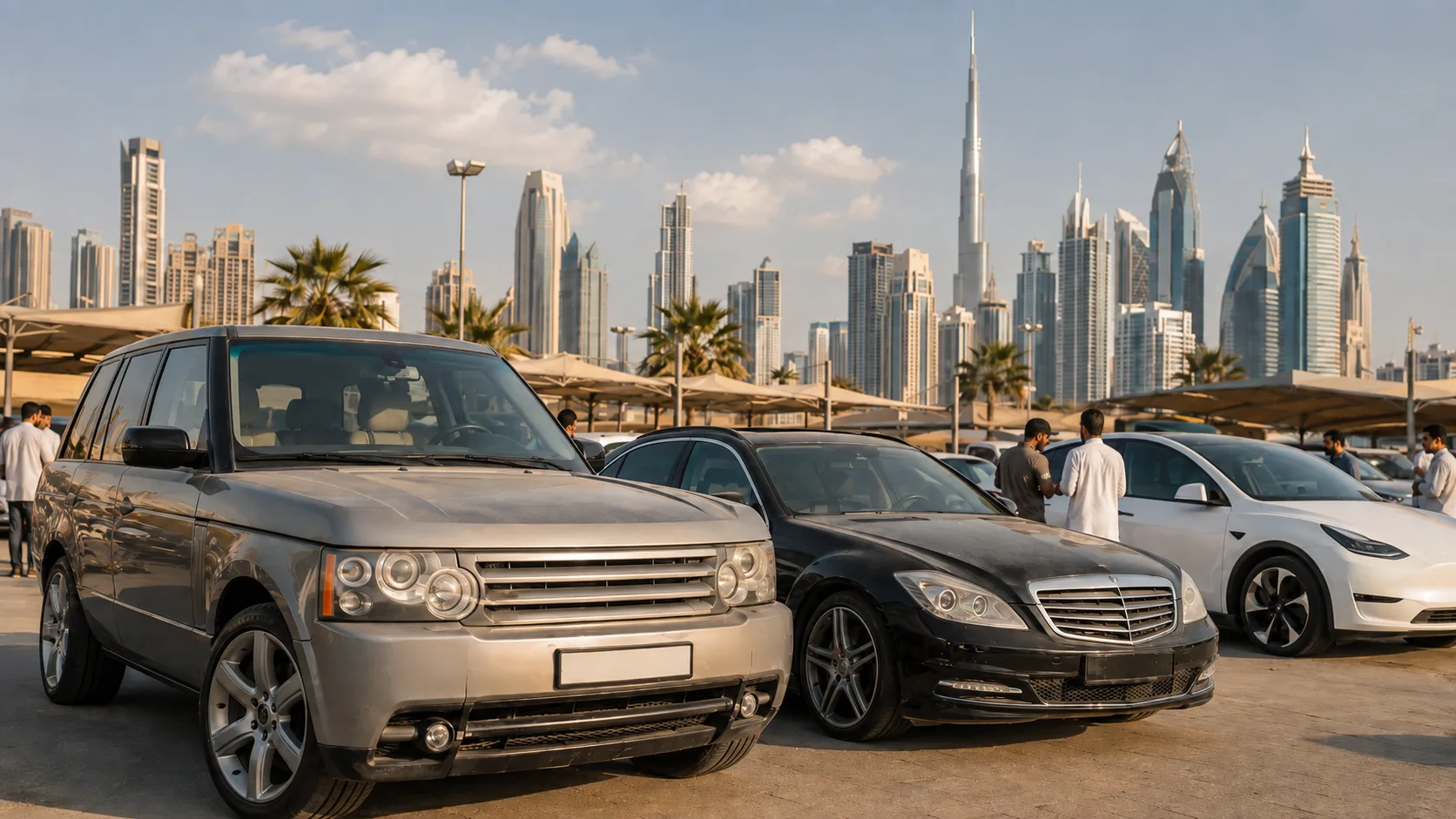
Most UAE banks cap the age of a used car they'll finance, and the cap isn't uniform. Lenders including RAKBank and Mashreq generally won't fund a car older than roughly five to seven years at purchase, with total age at loan maturity capped somewhere near eight to ten. Emirates NBD stretches further, up to twelve years. All of it sits under Central Bank Regulation 29/2011, which treats car loans separately from personal loans, caps them at 80 percent of the car's value and limits tenure to 60 months.
Do that arithmetic before you buy, not after. A car you sell in year four is competing for financed buyers. The same car in year seven is competing for cash buyers, and there are far fewer of them. That transition is where a lot of Gulf owners get hurt, because it doesn't feel gradual. The listing just stops getting calls.
It's also why the standard advice to buy a two or three year old car is sound but incomplete. Buy at three and sell at five and you stay inside almost every bank's window. Buy at five and hold to eight and you've moved yourself into the cash market whether you planned to or not.
The big premium cars fall hardest, and running cost is why
My view, after years of watching this play out in service bays: large luxury saloons and big premium SUVs lose value fastest in the GCC not because buyers dislike them, but because the second owner has to fund them out of warranty.
Three costs stack the moment factory cover ends. Parts and labour on a large German or British SUV. Cooling and air conditioning work that this climate demands every single summer. Tyres in sizes that cost several times what a Corolla wears. Auto Trader UAE's May 2026 used luxury running cost study made a related point I think is underrated: driver assistance systems and large infotainment screens help a car sell, then cost real money to repair once the warranty is gone. Insurers have noticed and price high value, tech heavy cars accordingly.
Now add finance. A seven year old flagship SUV with a six figure asking price needs a cash buyer, and cash buyers at that level usually want something newer. Thin demand on top of high running cost is what produces the listings that sit for four months and then reprice by 20 percent in one go.
None of that makes a used premium car a bad buy. It makes the timing of the buy the whole argument. If you're purchasing one at three or four years old, at a heavy discount, with an extended warranty you've actually read, the maths can work well. Buying one new and selling it at year five is where the money disappears, and no amount of careful servicing changes that.
Chinese brands are the newest variable, and the first owner carries the risk
AlixPartners forecasts Chinese brands will reach 34 percent of new car sales across the Middle East and Africa by 2030, up from 10 percent in 2024, the highest share of any region outside China, Russia and Belarus.
That's good news at the showroom. It's harder on residual values, for a mechanical reason rather than a snobbish one. When a brand launches several nameplates a year and keeps sharpening new car pricing, your three year old example ends up competing against a newer car with more equipment for similar money. Resale is always relative to what else is parked next to it.
Two things worth settling before you sign. First, whether there's an authorised workshop for that brand in your city, not merely somewhere in the country. Second, whether the warranty transfers to a second owner, confirmed in writing rather than over the phone, because terms vary by brand and by distributor. A long warranty that dies with the first owner does nothing for your resale.
Fuel prices are propping hybrids up right now
2026 has been a strange year at the pump. UAE prices climbed for four consecutive months during the disruption around the Strait of Hormuz, dipped in July, then went up again on 1 August. The UAE Fuel Price Committee set August rates at AED 3.49 a litre for Special 95, AED 3.60 for Super 98, AED 3.41 for E-Plus 91 and AED 3.80 for diesel. Rates reset monthly, so September's numbers land on 31 August.
Buyers reacted quickly. Abhinav Gupta, chief executive of Cars24 Arabia, told Khaleej Times in July that EV and hybrid demand on the platform was running 15 to 20 percent above the previous year, with enquiries for affordable Chinese EV models up more than 30 percent since the conflict began on 28 February 2026.
My read: a full hybrid from a brand with deep local service coverage is the lowest risk resale bet in this market today. Fuel driven demand supports the price and the running cost argument is easy for the next buyer to follow. The caveat is battery cover. A hybrid still inside its battery warranty moves fast. One just outside it invites a discount, because the next owner is pricing in a risk they can't inspect on a test drive.
Spec and paperwork cost you twice
Imported cars, usually US spec, are cheaper for a reason. Financing options narrow, several insurers charge more, and at resale your buyer pool shrinks to people comfortable with a history they can't fully trace. The discount you took at purchase isn't free money. You hand a chunk of it back on the way out, often more than you expected.
Which makes the official history tools the cheapest insurance in this whole process. In Saudi Arabia, Mojaz, run by Elm, compiles a used car's record from the date it entered the Kingdom: previous owners, accidents with images, maintenance, odometer readings and Fahas inspection history. In Dubai, the RTA's vehicle history report covers ownership history, insurance validity and the car's condition at its annual test, and it requires the current owner's consent through an SMS PIN. The RTA also links to Carfax and Auto DNA for cars imported from the US, Europe and Japan. Anyone shopping used cars in GCC markets should treat these as step one, ahead of the test drive.
And if a seller gets vague about approving that consent request, you already have your answer.
Buy the exit, not just the car
Decide how long you'll realistically stay, count forward to the month you'll actually sell, then ask three questions about the car in front of you as it will be on that date. Will banks still finance it. Will it still carry meaningful warranty cover, especially on a hybrid battery. How many newer alternatives will be sitting at that same price by then.
Get those three right and depreciation becomes a cost you planned around. Get them wrong and it turns into the largest bill of your entire ownership, presented in one lump, on the week you're already busy packing.