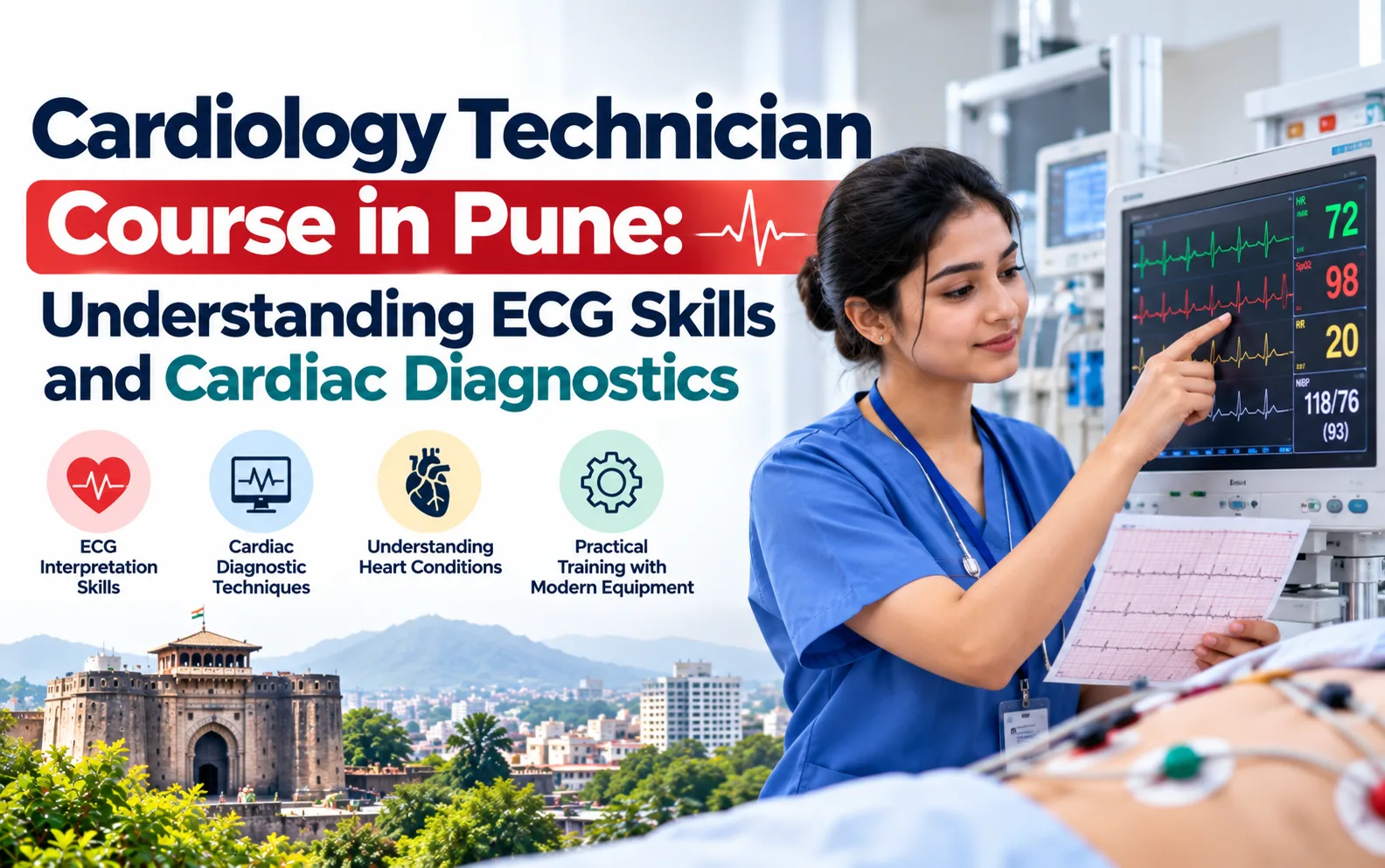
The heart plays a central role in maintaining circulation throughout the body, and cardiac investigations help healthcare professionals evaluate its function. Students researching a cardiology technician course in Pune may want to understand how ECG recording, patient preparation and diagnostic equipment are used in healthcare settings.
Cardiology technicians support cardiac diagnostic services by helping prepare patients, operate relevant equipment within their training and maintain accurate records. Their work requires attention to detail, communication, equipment awareness and an understanding of patient safety.
The exact responsibilities of a technician depend on their qualification, workplace and authorised scope of practice. Learning the fundamentals of cardiac diagnostics can help prospective students decide whether this area of healthcare matches their interests.
What Is Cardiac Diagnostic Technology?
Cardiac diagnostic technology involves equipment and procedures used to collect information about the heart. Different investigations provide different types of information, and healthcare professionals select tests according to the patient's needs.
One commonly used investigation is the electrocardiogram, usually called an ECG. It records the electrical activity of the heart through electrodes placed on the skin.
Other cardiac investigations may include echocardiography, exercise-related testing and ambulatory monitoring. These procedures are different from one another and require appropriate equipment, training and professional oversight.
What Students Should Learn in a Cardiology Technician Course in Pune
Students comparing training options should look for a curriculum that explains both the principles of cardiac investigations and the practical responsibilities involved.
1. Basic Anatomy and Physiology of the Heart
Understanding the heart's structure and function provides a foundation for cardiac diagnostic work. Learners should become familiar with the chambers, valves, blood flow and electrical conduction system.
This knowledge helps students understand why cardiac investigations are performed and how different tests contribute to clinical assessment.
2. ECG Fundamentals
An ECG records electrical signals associated with the heartbeat. The resulting tracing contains waves and intervals that trained healthcare professionals interpret in context.
Students may learn the purpose of ECG testing, electrode placement principles, patient preparation, recording procedures and common sources of recording errors.
Technicians must understand the limits of their role. Recording an ECG is not the same as independently diagnosing a cardiac condition. Clinical interpretation should be performed by appropriately qualified professionals.
3. Patient Preparation and Communication
Patients may feel nervous before a cardiac investigation. Clear explanations can help them understand what will happen and why the test is being performed.
Preparation may involve confirming the patient's identity according to workplace procedures, explaining the process, helping them adopt the required position and maintaining privacy.
Students should learn to communicate respectfully and report any patient discomfort or concern to the responsible healthcare professional.
4. Equipment Handling
Cardiac diagnostic equipment must be handled according to the manufacturer's instructions and the healthcare facility's procedures. Learners should understand the purpose of electrodes, cables, recording systems and related accessories.
They should also learn how to recognise obvious equipment problems, maintain cleanliness and report faults rather than attempting unauthorised repairs.
Why Does ECG Recording Quality Matter?
A recording is useful only when it captures the required information clearly. Poor electrode contact, patient movement, incorrect placement or equipment interference can affect recording quality.
Students should understand how to prepare the skin appropriately, follow the specified electrode placement procedure and encourage the patient to remain comfortable and still when possible.
If a tracing appears unclear or an equipment issue is suspected, the technician should follow the established procedure and seek assistance when necessary. Accuracy and patient safety are more important than simply completing a test quickly.
Infection Prevention and Patient Safety
Patient safety applies to every diagnostic procedure. Students need to understand hand hygiene, cleaning requirements, appropriate use of protective equipment and safe handling of reusable accessories.
They should also respect patient privacy during preparation and recording. Personal information and medical records must only be accessed or shared through authorised channels.
Training should reinforce the importance of following the facility's protocols rather than relying on memory or informal shortcuts.
How Practical Training Supports Learning
Cardiac diagnostic skills develop through a combination of theory, demonstrations and supervised practice. Students benefit from understanding how equipment works before performing tasks in a clinical environment.
When evaluating a cardiology technician course in Pune, ask whether the programme includes ECG equipment demonstrations, practical exercises, patient preparation training and supervised clinical exposure, where applicable.
Also verify the course's official name, duration, eligibility requirements, recognition and assessment process. These details vary between institutions and programmes, so they should not be assumed.
Career Pathways in Cardiac Diagnostics
Depending on their qualification and employer requirements, trained professionals may explore opportunities in hospitals, diagnostic centres, cardiac departments and other healthcare facilities that conduct cardiac investigations.
Job responsibilities may include preparing patients, recording tests, maintaining documentation and supporting diagnostic workflows under appropriate supervision.
Employers may require specific qualifications, practical competencies, experience or additional credentials. Students should review current job descriptions and check whether the course they are considering meets those requirements.
Questions to Ask Before Enrolling
Before choosing a course, students should ask:
- What is the exact qualification awarded?
- What are the admission requirements?
- Which cardiac diagnostic procedures are covered?
- What equipment is used during practical learning?
- Is supervised clinical exposure included?
- What are the total fees and additional charges?
- What qualifications do employers expect for entry-level roles?
Getting clear answers can help students avoid choosing a programme based on assumptions.
Conclusion
Cardiac diagnostic technology combines knowledge of heart function, patient preparation, ECG recording, equipment handling and careful documentation. These skills support healthcare professionals who investigate and monitor cardiac conditions.
Students interested in a cardiology technician course in Pune should compare course recognition, practical training and eligibility requirements before applying. Understanding the work involved can help them decide whether cardiac diagnostics is a suitable direction for their healthcare education.