
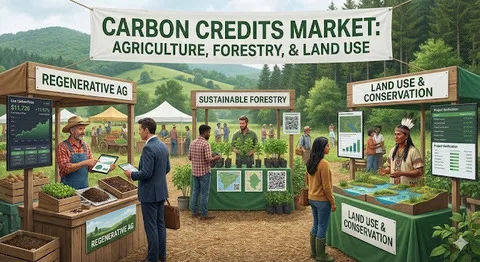
The carbon credits market for agriculture, forestry, and land use (AFOLU) is emerging as a critical component of global climate strategies. The market enables farmers, landowners, and project developers to generate tradable carbon credits through regenerative agriculture, reforestation, and emission-reduction practices. Rising corporate net-zero commitments, policy support, and advances in digital monitoring technologies are accelerating market expansion worldwide.
What Are the Key Drivers of the AFOLU Carbon Credits Market?
- Net-Zero Emission Targets: Governments and corporations are increasingly adopting net-zero targets by 2050, creating strong demand for high-quality carbon offsets from agriculture and forestry projects.
- Adoption of Digital MRV Technologies: Advanced Monitoring, Reporting, and Verification (MRV) technologies such as satellite imaging, AI-based soil carbon modeling, drones, and blockchain are improving transparency and reducing verification costs.
- Growth of Regenerative Agriculture: Farmers are increasingly adopting sustainable practices including cover cropping, reduced tillage, agroforestry, and biochar applications that enhance soil health while generating carbon credits.
- Rising Corporate Investments in Nature-Based Solutions: Large agribusinesses and food companies are investing in carbon farming initiatives to meet ESG and sustainability goals, boosting participation across global supply chains.
Request A Detailed Sample for Carbon Credits Market for Agriculture, Forestry, and Land Use - Focus on Emerging Startups, Policy Framework, and Country-wise Analysis and Forecast, 2025-2035
What Major Trends Are Shaping the AFOLU Carbon Credits Market?
- Expansion of Removal-Based Carbon Projects: Removal-focused projects such as agroforestry and soil carbon sequestration are gaining popularity because they offer long-term carbon storage and attract premium pricing.
- Blockchain Tokenization of Carbon Credits: Blockchain technology is enabling tokenized carbon credits that improve transparency, liquidity, and retail investor participation in carbon markets.
- Increasing Focus on Forestry Projects: Forestry and land-use projects are expected to witness the highest growth due to stronger carbon sequestration potential and supportive global regulations.
- Emergence of Harmonized Reporting Standards: New frameworks such as the Land Sector and Removals Standard (LSRS) are improving credibility and consistency in agricultural carbon accounting.
What Challenges and Opportunities Exist in the Market?
The AFOLU carbon credits market faces challenges related to land tenure uncertainty, permanence risks, fragmented methodologies, and concerns about credit quality. Investor confidence has also been impacted by scrutiny over additionality and transparency in some voluntary carbon projects.
However, substantial opportunities remain. Advances in AI-driven MRV systems, policy incentives, blended finance models, and blockchain-enabled trading platforms are expected to increase accessibility and market efficiency. Smallholder participation, especially in developing countries such as India, could further expand market scale and rural income generation.
Who are the Key Players in the Carbon Credits Market?
A diverse ecosystem of innovators and organizations is shaping this market, including:
- Indigo Ag, Inc.
- Carbon Credit Capital, LLC.
- Terra Global Capital
- South Pole
- Nori, Inc.
- The California Air Resources Board (CARB)
- Cargill, Incorporated
- Regenerative Agriculture Alliance
- Ecosystem Services Market Consortium (ESMC)
- Bayer AG
- 3Degrees Group, Inc.
- NATUREOFFICE
- Climetrek
- EKI Energy Services Ltd.
- Finite Carbon Corporation
These players contribute through project development, verification technologies, carbon trading platforms, and large-scale ecosystem programs.
Trending FAQ for Carbon Credits Market for AFOLU
What exactly are carbon credits in agriculture, forestry, and land use?
Carbon credits in this market represent tradable units earned by removing or avoiding greenhouse gas emissions through regenerative farming, forestry, and sustainable land practices. Each credit typically equals one metric ton of CO₂ equivalent sequestered or avoided.
How do farmers and landowners generate carbon credits?
Credits are generated by adopting practices like cover cropping, reduced tillage, agroforestry, peatland restoration, or other verified regenerative methods. Projects must follow rigorous monitoring, reporting, and verification (MRV) standards to ensure legitimacy.
What role does technology play in this market?
Emerging digital MRV tools — including satellite, drone, AI, and blockchain technologies — are making project validation faster, cheaper, and more reliable, expanding participation to small and large producers alike.
Conclusion
As global focus on climate mitigation intensifies, the carbon credits market for AFOLU use stands out as a critical arena for achieving emissions reduction targets while supporting sustainable land management. With robust market drivers, evolving trends, and expanding opportunities, stakeholders looking to Invest in Carbon Credits Market for AFOLU can benefit from both environmental impact and economic growth, particularly as the market scales over the coming decade.