
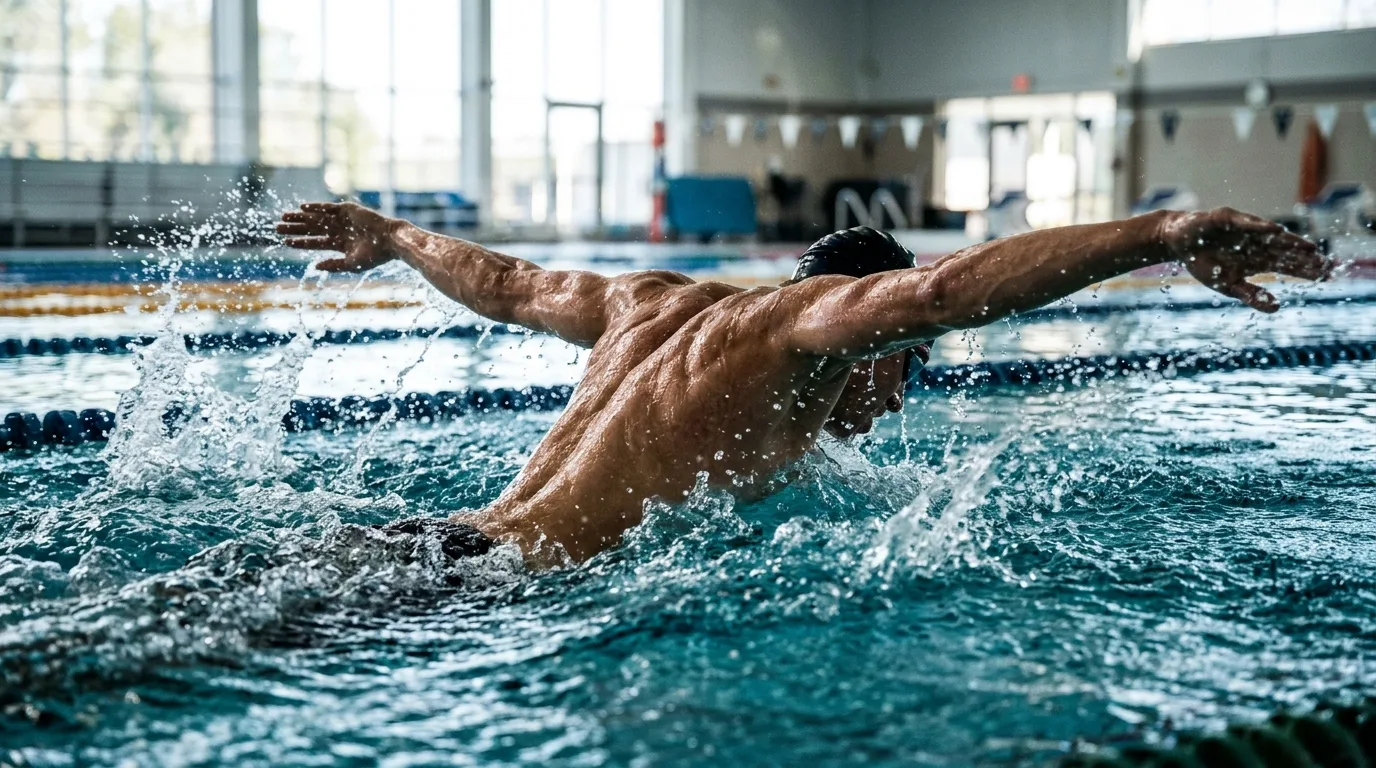
Watch a competitive swimmer climb out of the pool, and the answer looks obvious: broad shoulders, a strong back, a lean waist. Those athletes also spend plenty of time in the gym, though, so it is fair to ask how much of that physique actually comes from the water.
The short answer is yes. Swimming can build lean muscle, particularly in the shoulders, back, core and legs. It usually will not build as much muscle size as heavy weight training. Where you end up depends on how you swim, how often, what you eat and whether you add some strength work on dry land.
How Does Swimming Build Muscle?
Water is far denser than air, so every pull and kick meets resistance. Push harder or faster, and the resistance rises with you. That is why swimming works as resistance training even though there is no weight stack in sight.
Muscle growth, known as hypertrophy, generally needs three things: mechanical tension, metabolic stress and a degree of muscle damage. Swimming can supply all three, especially during sprint sets, hard intervals and demanding strokes such as butterfly. Easy, relaxed lengths of breaststroke are wonderful for fitness, but they give your muscles a much weaker growth signal.
It helps to separate two ideas. Muscular endurance is the ability to keep working for a long time, and swimming builds plenty of it. Muscle size is a different adaptation, and it responds best to short, demanding efforts that take muscles close to their limit. Most recreational swimmers gain far more endurance than size.
There is one more point in swimming’s favour. Water supports your body weight, so you can train hard without the pounding that running or jumping puts through the knees and ankles.
Which Muscles Does Swimming Work?
Nearly all of them, though not evenly.
Shoulders and upper back. The deltoids, rotator cuff and latissimus dorsi do most of the heavy lifting in every stroke. Strong lats are a big reason swimmers develop that V-shaped upper body.
Chest and arms. The pectorals help drive the pull, the triceps finish each stroke, and the biceps and forearms help you hold the water.
Core. Your abdominals, obliques and lower back keep your body long and stable, and they rotate your torso in freestyle and backstroke. In butterfly, the core is working almost constantly.
Legs and glutes. The quadriceps, hamstrings, calves and glutes power your kick. Breaststroke leans more on the inner thighs and glutes than the other strokes do.
Muscle Building by Stroke
| Stroke | Main muscles worked | Muscle-building potential |
| Freestyle | Shoulders, lats, triceps, core, legs | Good, especially in sprint sets |
| Butterfly | Shoulders, chest, upper back, core, glutes | Highest, but technically demanding |
| Backstroke | Lats, rear shoulders, core, glutes | Moderate to good |
| Breaststroke | Chest, inner thighs, quadriceps, glutes | Moderate |
Butterfly asks the most of your body, but it is hard to swim well and tiring very quickly. Most people get better results by mixing strokes. Variety spreads the load across more muscle groups and tends to be easier on the shoulders.
Swimming vs Weightlifting: Which Builds More Muscle?
For pure muscle size, weightlifting wins. Barbells and machines let you load specific muscles progressively and precisely, which is the most dependable route to hypertrophy. Swimming spreads the effort across the whole body and trains your heart and lungs at the same time, which is a different kind of benefit.
| Swimming | Weightlifting | |
| Muscle size | Modest | Highest |
| Muscular endurance | Excellent | Moderate |
| Joint stress | Low | Moderate to high |
| Cardiovascular fitness | Excellent | Limited |
| Control over loading | Low | High |
So can you build muscle just by swimming? Yes, especially if you are new to exercise or returning after a break. Experienced lifters, or anyone chasing visible size, will usually find that swimming alone stops being enough. Combining the two gives you size and strength from the gym, plus endurance and mobility from the pool.
How Fast Can You Build Muscle From Swimming?
It varies from person to person. Beginners often feel stronger within the first few weeks, largely because the nervous system gets better at recruiting muscle fibres. Visible changes usually take longer, commonly a couple of months of consistent training. Age, genetics, diet, sleep and how hard you push in the pool all play a part.
Regular swimmers also hit plateaus. Swim the same distance at the same pace in the same stroke, and the body adapts, then stops responding. That is your cue to raise the challenge.
How to Build More Muscle by Swimming
- Add sprint intervals. Try 8 x 25 metres fast with 30 seconds’ rest. Short, hard efforts give a stronger growth signal than steady lengths.
- Use resistance tools. Paddles, drag shorts,, and a pull buoy increase the load on the upper body, while fins build kicking power. Introduce paddles gradually, as a sudden jump can irritate the shoulders.
- Mix your strokes. Different strokes challenge different muscles.
- Progress one thing at a time. Raise the intensity, shorten the rests or add distance, but not all three in the same week.
- Swim often enough. Two to four sessions a week suits most people, with a rest day between the hardest ones.
- Keep working on technique. Good form lets you apply force where it counts and protects your shoulders. A coach can often spot drag-causing habits within a single lesson.
A Sample Swim Workout for Muscle
Intermediate swimmer (about 45 minutes)
- Warm-up: 200 m easy freestyle, then 100 m kick with a board
- Drill: 4 x 50 m catch-up freestyle
- Main set: 6 x 50 m freestyle at hard effort with 30 seconds’ rest, then 4 x 25 m butterfly or fast backstroke with 40 seconds’ rest
- Pull set: 4 x 100 m with pull buoy and paddles at a moderate to hard pace
- Cool-down: 100 to 200 m easy
Beginners can halve the volume, leave out the paddles and butterfly, and take longer rests. Anyone with a health condition or an old injury should check with their doctor before increasing intensity.
Nutrition and Recovery for Swimmers Who Want Muscle
Muscle repairs and grows between sessions, so what you eat and how you rest count. Aim for protein at each meal and enough overall energy, because swimming has a way of leaving people hungrier than they expect. If you are unsure about timing, a guide on what to eat before and after a swim is a useful starting point for swimmers in Singapore.
Sleep matters just as much. Most adults do best with around seven to nine hours, and a rest day after your toughest sessions gives tired muscles time to adapt.
Who Benefits Most From Swimming for Muscle?
Beginners see the fastest progress, simply because their bodies are meeting a new challenge. People with sore joints or those easing back after an injury often find the water a comfortable place to rebuild strength, ideally with medical guidance.
Older adults have a particular reason to swim. Muscle mass tends to decline gradually from around the age of 30, and regular activity, combined with some resistance work, helps slow that process. Better strength also supports balance and everyday movement.
Children and teenagers are a different case. Young swimmers build strength naturally through lessons, games and regular practice, and they do not need formal heavy lifting. A good swim school coach focuses on technique, confidence and enjoyment first, and progress varies from child to child.
Common Mistakes That Limit Muscle Growth
- Swimming only easy laps and never raising the effort
- Skipping strength work when size is the goal
- Eating too little protein or too few calories overall
- Adding paddles and volume too quickly, which can lead to shoulder pain
- Training hard every day with no recovery
Final Thought
Swimming can build lean, functional muscle, and it does so with very little stress on the joints. It will not match a well-planned weights programme for size, but paired with some strength training, good food and proper rest, it makes a strong foundation. If you would like help with technique before you push the intensity, a qualified coach can make your sessions far more effective.
FAQs
Can you build muscle just by swimming?
Yes, particularly as a beginner. Gains in size tend to level off sooner than they would with weight training.
Does swimming tone or build muscle?
Toning usually means building a little muscle while losing body fat, and swimming can support both.
Can swimming build leg muscles?
Yes. Kicking works the quadriceps, hamstrings, glutes and calves, and kick sets with fins increase the load.
How often should I swim to build muscle?
Two to four sessions a week suits most people, with at least one session including harder efforts.
Is swimming better than the gym for muscle gain?
For size, the gym has the edge. For joint-friendly, full-body conditioning, swimming is hard to beat. Many people do both.
Can women build muscle by swimming?
Yes. The same principles of resistance, progression and recovery apply.