
Why Are Peanut Shells Worth Recycling?
Peanut processing generates considerable quantities of shells that may have limited value when left untreated. For agricultural businesses, oil mills, and biomass fuel producers, these residues can become a useful resource instead of occupying storage space or being discarded.
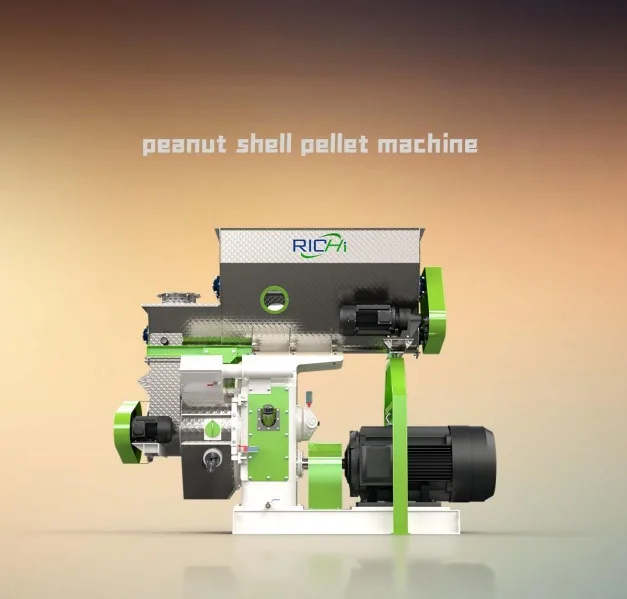
A peanut shell pellet machine compresses suitably prepared peanut shells into dense pellets that are easier to store, transport, and handle. Depending on the raw material and production process, these pellets may serve as biomass fuel for compatible industrial or commercial heating applications.
However, peanut shells cannot always go directly into a pellet mill. Their particle size, moisture content, and composition affect pellet formation, durability, and production efficiency. A successful project therefore begins with raw material testing and a clear understanding of the intended fuel market.
What Preparation Do Peanut Shells Need Before Pelletizing?
Although peanut shells are already relatively lightweight and dry in many processing environments, their condition varies according to harvesting, storage, and handling practices.
The preparation process typically involves several stages.
Crushing and grinding: Whole shells and oversized fragments may need to be reduced into smaller particles. A hammer mill can help produce a more uniform feedstock, allowing the material to move more consistently through the subsequent process.
Moisture adjustment: Material that is too wet may produce soft pellets or create storage problems. Excessively dry material can also affect pellet formation. Operators should determine the appropriate moisture range through material testing and the pellet mill manufacturer's recommendations.
Screening: Removing oversized particles and unwanted contaminants helps maintain more consistent feedstock quality. Screening requirements depend on the condition of the incoming shells and the specifications of the pelletizing equipment.
Pelletizing: The prepared material enters the pellet mill, where mechanical pressure forces it through die openings to form compact cylindrical pellets. Die specifications and operating conditions should match the intended pellet diameter and required production capacity.
Cooling and screening may follow pelletizing to reduce product temperature and separate excessive fines before packaging.
How Does Peanut Shell Pellet Production Compare with Other Agricultural Residues?
Peanut shells are only one of the agricultural by-products that can be used in biomass processing. Other materials, including rice husks, straw, corn stalks, and sugarcane bagasse, may also provide feedstock for suitable pellet production systems.
For example, a 5T/H bagasse pellet machine is designed for processing prepared sugarcane bagasse into pellets. Although the two applications share the same general objective, their raw materials can behave differently during processing.
Bagasse often contains more moisture when it comes directly from sugar production, so drying may become a major part of the preparation process. Peanut shells, by contrast, may require greater attention to grinding, particle uniformity, and the characteristics of the finished pellets.
These differences make it unwise to assume that one machine configuration will perform equally well with every agricultural residue. Businesses planning to switch between raw materials should confirm the equipment's compatibility and test the proposed feedstock before commercial production.
What Determines the Cost of a Peanut Shell Pellet Project?
The total investment depends on production capacity, the condition of the raw material, the desired pellet specifications, and the level of automation.
A small operation with clean, relatively dry shells may need only a pellet mill and basic conveying equipment. A larger facility handling variable-quality residues may require a crusher, dryer, storage bins, feeding equipment, cooling equipment, screening machinery, and an automated packaging system.
When requesting quotations, buyers should consider more than the initial equipment price. Electricity consumption, replacement dies and rollers, labor, maintenance, and raw material transportation all contribute to operating expenses.
It is also important to calculate the expected output using realistic operating conditions. The machine's rated capacity may differ from actual production when feedstock moisture, particle size, or pellet specifications change.
How Can Producers Improve Pellet Quality?
Consistent raw material preparation is one of the most practical ways to improve production stability. Operators should monitor moisture content, avoid excessive variations in particle size, and maintain the pellet mill according to the manufacturer's instructions.
Finished pellets should also be evaluated for durability, fines, moisture, and dimensions. These properties influence transportation losses, storage performance, and suitability for the intended combustion equipment.
For businesses planning a larger biomass project, pellet production line solutions can integrate preparation, pelletizing, cooling, screening, and packaging into a coordinated process. The appropriate configuration depends on the feedstock and production target rather than the number of machines alone.
Is Peanut Shell Pellet Production a Practical Investment?
The commercial potential depends on the availability and cost of peanut shells, the investment required for processing, and the selling price of the finished fuel. Producers should investigate local demand and applicable fuel-quality requirements before committing to a project.
When evaluating equipment, learn more about suitable biomass processing configurations and request a proposal based on your actual raw material, target capacity, and desired pellet specifications. This approach helps identify the equipment required for reliable production without adding unnecessary processing stages.