
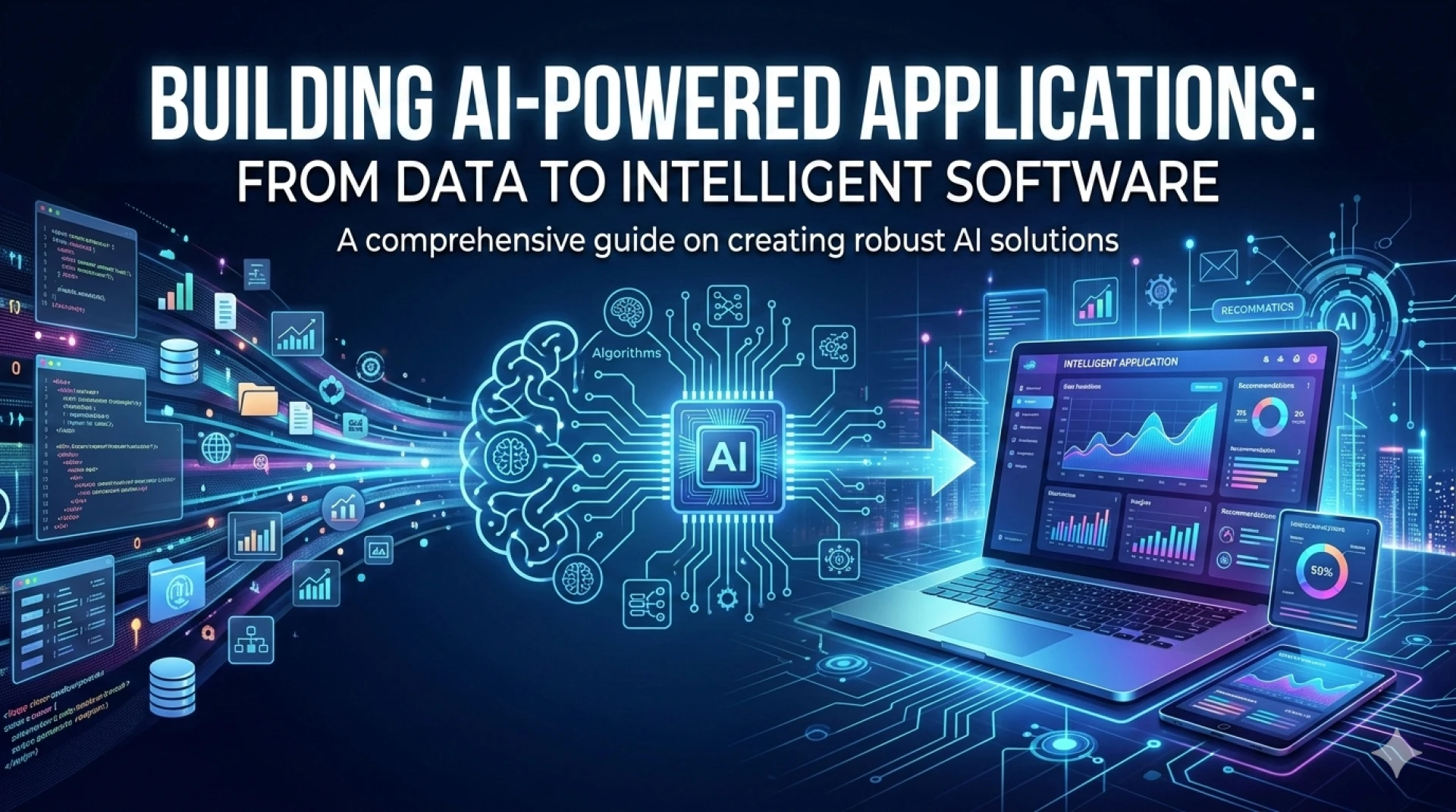
Introduction
Artificial Intelligence has moved from experimental research labs into the core of modern business software. What once required massive research teams and custom hardware is now being embedded directly into everyday applications—from recommendation engines and fraud detection systems to predictive analytics platforms and automated customer service tools.
Today, businesses across industries are exploring how intelligent software can improve decision-making, automate processes, and create entirely new digital experiences.
However, building AI-powered applications is not simply about plugging a machine learning model into an existing system. Successful AI software requires a carefully designed architecture that combines data pipelines, scalable infrastructure, APIs, and modern development workflows.
Organizations developing intelligent systems increasingly rely on custom software development services and AI solutions to integrate machine learning capabilities into their products while ensuring performance, scalability, and maintainability.
Companies like API DOTS help businesses design and deploy AI-powered applications by combining machine learning technologies with robust software engineering practices. Through expertise in web app development services, SaaS product development services, and API integration services, intelligent features can be integrated into scalable digital platforms.
This article explores how AI-powered applications are built, the technologies behind them, and how organizations can successfully deploy intelligent software in real-world environments.
For decades, business software primarily followed deterministic rules. Applications executed predefined instructions based on fixed logic. If a condition was met, the system produced a specific output.
Artificial Intelligence changes this paradigm.
Instead of relying solely on explicit rules, AI systems learn patterns from data. Machine learning algorithms analyze historical information and build models capable of making predictions or identifying patterns that humans may overlook.
This shift has enabled new types of applications, including:
- Personalized recommendation systems
- Fraud detection platforms
- Predictive maintenance tools
- Intelligent chatbots
- Image and speech recognition systems
- Automated analytics platforms
These capabilities allow businesses to automate complex decisions and extract insights from large datasets.
However, implementing AI in production software environments requires much more than training a machine learning model. It requires a full ecosystem of technologies.
Building intelligent applications requires multiple layers of infrastructure and software components.
These typically include:
Data Infrastructure
AI systems depend on large volumes of high-quality data.
Organizations must collect, store, and process data efficiently before it can be used for model training.
Data pipelines often include:
- data ingestion systems
- data cleaning processes
- transformation workflows
- structured storage environments
Many modern platforms rely on cloud infrastructure and scalable cloud servers for small business platforms to handle growing datasets.
Machine Learning Models
The core intelligence of an AI system lies in its machine learning models.
These models may perform tasks such as:
- classification
- regression
- clustering
- natural language processing
- computer vision
Different industries use different types of models depending on their use cases.
For example:
- E-commerce platforms use recommendation models.
- Financial platforms use fraud detection algorithms.
- Healthcare platforms use diagnostic prediction models.
Application Layer
Machine learning models must be integrated into user-facing applications.
This integration usually happens through APIs or microservices.
Companies providing API integration services for e-commerce websites often build systems where machine learning models communicate with other software components through APIs.
This allows AI features to be added without redesigning the entire application.
Deployment and Infrastructure
AI models must run on infrastructure capable of handling real-world workloads.
This may involve:
- cloud environments
- containerized services
- scalable compute resources
Organizations developing AI software frequently combine machine learning systems with SaaS product development services, enabling businesses to deliver AI capabilities to thousands of users through web-based platforms.
Artificial Intelligence is fundamentally powered by data.
Without reliable data pipelines, even the most advanced machine learning algorithms will fail to produce meaningful results.
Companies building AI systems must establish robust processes for:
- collecting data from multiple sources
- cleaning and validating datasets
- ensuring data consistency
- storing data in scalable systems
Many organizations integrate multiple software systems during this stage. This is where API integration services become essential.
For example, an AI-powered analytics platform may need to collect information from:
- customer databases
- financial systems
- marketing platforms
- mobile applications
APIs allow these systems to exchange data automatically.
Through structured integration, organizations can create centralized datasets that power intelligent software.
Once reliable data infrastructure exists, developers can begin building machine learning models.
The development process typically includes several steps.
Data Preparation
Raw data must be processed before training models.
This includes tasks such as:
- removing duplicate entries
- handling missing values
- normalizing data formats
- feature engineering
These processes ensure that machine learning models can interpret the data effectively.
Model Training
During training, algorithms analyze the dataset to identify patterns and relationships.
Different machine learning algorithms may be used depending on the application:
- decision trees
- neural networks
- support vector machines
- gradient boosting models
Training requires computational resources and specialized machine learning frameworks.
Model Evaluation
Before deployment, models must be tested against validation datasets to ensure accuracy and reliability.
Metrics such as precision, recall, and accuracy help determine how well the model performs.
After models are developed, they must be integrated into real applications.
This is one of the most complex aspects of building AI-powered software.
Machine learning models typically operate within backend services that communicate with applications through APIs.
For example:
- A chatbot application sends user queries to a natural language processing model.
- A recommendation engine receives product browsing data and returns personalized suggestions.
- A fraud detection system analyzes financial transactions before they are approved.
Organizations offering web app development services often design these integrations so that AI systems can operate as modular services within larger software platforms.
This modular architecture makes applications easier to scale and maintain.
Cloud computing has dramatically accelerated the adoption of artificial intelligence.
Machine learning models often require significant computational resources, particularly during training.
Cloud platforms provide scalable infrastructure that can handle these workloads.
Benefits of cloud-based AI development include:
- scalable processing power
- distributed data storage
- automated deployment pipelines
- high availability environments
Many organizations launching AI products rely on cloud servers for small business solutions, which allow them to scale resources as their user base grows.
This flexibility makes AI development more accessible even for startups and small companies.
Software-as-a-Service (SaaS) platforms are increasingly integrating AI capabilities into their core functionality.
Examples include:
- marketing platforms that predict customer behavior
- CRM systems that suggest sales actions
- HR platforms that analyze hiring data
- analytics platforms that generate automated insights
These platforms rely heavily on SaaS product development services to build scalable software architectures capable of delivering AI functionality to thousands of customers simultaneously.
AI transforms SaaS platforms from simple tools into intelligent assistants that help businesses make better decisions.
Artificial Intelligence is also driving a new wave of automation.
Businesses are using AI systems to automate tasks such as:
- document processing
- customer support
- supply chain optimization
- predictive maintenance
- data analysis
Automation reduces manual workloads and allows organizations to focus on strategic activities.
However, effective automation requires more than machine learning models. It requires integration with existing business systems.
This is why many organizations rely on technology consultants and specialized development teams to design integrated AI architectures.
Scaling AI applications presents unique challenges.
Unlike traditional software systems, AI platforms must manage both application workloads and machine learning operations.
Scaling strategies often include:
- containerized model deployments
- distributed computing environments
- GPU acceleration
- real-time data pipelines
Organizations offering custom software development services often build architectures that support these scaling strategies while maintaining system reliability.
Scalable infrastructure ensures that AI applications continue to perform effectively as user demand grows.
AI systems require ongoing maintenance and monitoring.
Unlike traditional software, machine learning models can degrade over time as data patterns change.
This phenomenon is known as model drift.
To maintain accuracy, organizations must regularly:
- retrain models using updated datasets
- monitor prediction performance
- update algorithms when necessary
Companies offering software maintenance services for legacy systems are increasingly extending these services to include machine learning model maintenance.
This ensures that AI-powered applications continue delivering reliable results.
AI systems introduce new ethical and security challenges.
Organizations must ensure that their models:
- avoid bias
- protect user privacy
- comply with data regulations
- maintain transparency in decision-making
Security is also critical because AI systems often process sensitive data.
Proper encryption, access control, and monitoring systems must be implemented to safeguard information.
Responsible AI development requires collaboration between engineers, data scientists, and policy experts.
Artificial Intelligence continues to evolve rapidly.
Several emerging trends are shaping the future of AI applications.
Generative AI
Generative models can create text, images, code, and even software interfaces.
These capabilities are transforming industries such as content creation, design, and software development.
Edge AI
Edge computing allows AI models to run directly on devices such as smartphones and IoT sensors.
This reduces latency and enables real-time decision-making.
AI-Driven Development
AI tools are increasingly assisting developers by generating code, detecting bugs, and suggesting architectural improvements.
These technologies are accelerating software development processes.
Building intelligent applications requires expertise across multiple domains, including software engineering, cloud infrastructure, and machine learning.
At API DOTS, AI development is combined with custom software development services, API integration services, and SaaS product development services to create scalable digital platforms.
By integrating intelligent features directly into modern application architectures, organizations can transform traditional software systems into AI-powered platforms capable of delivering smarter user experiences.
From data infrastructure design to AI model deployment, a structured development approach ensures that intelligent software remains reliable, scalable, and secure.
Artificial Intelligence is rapidly transforming the way modern software systems are designed and deployed.
From predictive analytics to intelligent automation, AI-powered applications are helping organizations make better decisions, improve efficiency, and create innovative digital products.
However, building intelligent software requires more than training machine learning models. It requires scalable infrastructure, reliable data pipelines, secure integration systems, and robust software architecture.
Organizations that combine AI technology with strong software engineering practices can unlock the full potential of intelligent applications.
Companies like API DOTS play a critical role in this transformation by helping businesses integrate AI capabilities into scalable platforms through web app development services, API integration services, and custom software development services.
As artificial intelligence continues to evolve, businesses that invest in intelligent software today will gain a powerful competitive advantage in the digital economy.