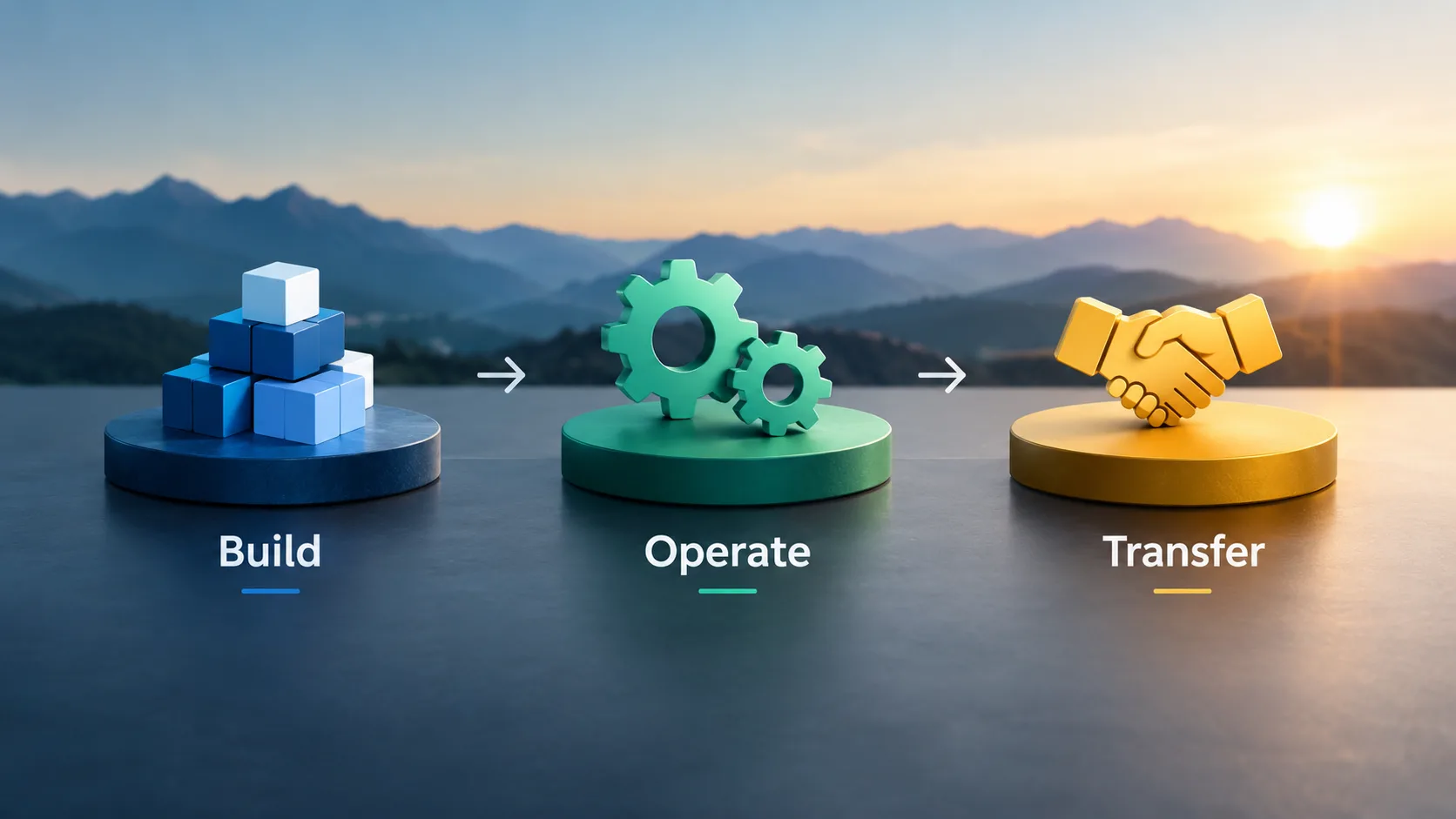
Build Operate Transfer sounds simple because the name spells out the plan. Build the team, operate it, transfer it to you. In practice, each phase has its own risks, its own exit gate, and its own way of going wrong. Companies that treat BOT as one long contract instead of three distinct stages are the ones who end up with a center they cannot fully own.
This is a phase-by-phase breakdown of how a Build Operate Transfer engagement should run, what you should own at the end of each stage, and where teams get tripped up. The goal is the same for every BOT: a fully owned Global Capability Center in India, handed over clean.
Why the Three Phases Matter
A Global Capability Center is a company-owned office that runs engineering, product, and support as your team rather than an outsourced vendor. BOT is the phased, lower-risk way to reach that end state. Instead of registering an entity and hiring from scratch on day one, you let a partner build and run the center first, then transfer it once the model is proven.
The value of splitting this into three phases is control. Each phase ends with a clear gate and a clear deliverable you can inspect. If a stage is not done right, you find out before the next one starts, not after you have signed for full ownership.
Phase 1: Build
The build phase turns a plan into a working center. It usually spans the first few months and covers three things at once.
Entity and Legal Formation
Your partner registers the legal entity, sets up banking, and puts the statutory framework in place. This is the foundation the center runs on, and getting the structure right here affects tax, compliance, and how clean the eventual transfer is. A GCC in India requires a registered entity plus ongoing corporate, tax, payroll, and data-security compliance.
Infrastructure
Office space, IT hardware, network, and security get provisioned and made ready for a team to walk in and work. In a BOT, this is often set up so it can transfer to your entity later without a rebuild.
First Hires
The partner sources, screens, and hires the initial engineers and leaders. This is where delivery credibility matters. A partner who has placed hundreds of engineers, as MetaDesign Solutions has over 20-plus years, ramps a productive team faster than a firm learning on your project.
Exit gate for Build: the entity is incorporated and compliant, the center is physically and technically ready, and the core team is hired. Do not let this phase close until all three are true.
Phase 2: Operate
The operate phase is where a group of new hires becomes a functioning center. This is the phase most sales decks skip over, and it is the one that decides whether the transfer is worth anything.
Delivery Governance
The partner runs delivery management, KPIs, SLAs, and a reporting cadence. You watch how the center performs against real targets, not promises. This is your chance to learn the operating model before you own it.
Team Ramp and Retention
New engineers get onboarded, trained, and brought to productive delivery. Attrition is the quiet killer in this phase. A partner who manages retention well hands you a stable team. One who does not hands you a revolving door.
Knowledge Transfer to You
The best BOT engagements use the operate phase to move knowledge into your hands: your processes, your standards, your documentation. If everything lives in the partner's heads, the transfer will hurt.
Exit gate for Operate: the center is hitting its KPIs and SLAs, the team is stable and productive, and your side understands how it runs. Only then does transfer make sense.
Phase 3: Transfer
The transfer phase is the whole reason you chose BOT. Ownership of the entity, the team, and the IP moves to you. This is also where weak contracts fall apart, so the terms should have been fixed back in phase one.
What Transfers
You take ownership of the legal entity, the employment contracts, the infrastructure, and the intellectual property. What was a partner-run center becomes your own Global Capability Center.
The Transfer Terms
A clean transfer has clear triggers, a defined fee, and no ambiguity on IP. If any of these were vague when you signed, the transfer is where the disputes happen. Confirm them before Build, not during Transfer.
Life After Transfer
Once the center is yours, you run it directly, often with ongoing advisory from the partner while you find your footing. From here you scale headcount and mandate on your own terms.
Exit gate for Transfer: you hold the entity, the people, and the IP, and the center runs under your control. That is a completed BOT.
Real-World Use Case
An enterprise software company used BOT precisely because the India regulatory landscape looked daunting. The partner absorbed the build and operate risk, stood up a 40-person center in under three months, and left a documented path to ownership. Because the transfer terms were set at the start, the handover was a formality, not a fight. That is what all three phases done right looks like.
Conclusion and Next Step
Build, Operate, Transfer only works when each phase has a real exit gate and the transfer terms are locked from day one. Build gives you an entity, a center, and a team. Operate proves the model and moves knowledge to you. Transfer makes it yours. Skip the discipline in any one phase and the owned GCC you were promised gets shakier.
Planning a BOT or a full GCC setup in India? Book a consultation with MetaDesign Solutions. We will map all three phases, the exit gates, and the transfer terms up front, so you know exactly what you own at each step. We sign NDAs and respond within one business day.
Frequently Asked Questions
What are the three phases of Build Operate Transfer?
Build, where the partner sets up the entity, infrastructure, and team. Operate, where the partner runs delivery while you learn the model. Transfer, where ownership of the entity, team, and IP moves to you.
What is a Global Capability Center?
A company-owned office, usually in India, that runs engineering, product, and support as your own team rather than an outsourced vendor, giving you control of talent, IP, and roadmap.
How long does each BOT phase take?
Build commonly runs 2 to 4 months, operate runs several months while the team ramps, and transfer follows once KPIs are met. A typical center is operational in 6 to 9 months before transfer.
What do I own at the end of a BOT?
The registered legal entity, the directly employed team, the infrastructure, and the intellectual property. It becomes your own GCC in India.
When should the transfer terms be agreed?
In the Build phase, before you sign. Triggers, fees, and IP ownership left vague at the start are where transfers turn into disputes.
What happens during the operate phase?
The partner runs delivery governance, KPIs, and SLAs, ramps and retains the team, and transfers operating knowledge to you so you can run the center after handover.
Can a BOT engagement fail at transfer?
Yes, usually because of vague transfer terms, unclear IP ownership, or an unstable team. Locking terms early and watching retention in the operate phase prevents most failures.
Who employs the team before transfer?
The partner's entity employs the team during Build and Operate. At Transfer, employment moves to your entity as part of the handover.
Is BOT better than setting up a GCC directly?
BOT is lower risk because a partner absorbs the setup and hiring first. Companies with a long horizon and 20 to 50 or more engineers sometimes go straight to a GCC instead.
What does the partner do after transfer?
Often ongoing advisory while you take over, plus support to scale headcount and mandate. Day-to-day control sits with you once the center is yours.