India’s textile and apparel industry is among the country’s largest supporters of manufacturing, exports, and jobs. At the core of this industry are weaving machines, necessary for making fabric for clothes, home furnishings, and industrial use. As domestic demand continues to increase and with the country’s heavy export focus, there is a need to guarantee quality and safety standards of weaving machines within the country.
To ensure this, the Bureau of Indian Standards (BIS), the National Standards Body of India, has been set up and it is the BIS that has been formulating and implementing the product certification schemes in India under which the product is certified. This standard ensures that machines which enter the Indian market meet Indian Standards for performance, durability and safety.
In this article, we will explain the significance of the BIS Scheme X Certificate for weaving machines, the process of compliance under the OTR for weaving machines and how to get BIS certification in India, BIS Registration for Weaving Machines and labeling of the ISI mark for Weaving Machines.
Why BIS for Weaving Machines?
Weaving machines are used across:
● Textile mills and garment factories
● Home furnishing production units
● Industrial fabric manufacturing
● Export-focused textile plants
Deprived of BIS for Weaving Machines, unbranded machinery can result in :
● Inferior fabric and defects.
● Breakage down Rate, a measure of mechanical problems and time out of action
● Increased costs of operation, waste and waste management
● Breach of government and export contracts
The BIS mark on Weaving Machines gives confidence to the consumer and inspector that the product is up to Indian standards.
What is BIS Scheme X Certification for Weaving Machines?
BIS Scheme X Certification for Weaving Machines is part of BIS Conformity Assessment Regulations, 2018, that aims to regulate quality in important machinery.
Some of the Features of Scheme X certification for Weaving Machines:
● Mandatory for both Indian and Foreign Manufacturing supplying to India
● Covers various weaving machines with respect to which Indian Standards are in force
● Calls for machine testing, factory inspections and audits that continue over time
● Permits the use of official BIS mark for Weaving Machines
BIS OTR for Weaving Machines
Scheme X Certification will be mandatory under the Omnibus Technical Regulation (OTR) 2024 for Weaving Machines, published by the Ministry of Heavy Industries.
Deadline: 1st September, 2026 Application for grant of a BIS Licence for Weaving Machines shall be mandatory for all manufacturers and importers. Post deadline, un-registered weaving machines can’t be sold, imported or delivered for commercial use in India.
Advantages of Bis Certification for Weaving Machines
● Product Quality Assurance: Certified machineries ensures uninterrupted production and optimal efficiency of fabric.
● Market Access & Tenders: BIS license for Weaving Machines is generally compulsory in government tenders and big supply orders.
● Buyer Confidence: The BIS mark for Weaving Machines ensures trust in the domestic and overseas market.
● Legal & Regulatory Compliance: Ensures compliance of Indian regulations under the OTR for Weaving Machines.
● Competitive Advantage: Certified machinery is rare in an extremely competitive textile equipment industry.
Types of Weaving Machines Under Scheme X Certification
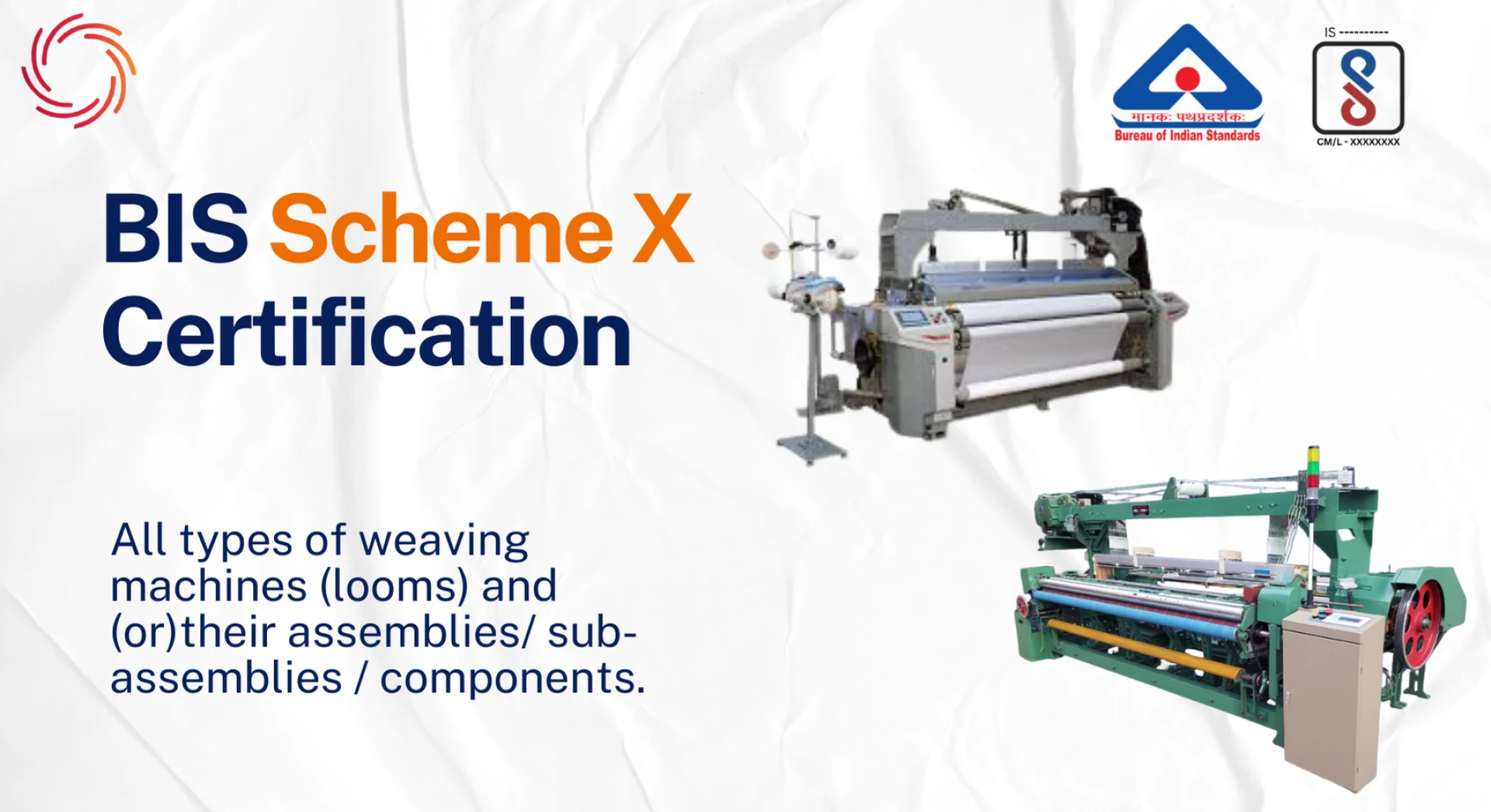
The Weaving Machines receive the Scheme X certification:
● Power looms
● Rapier looms
● Air jet looms
● Water jet looms
● Shuttle looms
● Automatic looms
● Industrial specialized weaving machinery
All those must be in accordance with applicable Indian Standard (IS Codes) like IS 17361(Part 6): 2020 / ISO 11111: (Part 6) : 2005 (Textile Machinery Safety Requirements Part 6 Fabric Manufacturing Machinery). All types shall conform to relevant Indian Standards (IS codes) based on design, performance, safety and energy conservation.
Process for BIS License for Weaving Machines
● Identify Applicable Standards: Locate the IS number of your type of weaving machine.
● Product Testing: Machines are tested in laboratories accredited by BIS for safety and efficiency.
● Factory Inspection: Inspectors of BIS do a thorough examination of the process of manufacturing and quality control system.
● Application Submission: Submit documents such as technical details, test reports and quality manuals.
● Issue of BIS Licence for Weaving Machines: With the approval, the manufacturers would be able to mark BIS on the product.
● Ongoing Compliance: Audits and testing are conducted on a regular basis to make sure we continue to meet our standards.
Penalties for Non-Compliance
Non-compliance of BIS Certification for Weaving Machines within OTR will result:
● Prohibition of uncertified machines from being sold or imported
● Heavy fines and product seizures.
● Disqualification in government works/tenders
● Long term damage to brand and market reputation
Conclusion
The roll out of BIS Scheme X Certification for Weaving Machines through OTR for Weaving Machines (2024) is a major milestone in having a textile industry in India that uses safe, quality and reliable machinery.
For the manufacturers/importers, acquiring a BIS License for Weaving Machines and marking products with the BIS effigy is not only a mandatory compliance but also adds value to the product for marketing. It consolidates market reliability and guarantees compliance, it also in intermediate terms impels competitiveness within the domestic and international markets for textiles.