
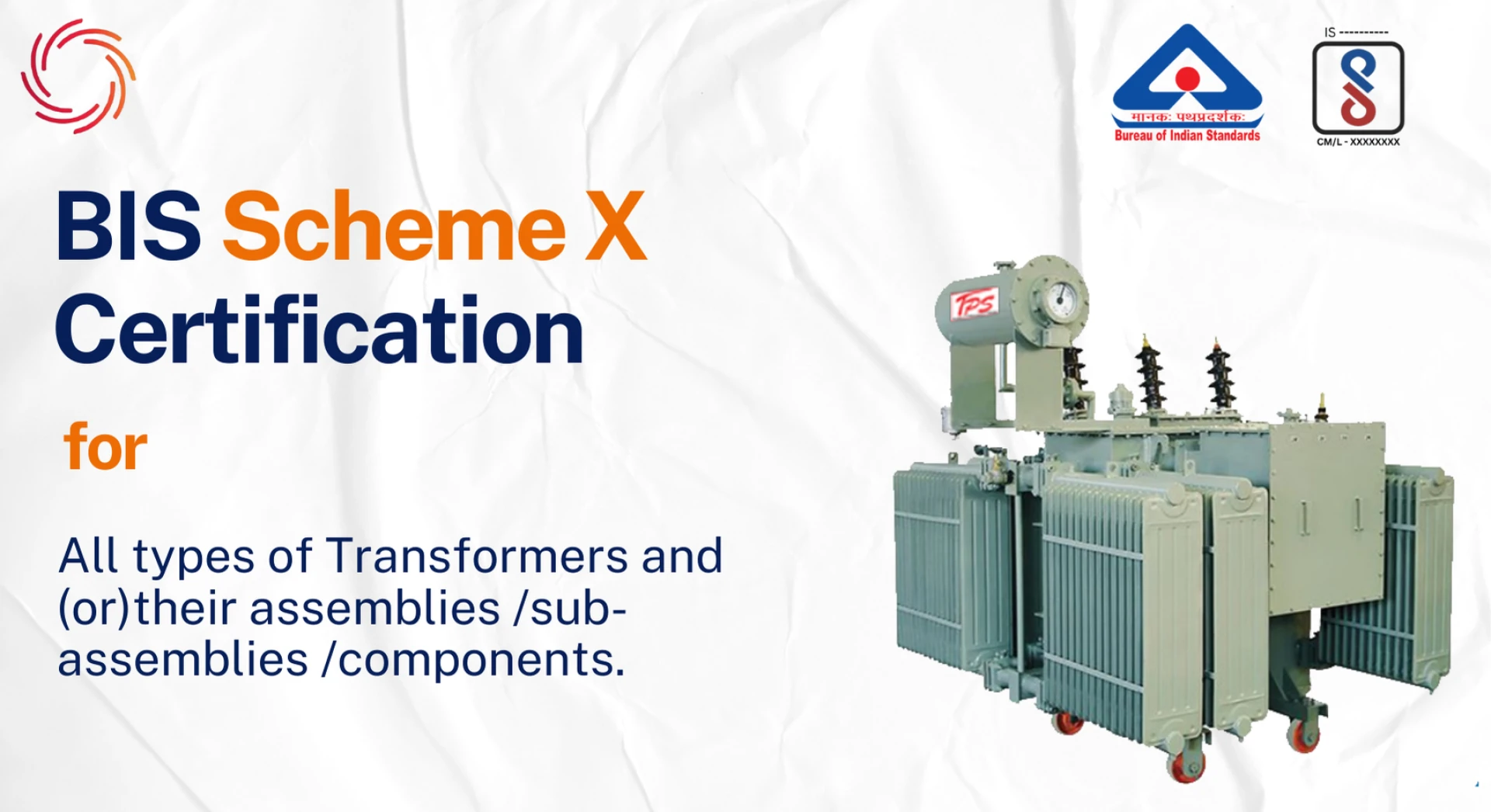
Transformers are the workhorses of India’s power sector as they facilitate the transmission and distribution of electricity in industries, commercial complexes, and residences among others. Considering their significance in ensuring the grid stability and energy utilization efficiency, transformers shall be designed to high-safety and high-performance standards.
BIS Scheme X Certification for Transformers specifies the quality and safety standards for transforming manufacturing and importing transformers into India.
To protect quality and compliance of regulation, the (BIS) Bureau of Indian Standards has announced mandatory use for the BIS Certification for Transformers under Scheme X Certification. It mandates that all domestic and foreign manufacturers conform to Indian Standards before launching their products into the Indian market.
In this blog, we discuss what the BIS Scheme X Certification for Transformers is, why the scheme is important, the OTR mandate of 2024 and how manufacturers can get certified.
Why Scheme X for Transformers is Important
Transformers are widely used in:
● Generation facilities
● Networks for transmission and distribution
● Factories and production buildings
● Renewables projects (solar / wind / hydro)
● Commercial properties / residential estates
Without proper compliance, transformers may cause:
● Overheat, fire and electric shock.
● Losses and waste of power during transmission
● Blackouts due to system breakdowns
● Rejected in Public tenders, government projects
The Scheme X certification for Transformers ensures high safety, energy efficiency, and product reliability.
What is Scheme X Certification for Transformers?
The BIS Scheme X Certification for Transformers is a legal framework under the BIS Conformity Assessment Regulations, 2018. It mandates stringent testing and inspection and insists on a higher-level of documentation to ascertain the quality along the Indian Standards.
Key Features of Scheme X Certification:
● For all manufacturers, Indian and foreign.
● Includes distribution transformers, power transformers, and special-purpose transformers
● Performance, efficiency and safety testing in BIS-approved labs is obligatory
● Factory audited for examined Manufacturing processes and quality systems
● Provides a license for the use of the BIS Standard Mark.
BIS OTR for Transformers
The Ministry of Heavy Industries has introduced the Omnibus Technical Regulation (OTR) for Transformers, in 2024.
Compliance Date: All manufacturers and importers must be certified by September 1, 2026. After which, non-certified transformers cannot be made, brought to the country or sold in India.
Advantages of BIS for Transformers
● Safety & Reliability: Verifies transformers comply with electrical safety and fire-prevention requirements.
● Energy Efficiency: Encourages less power loss and better power performance.
● Market Compliance: Complies with transformer regulatory requirements, as listed in the OTR.
● Tender Eligibility: Certified products are eligible for Government and PSU tenders.
● Customer Confidence: The BIS Standard Marking ensures product quality and durability.
Types of Transformers Covered
BIS scheme X Certification for Transformers applies to:
● Distribution Transformers (for use in local grids and residential supply)
● Power Transformers (at the level of high-voltage transmission network)
● Special Purpose Transformers (industrial, railway and renewable projects applications)
Each type shall meet the relevant IS (see note) SO code such as IS 16819:2018/ISO 12100:2010 (safety of machinery General principles for design – Risk assessment and risk reduction). All types have to conform to the respective IS codes for certification.
Process of BIS Certification for Transformers
Identify Applicable Standards: Please refer to IS code for various types of transformer.
Product Testing: Conduct safety, energy efficiency and performance checks in BIS-approved laboratories.
Factory Audit: BIS personnel observe the manufacturer’s production and quality control systems.
Documentation Submission: Submit specification, test reports and compliance data.
Grant of License: BIS provides license to use the Standard Mark when all provisions are met.
Ongoing Compliance: Regular testing and review are conducted to maintain certification validity.
Penalties for Non-Compliance
Failure to conform to BIS / OTR for Transformers BIS Certification for Transformers under the OTR for Transformers would mean the following:
● Prohibition of sale manufactures and import of non-certified transformers.
● Mandatory seizing of non-conforming products and stiff penalties.
● Disqualification from government and PSU tenders
● Long-tail reputational, financial damages
Conclusion
The BIS Scheme X Certification for Transformers as will be required under OTR for Transformers (2024) is an important step in the upgradation of India’s power infrastructure with reliable, efficient & safe products.
For manufacturers and importers, the Scheme X certification for Transformers is not just an obligatory certification but also a strategic tool for gaining trust in the Indian market and sustaining long-term success in the country’s power industry.