Introduction
Think about how many times you open a door in a day. The small hinge on that door works every single time, and you hardly notice it. But when a hinge is badly made, the door starts to sag, make noise, or even fall off.
To avoid this, India has set a quality rule for hinges made of metals like brass and aluminium. In this guide, EVTL India explains that rule in very simple words, so even a first-time manufacturer can follow it.
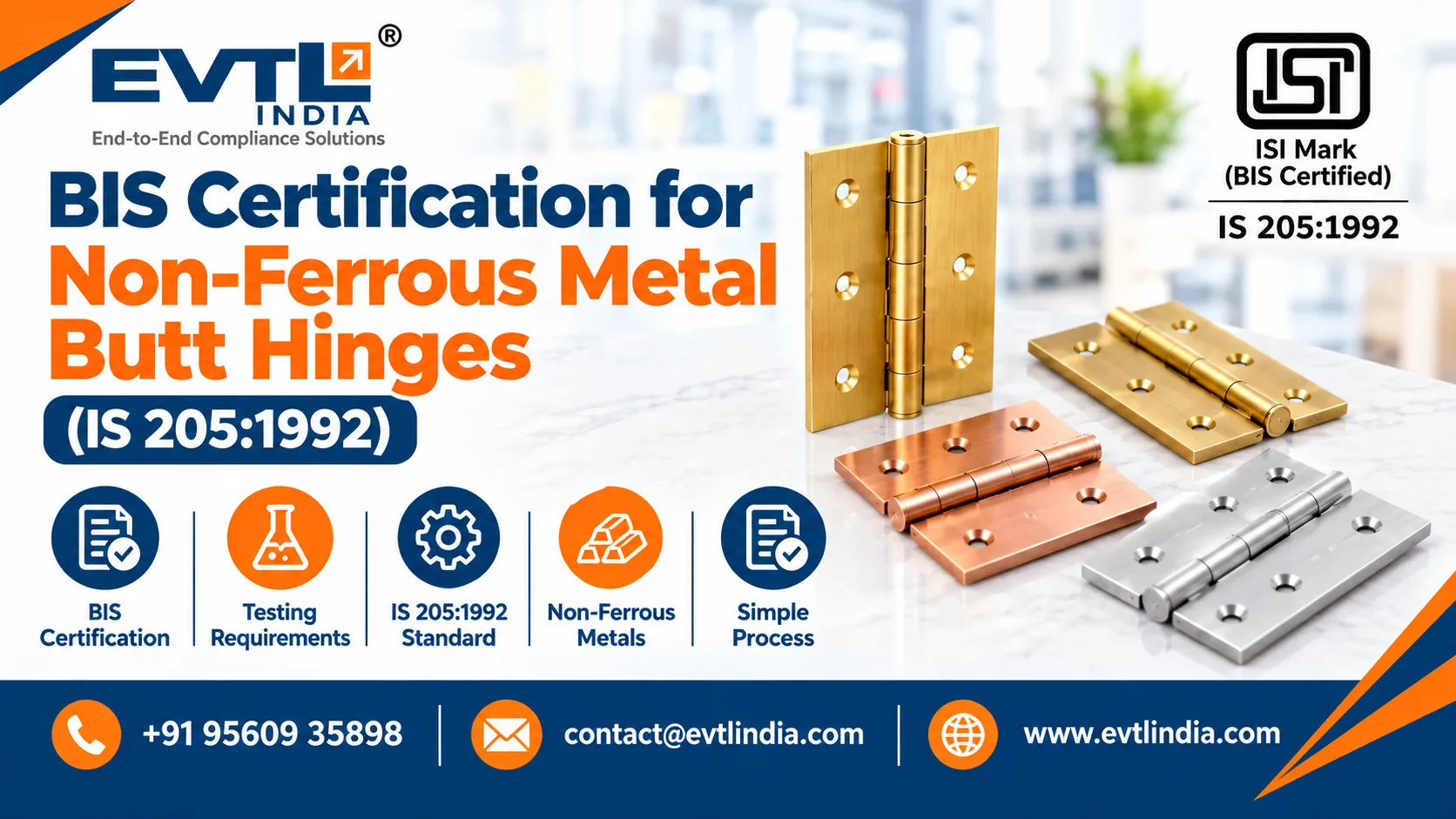
What Are Non-Ferrous Metal Butt Hinges?
"Non-ferrous" means a metal that has no iron, or very little iron, in it. Since iron is what rusts, these hinges last longer in damp places.
Common metals used are:
- Brass
- Bronze
- Aluminium
- Copper alloys
You will see these hinges in bathroom doors, homes near the sea, boats, wooden cupboards, and fancy furniture. People also like them because they look good and shine nicely.
What Is IS 205:1992?
IS 205:1992 is the Indian Standard made by the Bureau of Indian Standards (BIS) for butt hinges made of non-ferrous metals. You can think of it as a rule book for making a good hinge.
It tells the maker things like:
- Which metals can be used
- How thick and wide the hinge leaves should be
- Where the screw holes should be
- How the pin should fit
- How smooth the finish should be
When every maker follows the same rule book, buyers get hinges that fit properly and work well.
Is BIS Certification Compulsory?
Yes. The government has put these hinges under a Quality Control Order (QCO). This means you cannot make, import or sell them in India without a valid BIS licence.
If a business sells hinges without it, it can face penalties, stock seizure, and loss of buyer trust. Foreign companies that export these hinges to India must also get certified.
Why This Certification Matters
Getting BIS Certification for Non-ferrous metal butt hinges is not only about following the law. It also helps your business in real ways:
- Builders and dealers trust certified products more
- You can sell in big projects and government tenders
- Your hinges are checked regularly, so quality stays steady
- Fewer customer complaints and returns
- A stronger brand name in the market
What Is the BIS ISI Mark?
The BIS ISI Mark for Non-ferrous metal butt hinges is a small logo printed or stamped on the product or its box. It tells the buyer that the hinge was tested and the factory was checked by BIS. For a normal shopper, this little mark is the easiest way to know the product is safe to buy.
Testing: What Does BIS Check?
Before giving a license, BIS wants proof that your hinge is good. The BIS testing requirement for Non-ferrous metal butt hinges means your samples must pass tests in a BIS-recognized lab.
Here are the main checks:
TestWhat It ChecksMaterialIs the metal the right type?DimensionsAre size, thickness and hole positions correct?Workmanship and finishIs the surface smooth, with no cracks or sharp edges?Pin and jointDoes the hinge open and close smoothly?StrengthCan it hold weight without bending?Lab testing usually takes about 7 to 15 days once samples reach the lab.
Step-by-Step Process
StepWhat Happens1. DocumentsYou collect company, factory and product papers2. ApplicationYou fill in the BIS form online and pay the fees3. Factory auditA BIS officer visits and checks your factory and lab4. Sample testingSamples go to a BIS-recognized lab5. License grantBIS approves and gives you the licenseFor Indian manufacturers, the whole process often takes around 30 to 45 days if the papers are ready. Foreign manufacturers usually need more time.
Documents You Will Need
Keep these ready to save time:
- Business registration proof
- Factory address proof
- Factory layout and list of machines
- Process flow chart
- Details of your testing lab and equipment
- Product drawings and specifications
- For foreign makers: details of an Authorized Indian Representative (AIR)
Common Mistakes to Avoid
Many new applicants lose weeks because of small errors. Watch out for these:
- Wrong or incomplete documents
- A factory lab without the needed testing equipment
- Sending samples that do not match the standard
- Missing the renewal date of the license
A little planning at the start prevents most of these problems.
Conclusion
EVTL India is one of the leading BIS Consultant in India, helping manufacturers obtain their BIS licenses hassle-free.
If you make or import brass, bronze or aluminium hinges, getting certified is the safest way to grow your business in India. Our team will explain each step in simple words, prepare your papers, guide you for testing and the factory audit, and stay with you until your license is in your hand.
Contact EVTL India
- Phone: +91 95609 35898
- Email: [email protected]
- Website: www.evtlindia.com
Frequently Asked Questions (FAQs)
1. What is IS 205:1992?
It is the Indian Standard that sets quality rules for non-ferrous metal butt hinges.
2. Which metals are covered?
Brass, bronze, aluminium and other copper-based alloys.
3. Is BIS certification compulsory for these hinges?
Yes. It is compulsory under a Quality Control Order for makers and importers.
4. What does the ISI Mark tell a buyer?
It tells the buyer that the product has been tested and the factory is checked by BIS.
5. Where are the hinges tested?
In a BIS-recognized laboratory.
6. What tests are done on the hinges?
Material, size, finish, pin fitting and strength tests.
7. How long does it take to get the license?
For Indian manufacturers, about 30 to 45 days when all papers are ready.
8. How long is the license valid?
Usually 1 to 2 years. You must renew it before it ends.