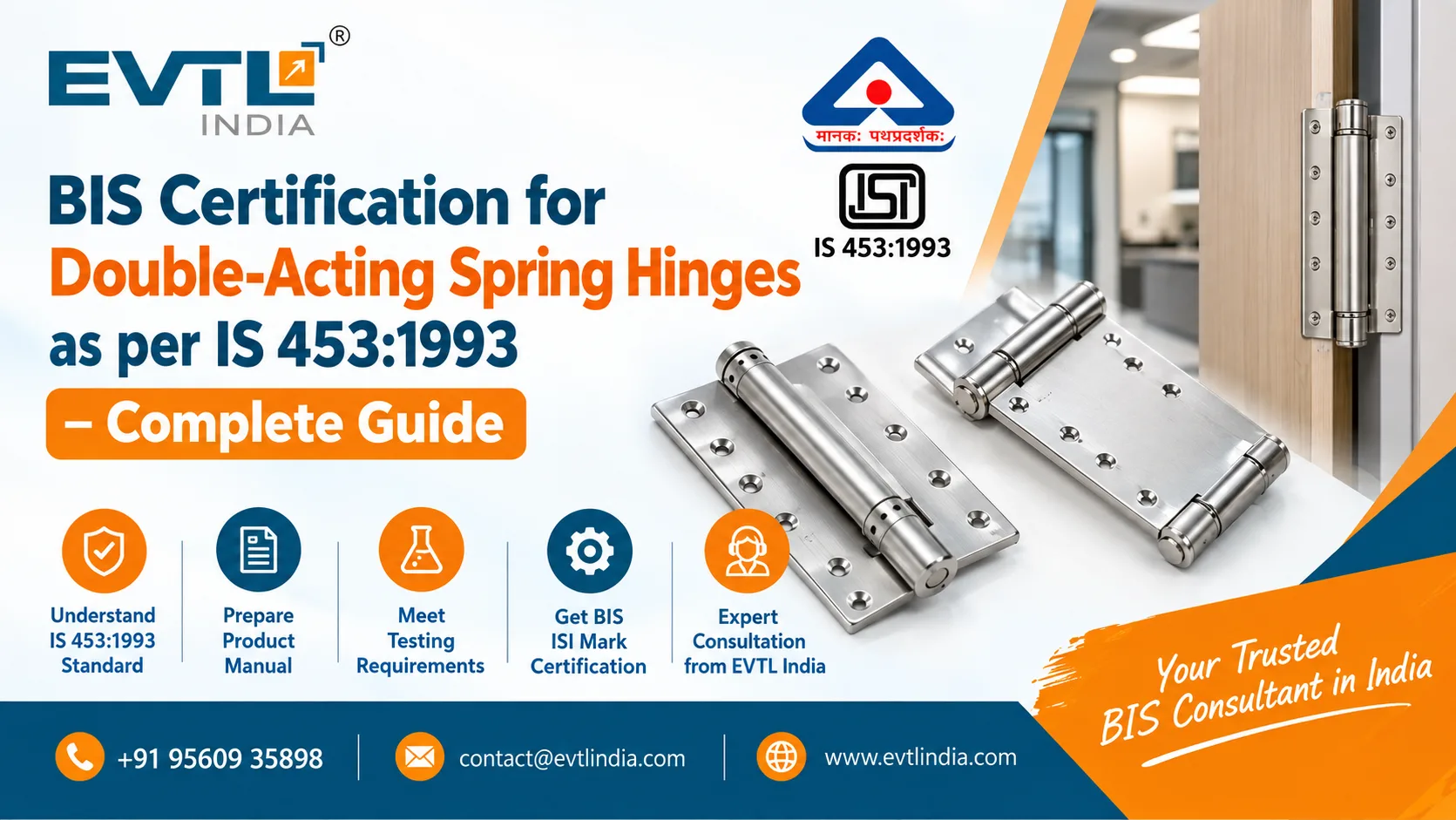
Double-acting spring hinges are used on doors that need to open in both directions and return toward the closed position. They are commonly used in restaurants, offices, commercial buildings, hospitals, and other places where doors are opened frequently. IS 453:1993 gives requirements related to the material, dimensions, manufacture, finish, and testing of these hinges. Manufacturers should understand the applicable BIS requirements before producing or selling products covered by the relevant regulatory requirements.
What Are Double-Acting Spring Hinges?
A double-acting spring hinge is a door hinge designed to allow movement in two directions. A spring mechanism helps bring the door back toward its closed position after it is opened.
These hinges can be useful in areas where people need to pass through a door from either side. Their simple working makes them suitable for many commercial and building applications.
Some common uses include:
- Restaurant and kitchen doors
- Office and commercial doors
- Hospital and service-area doors
- Building entrance or internal doors
- Other swing-door applications
The quality of the hinge is important because it may be opened and closed many times during normal use.
Understanding IS 453:1993
IS 453:1993 is the Indian Standard covering double-acting spring hinges and corresponding blank hinges generally used for swing doors. The standard provides requirements that help manufacturers maintain consistent product quality.
The standard covers important areas such as:
RequirementWhat it meansMaterialRequirements related to materials used in the productDimensionsRequired measurements and sizesManufactureRequirements related to construction and manufacturingFinishRequirements related to the product surface and finishTestsChecks used to assess applicable product requirementsManufacturers should refer to the applicable standard and current BIS requirements to understand which provisions apply to their particular product.
BIS For Double-acting spring hinges
The applicable BIS requirement is important for manufacturers whose products fall under the mandatory certification framework. BIS certification is intended to show that the product has been assessed against the relevant Indian Standard under the applicable certification scheme.
For a manufacturer, the first step is to understand whether the product is covered by a Quality Control Order or another mandatory requirement. The manufacturer should then identify the applicable certification route and prepare the product and factory for the required assessment.
BIS Certification for Double-acting spring hinges
The certification process normally involves several stages. The manufacturer needs to provide correct product and factory information, prepare the required documents, arrange applicable testing, and complete the BIS application procedure.
A simple overview of the process is:
- Identify the applicable Indian Standard.
- Check the current BIS regulatory requirement.
- Prepare product and manufacturing information.
- Arrange testing through the applicable laboratory.
- Prepare and submit the BIS application.
- Complete inspection or assessment, where applicable.
- Address any observations or additional requirements.
- Complete the applicable BIS approval and licensing process.
The actual process can vary depending on the manufacturer, product details, certification scheme, and current BIS requirements.
Testing Requirements for Double-Acting Spring Hinges
Testing is an important part of product compliance. It helps determine whether the hinge meets the applicable technical requirements.
Major areas that may be considered include:
- Dimensions: Product measurements are checked against applicable requirements.
- Material: The material used in manufacturing is assessed according to the relevant requirements.
- Manufacture: The construction and manufacturing quality are examined.
- Finish: The surface finish is checked as required.
- Performance: The working performance of the hinge is assessed through applicable testing.
Manufacturers should not assume that the same testing process applies to every product variant. The applicable requirements should be confirmed before testing begins.
Documents Required for BIS Compliance
Good documentation can make the certification process easier to manage. Depending on the application, manufacturers may need documents and information such as:
- Manufacturer and company details
- Manufacturing-unit information
- Product specifications
- Product drawings
- Raw-material details
- Manufacturing process information
- Quality-control details
- Machinery and testing equipment details
- Applicable test reports
- Other documents required by BIS
The exact documents can depend on the certification application and current BIS requirements. Therefore, manufacturers should prepare documents according to the applicable procedure rather than relying on a general checklist.
BIS Registration for Double-acting spring hinges
Manufacturers often use the term registration when discussing BIS compliance, but the exact BIS route depends on the product and applicable certification scheme. For products covered under the relevant product certification requirements, the manufacturer needs to follow the prescribed BIS licensing procedure.
This may include application submission, testing, factory assessment, documentation review, and compliance with applicable conditions before the license is granted.
Therefore, businesses should first confirm the correct BIS scheme and procedure applicable to their double-acting spring hinges.
Who May Need BIS Compliance?
BIS requirements can be relevant to manufacturers producing products that fall within the scope of applicable mandatory regulations.
Businesses should determine their obligations based on:
- Product type
- Applicable Indian Standard
- Manufacturing location
- Current Quality Control Order
- Applicable BIS certification scheme
- Product specifications and variants
Foreign manufacturers may also have additional requirements when seeking BIS certification for products intended for the Indian market.
Why Proper Compliance Matters
Following the applicable requirements can help manufacturers maintain consistent product quality and meet regulatory obligations. It also provides a structured approach to manufacturing, testing, documentation, and quality control.
For buyers and businesses, compliance information can provide greater clarity about whether a covered product has gone through the applicable conformity assessment process.
Manufacturers should also keep themselves updated because BIS standards, Quality Control Orders, certification schemes, and implementation dates can change.
How a BIS Consultant Can Help
BIS Consultant for Double-acting spring hinges can assist manufacturers in understanding the certification requirements and managing different stages of the compliance process.
Professional assistance may include:
- Understanding applicable BIS requirements
- Document preparation
- Application support
- Testing coordination
- Communication related to the certification process
- Factory inspection preparation
- Assistance in responding to BIS observations
- General compliance guidance
A consultant does not replace the manufacturer's responsibility to maintain product quality. The manufacturer must ensure that its product and manufacturing system meet the applicable requirements.
Why Choose EVTL India?
EVTL India provides support for BIS certification and regulatory compliance requirements for manufacturers. Its team can help businesses understand the applicable procedure and coordinate different activities involved in the certification process.
For double-acting spring hinge manufacturers, EVTL India can provide assistance with documentation, testing coordination, application-related work, and other compliance activities based on the product and applicable BIS requirements.
Conclusion
EVTL India is one of the leading BIS Consultant in India, helping manufacturers obtain their BIS licenses hassle-free. Manufacturers of double-acting spring hinges should understand IS 453:1993, applicable testing requirements, documentation, and the relevant BIS certification procedure before starting the application process. Proper preparation can help reduce confusion and make the compliance process more organized.
For assistance with BIS requirements for double-acting spring hinges, manufacturers can contact EVTL India:
📞 Phone: +91 95609 35898
📧 Email: [email protected]
🌐 Website: www.evtlindia.com
Frequently Asked Questions
1. What is IS 453:1993?
IS 453:1993 is the Indian Standard covering requirements for double-acting spring hinges and corresponding blank hinges generally used for swing doors.
2. What requirements are covered under this standard?
The standard covers areas such as material, dimensions, manufacture, finish, and applicable tests.
3. Is testing required for BIS certification?
Testing may be required as part of the applicable BIS certification process. The exact tests depend on the product and current certification requirements.
4. Can a BIS consultant help with the application?
Yes. A consultant can assist with documentation, testing coordination, application-related activities, inspection preparation, and other compliance steps.
5. Does the BIS process take the same time for every manufacturer?
No. The timeline can vary depending on testing, documentation, inspection, BIS processing, and other factors related to the application.
6. Can foreign manufacturers apply for BIS certification?
Foreign manufacturers can apply under the applicable BIS certification route when their products are covered by the relevant requirements. Additional procedures may apply to overseas manufacturing units.