
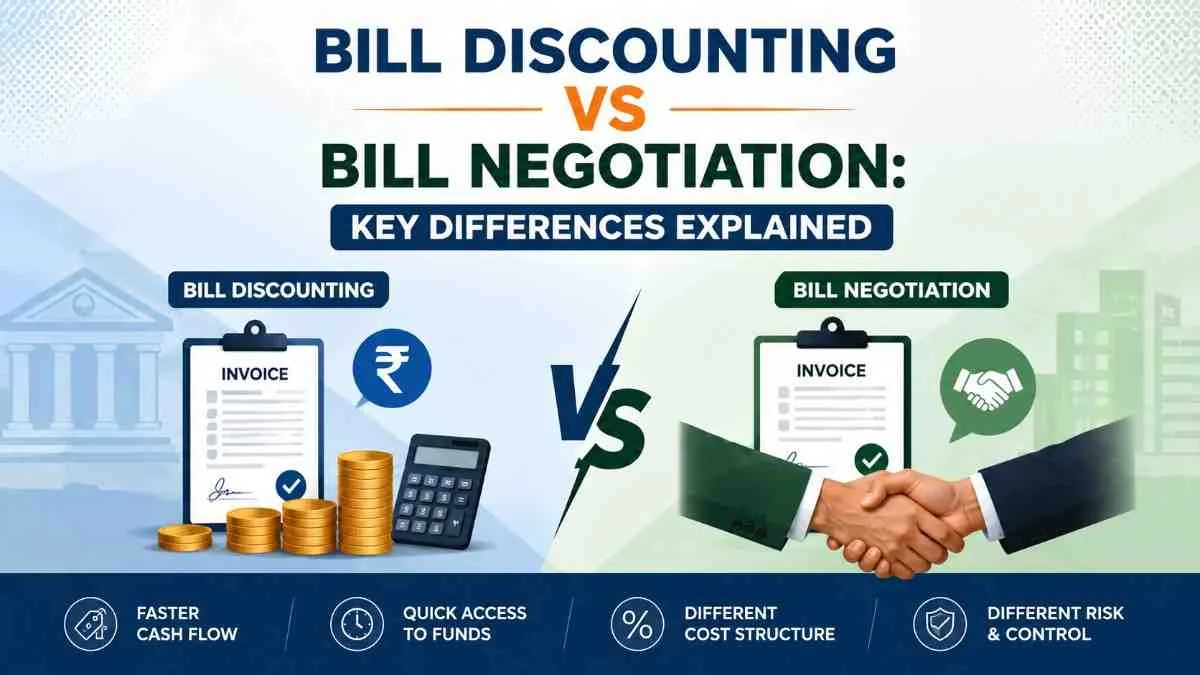
Businesses often sell goods or services on credit. That means payment comes after 30, 60, or even 90 days. While waiting for customers to pay, businesses still need money to buy raw materials, pay salaries, manage operations, and accept new orders.
This is where financing options like bill discounting and bill negotiation become useful. Both help businesses receive funds before the actual payment date, but they work differently and are meant for different business situations.
Many people use these terms interchangeably, but they are not the same. Knowing the difference helps businesses choose the right financing option and manage cash flow more efficiently.
In this guide, we'll explain what bill discounting and bill negotiation mean, their benefits, key differences, and which option is suitable for your business.
What Is Bill Discounting?
Bill discounting is a financing method where a business receives money against its unpaid invoices or bills before the payment due date. Instead of waiting for the buyer to make the payment, the business approaches a bank, NBFC, or a TReDS platform to get most of the invoice value in advance.
The financing institution deducts a discounting charge or interest and releases the remaining amount immediately. Once the invoice becomes due, the buyer pays the financer.
Bill discounting is widely used by MSMEs and suppliers who regularly sell goods on credit and need working capital without taking a traditional business loan.
Advantages of Bill Discounting
Improves Cash FlowBusinesses receive funds quickly instead of waiting for long credit periods.
No Need to Wait for Customer PaymentsOperations continue without depending on delayed customer payments.
Supports Working CapitalThe funds can be used for inventory purchases, salaries, supplier payments, transportation costs, or business expansion.
No Collateral in Many CasesPlatforms like RXIL TReDS allow eligible MSMEs to access invoice financing without pledging assets.
Better Financial PlanningPredictable cash inflows help businesses manage expenses more confidently.
What Is Bill Negotiation?
Bill negotiation is a banking process mainly used in international trade or transactions backed by trade documents.
In this method, a seller submits documents such as the bill of exchange, invoice, shipping documents, insurance papers, and other required documents to the bank. The bank checks whether these documents comply with the agreed terms. If everything is in order, the bank releases payment to the seller before collecting the amount from the buyer.
Bill negotiation is commonly used for export transactions conducted under a Letter of Credit (LC).
Unlike bill discounting, the focus here is not only on early payment but also on verifying trade documents before making the payment.
Advantages of Bill Negotiation
Faster Payment in Export TransactionsExporters receive funds before overseas buyers complete payment.
Document VerificationBanks carefully verify documents, reducing the chances of disputes.
Better SecurityTransactions backed by Letters of Credit provide additional payment assurance.
Supports International TradeIt helps exporters maintain smooth cash flow while dealing with overseas customers.
Reduces Payment RiskProper banking procedures lower the chances of payment defaults due to document-related issues.
Bill Discounting vs Bill Negotiation
Although both methods help businesses receive money before the payment due date, they differ in several ways.
Purpose
Bill discounting focuses on improving working capital by converting unpaid invoices into immediate cash.
Bill negotiation mainly supports trade transactions where banks verify documents before releasing payment.
Type of Transactions
Bill discounting is commonly used in domestic business transactions and increasingly through digital invoice financing platforms.
Bill negotiation is mostly associated with export-import transactions and Letter of Credit arrangements.
Document Verification
In bill discounting, financing is based mainly on the invoice and buyer's creditworthiness.
In bill negotiation, banks verify shipping documents, invoices, bills of exchange, and other trade documents before making payment.
Risk Assessment
Bill discounting largely depends on the financial strength and repayment capability of the buyer.
Bill negotiation depends on document compliance as well as the terms mentioned in the Letter of Credit or trade agreement.
Speed of Funding
Bill discounting is generally faster because documentation requirements are simpler.
Bill negotiation may take additional time due to document examination by the bank.
Best Suited For
Bill discounting works well for MSMEs, manufacturers, wholesalers, suppliers, and service providers that regularly sell on credit.
Bill negotiation is more suitable for exporters involved in international trade.
When Should You Choose Bill Discounting?
Bill discounting is a suitable option if your business:
- Regularly sells goods on credit.
- Faces delayed customer payments.
- Needs working capital to fulfil new orders.
- Wants quick access to funds without applying for a long-term loan.
- Prefers invoice-based financing instead of borrowing against assets.
For Indian MSMEs, digital invoice financing through RXIL TReDS has made bill discounting much faster and more transparent. Approved invoices can be financed by multiple banks and financial institutions through a competitive bidding process, helping businesses receive funds at competitive rates.
When Should You Choose Bill Negotiation?
Bill negotiation is the better choice if:
- Your business exports goods internationally.
- Payments are backed by a Letter of Credit.
- Trade documents require bank verification.
- You want additional payment security in overseas transactions.
- Your business regularly deals with international buyers.
It is particularly useful where documentary compliance plays an important role in completing the transaction.
Can Businesses Use Both?
Yes. Some businesses may use both financing methods depending on the type of transaction.
For example, a manufacturing company may use:
- Bill discounting for domestic sales made to Indian buyers.
- Bill negotiation for export shipments supported by Letters of Credit.
Using the right financing option for each transaction helps maintain healthy cash flow while reducing payment-related risks.
Why Bill Discounting Is Becoming More Popular in India
Over the last few years, invoice financing has become more accessible for MSMEs. Digital platforms, improved regulations, and faster approval processes have made bill discounting easier than ever.
Businesses no longer need to rely only on traditional bank loans for working capital. Instead, they can unlock funds already tied up in unpaid invoices.
Platforms operating under the Trade Receivables Discounting System (TReDS), such as RXIL, connect MSME suppliers with multiple financiers through a digital marketplace. This allows eligible businesses to receive payments faster while improving overall cash flow.
For businesses that regularly face delayed customer payments, bill discounting has become an efficient working capital solution.
Conclusion
Both bill discounting and bill negotiation help businesses access funds before the payment due date, but they serve different purposes.
Bill discounting is mainly designed to improve working capital by financing unpaid invoices. It is widely used by MSMEs and businesses selling on credit in the domestic market.
Bill negotiation, on the other hand, is more common in international trade, where banks verify shipping and trade documents before releasing funds under a Letter of Credit.
If your business wants faster access to cash from domestic receivables, bill discounting is usually the more practical option. If you're dealing with export transactions that require documentary compliance, bill negotiation is the appropriate financing method.
Choosing the right option depends on your business model, customer profile, and the type of transactions you handle.
Frequently Asked Questions
Is bill discounting the same as bill negotiation?
No. Bill discounting focuses on financing unpaid invoices for working capital, while bill negotiation involves document verification, mainly in export transactions backed by Letters of Credit.
Who can use bill discounting?
MSMEs, manufacturers, suppliers, distributors, wholesalers, and service providers that sell goods or services on credit can use bill discounting.
Is bill negotiation only for exporters?
It is primarily used in export-import trade, especially where payments are secured through Letters of Credit and documentary compliance is required.
Is bill discounting available without collateral?
Yes. Many invoice financing solutions, including eligible transactions on the RXIL TReDS platform, provide bill discounting without requiring traditional collateral.
Which option is better for MSMEs?
For most MSMEs dealing with domestic credit sales, bill discounting is generally the better option because it provides quicker access to working capital and supports day-to-day business operations.