
Introduction
Some of the biggest stories a child ever tells happen in the smallest spaces. Hand a little girl a dollhouse, and within minutes she's got a whole world running, someone's cooking dinner, someone's napping, someone's throwing a party on the balcony. It looks like simple play from the outside, but a good doll house for girls does a lot more than fill an afternoon. It gives a child a space to think, decide, and imagine, all on her own terms.
Why Pretend Play Matters More Than It Looks
Pretend play is one of the earliest ways children make sense of the world around them. When a child arranges furniture in a dollhouse, decides who sleeps where, or invents a small argument between two characters, she's practicing skills that go far beyond the toy itself. Problem-solving, storytelling, decision-making, and even early social understanding all get a workout during this kind of open-ended play. Unlike toys with a fixed outcome, a dollhouse never really has a "finished" state. There's always another room to rearrange or another story to invent, which is exactly why it holds a child's attention for so long.
What Makes the Chanak Wooden Doll House Different
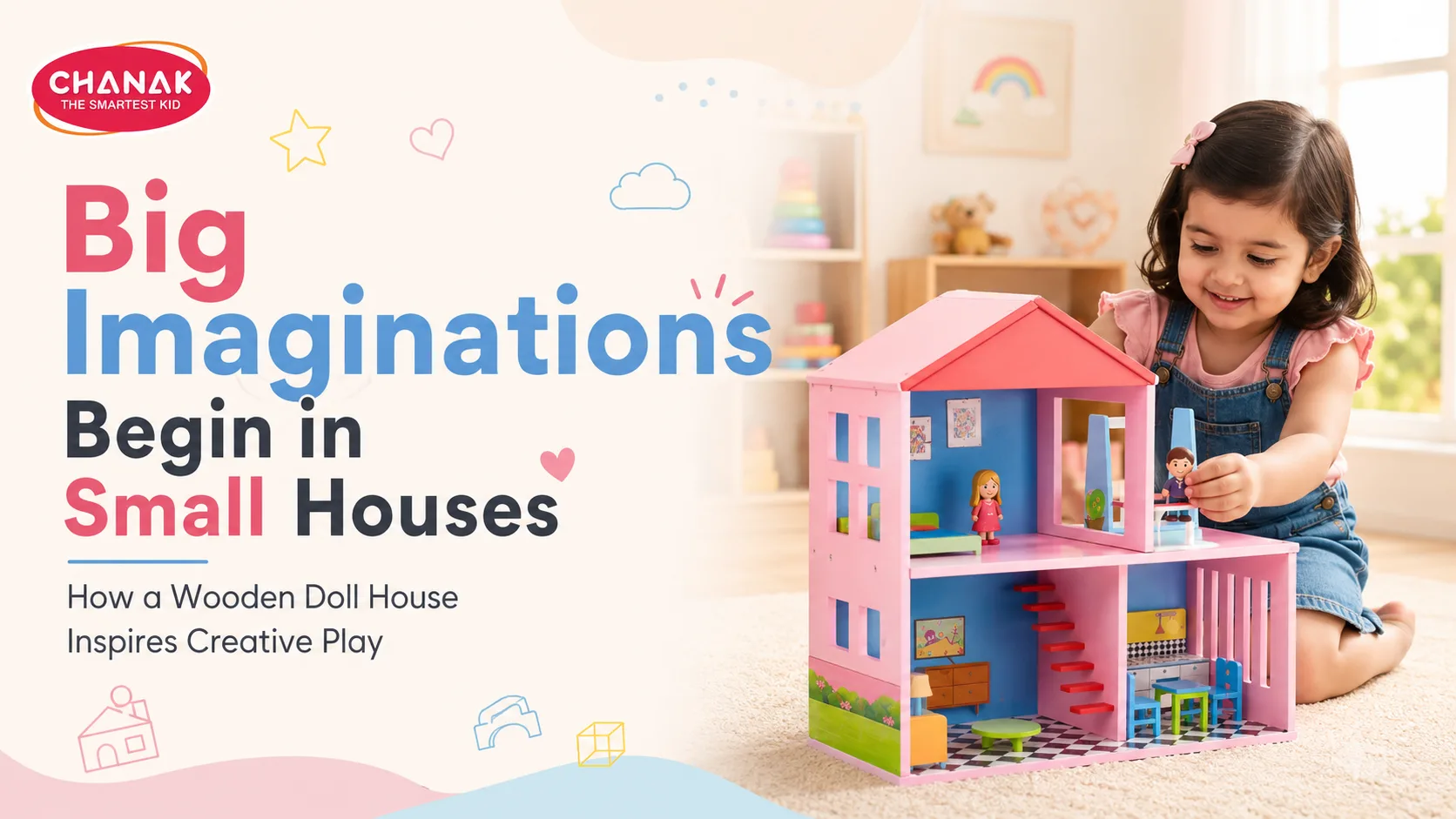
The Chanak Wooden Doll House for Girls is built from MDF wood with rounded edges, finished in non-toxic, BPA-free paint, and comes fully furnished right out of the box. It includes four rooms, a hall, bedroom, kitchen, and balcony, along with 16 furniture and accessory pieces: a bed, sofa, dining table, round table, two chairs, a kitchen platform, a drawer, a night lamp, a swing, a flower pot, a pillow, two characters, and their stands. Nothing extra needs to be bought separately, which means a child can start playing and building stories the moment it's unboxed.
It's also BIS certified and manufactured under ISO 9001:2015 quality standards, made in India by Aditi Toys Pvt. Ltd. in Rajkot, Gujarat. For parents comparing wooden toy houses at a similar price point, that combination of safety certification and genuine build quality isn't always a given.
The Real Skills Behind the Play
Every time a child sets up a room or moves a character from the kitchen to the balcony, she's making small decisions, where does this go, what happens next, does this make sense. That's a form of problem-solving that doesn't feel like a lesson because it's wrapped inside play she actually enjoys. Arranging furniture also builds spatial thinking, understanding how objects fit together in a space, while inventing little stories between the two included characters supports language development and early social-emotional understanding.
None of this needs to be taught directly. A well-designed doll house for girls does most of the work simply by giving a child enough pieces and just enough structure to build her own version of a home.
A Toy Built for Shared Time, Not Just Solo Play
One of the most overlooked benefits of a dollhouse is how naturally it invites a parent into the play. Setting up rooms together, deciding where the sofa goes, or taking turns narrating what each character is doing turns a simple toy into genuine shared time. It's a small thing, but for busy parents looking for a screen-free way to connect with their child for even twenty minutes, it matters.
Why It's a Reliable Gift Choice
A wooden dollhouse tends to hold up well as a gift because it isn't tied to a single trend or a single way of playing. It works for birthdays, festive gifting, or just because moments, and it's suitable for kids from age 3 and up, with enough furniture and detail to stay interesting well beyond the first few weeks. Parents looking for a doll house for girls that combines genuine play value with safety certification will find the Chanak version checks both boxes without needing any compromise between the two.
Conclusion
A dollhouse isn't just a toy that sits in the corner of a room. It's a small, contained world that a child gets to build, rebuild, and reimagine every time she sits down to play. The Chanak Wooden Doll House for Girls gives kids everything they need to start that imaginative process right away, four furnished rooms, sixteen pieces, and enough open-ended possibility to keep big imaginations busy for a long time to come. You can explore the full range at chanak.co.
Frequently Asked Questions
What age group is a wooden doll house suitable for?
Most wooden dollhouses, including the Chanak version, are designed for children aged 3 and above, since the pieces are large enough to handle safely and the play style suits early pretend-play skills.
What is the Chanak doll house made from?
It's made from MDF wood with rounded edges for safety, finished in non-toxic, BPA-free paint, making it safe for regular handling by young children.
How many pieces come with the doll house?
The set includes 16 pieces across 4 rooms, a hall, bedroom, kitchen, and balcony, along with furniture like a bed, sofa, dining table, chairs, a kitchen platform, a night lamp, and two characters with stands.
Is this doll house only suitable for girls?
While it's marketed as a doll house for girls, pretend play with a dollhouse works well for any child, since the skills it builds, storytelling, spatial thinking, and problem-solving, aren't specific to gender.
Is the doll house safe for daily play?
Yes, it's BIS certified and manufactured under ISO 9001:2015 quality standards, with non-toxic paint and BPA-free materials suited for regular, everyday use.
Does a wooden doll house help with child development?
Yes, arranging furniture and inventing stories with the included characters supports problem-solving, spatial awareness, language development, and imaginative thinking.
Is a doll house a good gift for a 3-year-old?
Yes, it works well as a gift for birthdays, festive occasions, or just-because moments, and it's suited to children aged 3 and up who are ready for imaginative, hands-on play.
Do parents need to play along, or can kids use it independently?
Both work well. Younger children benefit from a parent setting up the first few scenes together, while older kids are usually comfortable playing and rearranging rooms independently.