
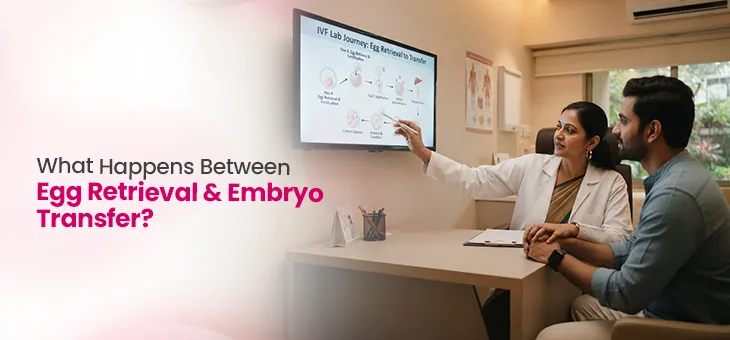
For many people undergoing IVF, egg retrieval feels like a major milestone. But once the procedure is over, an equally important part of the treatment begins behind the scenes.
The days between egg retrieval and embryo transfer involve laboratory assessment, fertilisation, embryo development and decisions about when or whether to proceed with a fresh transfer.
Understanding what happens during this stage can make the IVF process feel less uncertain and help patients know why every cycle does not necessarily follow exactly the same timeline.
What Happens Immediately After Egg Retrieval?
Once eggs have been collected, they are transferred to the fertility laboratory for assessment.
At the same time, the sperm sample is prepared according to the treatment plan. The next step is attempting fertilisation.
It is important to remember that retrieving several eggs does not mean every egg will fertilise or develop into an embryo. Cambridge Hospital’s own IVF guidance notes that fertilisation and embryo development are assessed progressively before a decision about transfer is made. Cambridge Hospital
The Human Fertilisation and Embryology Authority (HFEA) similarly describes IVF as a multi-stage process involving egg collection, fertilisation in a laboratory, embryo development and eventual transfer into the uterus. HFEA
Conventional IVF or ICSI: How Does Fertilisation Happen?
Fertilisation can take place in different ways depending on the individual treatment plan.
Conventional IVF
In conventional IVF, prepared sperm and mature eggs are placed together in the laboratory so fertilisation can occur.
ICSI
Intracytoplasmic sperm injection, commonly called ICSI, involves an embryologist injecting a single sperm directly into a mature egg.
ICSI may be considered in certain circumstances, including some cases involving sperm-related fertility factors. The appropriate approach depends on the couple’s clinical situation and the specialist’s treatment recommendation. HFEA
Patients exploring assisted reproduction can review the services offered by a best fertility hospital in Bangalore to understand how IVF, ICSI and other fertility options may fit into an individual treatment plan.
What Happens After Fertilisation?
When fertilisation occurs, the resulting embryos are cultured and monitored in the laboratory.
This is not simply a waiting period.
Embryologists observe how the embryos develop and assess their progress over the following days. According to HFEA guidance, embryos created through IVF may develop in the laboratory for several days before the appropriate embryo is selected for transfer. HFEA
Not every fertilised egg will continue developing at the same rate, and this variation is a normal part of IVF biology.
The fertility team therefore considers embryo development alongside the patient’s broader treatment plan before deciding on the next stage.
When Does Embryo Transfer Happen?
There is no single transfer timeline that applies to every IVF patient.
Cambridge Hospital explains that the timing depends on embryo development, the treatment plan and the patient’s individual circumstances. Cambridge Hospital
Some patients may undergo a fresh embryo transfer during the same treatment cycle.
For others, suitable embryos may be frozen and transferred during a later cycle.
This means a delayed transfer does not necessarily indicate that something has gone wrong. In some treatment plans, freezing embryos and scheduling a later frozen embryo transfer is intentionally chosen based on clinical circumstances.
What Is a Frozen Embryo Transfer?
A frozen embryo transfer uses an embryo that was previously frozen and stored after an earlier IVF cycle.
Before transfer, the uterus is prepared according to the treatment protocol, and the timing is planned individually.
Suitable embryos that are not transferred immediately may also be frozen for possible future use. Cambridge Hospital’s IVF information and HFEA guidance both describe embryo freezing as part of IVF treatment in appropriate cases. Cambridge Hospital
Does Every Retrieved Egg Become an Embryo?
No.
One of the most useful things for patients to understand before IVF is that there are several biological stages between egg retrieval and pregnancy.
Not every retrieved egg will necessarily be mature. Not every mature egg will fertilise. And not every fertilised egg will continue developing into an embryo suitable for transfer.
The American Society for Reproductive Medicine also highlights this natural attrition during IVF, noting that development occurs progressively from retrieved eggs through fertilisation and embryo development. ASRM
This is one reason IVF outcomes cannot be predicted simply from the number of eggs collected.
What Happens Before the Embryo Is Transferred?
Before embryo transfer, the fertility team reviews the embryo’s development and the patient’s treatment plan.
The embryo selected for transfer is prepared in the laboratory and then placed into the uterus using the appropriate transfer procedure.
Embryo transfer itself is an important step, but it is not the final confirmation of pregnancy. Patients are subsequently advised when to perform the appropriate pregnancy test and what follow-up is required.
From Fertility Treatment to Pregnancy Care
When an embryo implants and pregnancy is confirmed, the focus gradually moves from fertility treatment toward pregnancy monitoring and antenatal care.
Continuity during this transition can be valuable because pregnancy care involves much more than confirming conception. Regular monitoring helps clinicians follow maternal health, fetal development and pregnancy-specific needs as the pregnancy progresses.
Families planning this next stage may therefore also consider the pregnancy and maternity services available at a pregnancy hospital in Bangalore.
The Cambridge maternity service currently lists pregnancy care, fetal monitoring, labour and delivery care, anaesthesia support, neonatal support and postpartum care among its maternity services. Cambridge Hospital
Planning Ahead for Delivery
The fertility journey and maternity journey are connected, but they involve different clinical needs.
Once pregnancy progresses, expectant parents will eventually need to consider factors such as:
- Obstetric support
- Fetal monitoring
- Labour and delivery facilities
- Emergency medical support
- Neonatal care
- Postpartum support
- Accessibility of the hospital
When comparing options for the best hospital for delivery in Bangalore, these practical maternity-care factors can be more useful than focusing only on the hospital name or location.
Cambridge Hospital’s maternity page states that its services include fetal monitoring during labour, anaesthesia support, labour and delivery care, neonatal support and postpartum assistance. Cambridge Hospital
Questions Patients Often Have Between Retrieval and Transfer
Is embryo transfer always performed immediately after egg retrieval?
No. Depending on embryo development and the treatment plan, a fresh transfer may take place during the same cycle or embryos may be frozen for later transfer. Cambridge Hospital
Are all retrieved eggs fertilised?
No. Egg retrieval does not guarantee that every egg will fertilise or develop into an embryo. Cambridge Hospital
Can embryos be frozen?
Yes. Suitable embryos may be frozen and stored for future transfer when this is appropriate for the treatment plan. Cambridge Hospital
Is ICSI used in every IVF cycle?
No. ICSI is a specific fertilisation technique and is selected based on the couple’s circumstances and treatment strategy. Cambridge Hospital
Understanding the Process Can Reduce Uncertainty
Egg retrieval is only one stage of IVF.
Between retrieval and transfer, several important events need to take place: the eggs are assessed, fertilisation is attempted, embryos are monitored as they develop, and the fertility team determines whether a fresh or frozen embryo transfer is appropriate.
There is also no reason to compare one patient’s exact IVF timeline with another’s. Embryo development, fertility factors and treatment strategies differ from person to person.
Knowing what happens during these days can help patients ask more informed questions and understand why their fertility specialist may recommend a particular next step.
And when treatment progresses to pregnancy, planning appropriate antenatal, maternity and delivery care becomes the next important part of the journey.
Medical Disclaimer: This article is intended for general educational information only. IVF protocols and outcomes vary between individuals. Decisions about fertility treatment, embryo transfer, pregnancy care and delivery should be made in consultation with qualified healthcare professionals.