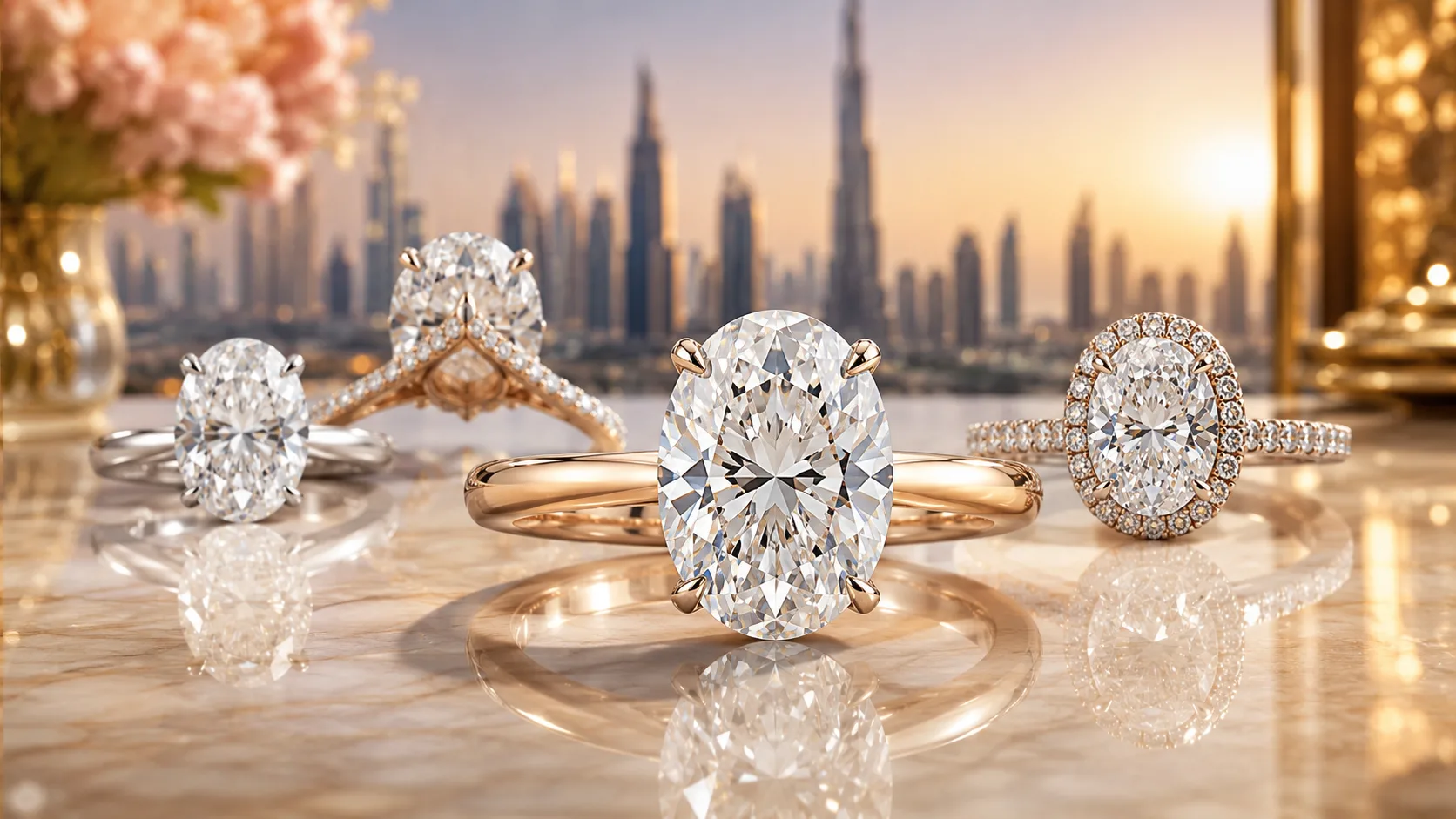
Oval diamonds are popular for engagement rings because their elongated shape combines the brilliance of a round diamond with a distinctive and elegant outline.
The shape can create noticeable finger coverage and may make the finger appear longer. However, the final appearance of an oval diamond depends heavily on its setting.
A well-chosen setting should hold the diamond securely, complement its proportions and suit the wearer’s everyday lifestyle. It should also control how high the diamond sits, how easily the ring catches on clothing and whether a wedding band can sit comfortably beside it.
From classic solitaire rings to hidden halos, bezels and three-stone designs, there are several oval engagement ring settings available in Dubai.
This guide compares the best settings for oval engagement rings and explains how to choose according to diamond size, hand shape, personal style and long-term wear.
Why the Setting Matters for an Oval Diamond
The setting is the metal structure that holds the centre diamond in place.
It affects:
- Diamond security
- Ring height
- Visible diamond size
- Light entering the diamond
- Side profile
- Wedding-band compatibility
- Comfort during daily wear
- Overall ring style
Oval diamonds have curved sides and narrower ends. The setting should support this outline without making the diamond look too wide, too narrow or visually unbalanced.
A setting that works well for a round diamond may not create the same result for an oval diamond.
The centre stone’s length-to-width ratio, bow-tie visibility and overall symmetry should all be considered before the ring design is finalised.
Check the Oval Diamond Before Choosing a Setting
The setting can enhance an oval diamond, but it cannot correct every issue in the stone.
Before selecting the ring design, review the diamond itself.
Important factors include:
- Length-to-width ratio
- Symmetry
- Shoulder shape
- Face-up dimensions
- Bow-tie effect
- Cut and light performance
- Colour
- Clarity
- Carat weight
Length-to-Width Ratio
The length-to-width ratio describes how long or rounded an oval diamond appears.
A more elongated oval creates a slim, lengthened appearance, while a lower ratio produces a rounder outline.
There is no single correct ratio for every buyer.
The best proportion depends on:
- Personal preference
- Finger shape
- Ring setting
- Side stones
- Halo design
- Desired finger coverage
A very elongated diamond may require a setting with strong support at both ends.
A rounder oval may work well in a halo or wider band because the overall design remains balanced.
Bow-Tie Effect
Many oval diamonds display some level of bow-tie effect.
This appears as a darker area across the centre of the diamond and results from how light interacts with the elongated facet pattern.
A mild bow tie may not be noticeable during normal wear. A very dark or wide bow tie can reduce the diamond’s brightness.
The setting may influence how the bow tie appears under different lighting, but it cannot completely remove a strong bow tie already present in the diamond.
View the oval diamond moving under natural and indoor light before finalising it.
Oval Diamond Symmetry
The two halves of an oval diamond should appear visually balanced.
Review:
- Alignment of both ends
- Consistency of the curved sides
- Shoulder shape
- Centre alignment
- Overall outline
An uneven oval can become more noticeable in symmetrical settings such as solitaires, halos and three-stone rings.
1. Four-Prong Solitaire Setting
A four-prong solitaire is one of the most popular settings for an oval engagement ring.
It uses four metal prongs positioned around the diamond to hold it securely while leaving most of the stone visible.
The prongs are commonly placed near the curved corners or at carefully selected points along the sides of the oval.
Why Choose a Four-Prong Setting?
A four-prong solitaire can provide:
- A clean and minimal appearance
- Greater visibility of the centre diamond
- Good light access
- A larger-looking face-up outline
- Easy pairing with many wedding bands
- A timeless engagement-ring style
This setting works well when the oval diamond is intended to be the main visual focus.
It may suit someone who prefers an elegant ring without additional side diamonds or detailed metalwork.
Points to Consider
Because fewer prongs are used, the position and construction of each prong are important.
Check that:
- The prongs are evenly aligned
- The diamond does not move
- The narrow ends are sufficiently protected
- Prongs do not catch on clothing
- The ring basket supports the diamond properly
A four-prong setting can expose more of the oval’s edge than a six-prong or bezel design.
For an active wearer, the setting should be constructed carefully and inspected periodically.
2. Six-Prong Solitaire Setting
A six-prong setting uses two additional prongs to provide more contact points around the oval diamond.
The exact arrangement can vary. Some settings place prongs near both ends and along the sides, while others use a more decorative pattern.
Benefits of Six Prongs
A six-prong setting may provide:
- Additional centre-stone security
- Better protection around the narrow ends
- A more detailed or traditional appearance
- Greater reassurance for larger oval diamonds
- A distinctive basket design
This setting may suit buyers who want a solitaire appearance but prefer more metal securing the diamond.
Possible Drawbacks
Additional prongs may cover slightly more of the diamond.
If the prongs are too heavy or positioned poorly, they may make the oval appear shorter or interrupt its smooth outline.
The prongs should be proportional to the diamond’s size.
For smaller oval diamonds, very large prongs can overwhelm the stone. For larger diamonds, extremely fine prongs may not provide enough visual or structural balance.
3. Hidden-Halo Setting
A hidden halo places a row of small diamonds beneath the centre stone.
Unlike a traditional halo, the small diamonds do not surround the oval’s face-up outline. They are mainly visible from the side.
This allows the oval diamond to retain a solitaire-style appearance when viewed from above while adding detail to the ring’s profile.
Why Hidden Halos Are Popular
A hidden-halo setting can provide:
- Extra sparkle from the side
- A modern ring profile
- A clean face-up appearance
- More design detail without widening the centre
- A transition between the centre stone and pavé band
It may suit someone who wants a classic oval diamond from above but prefers a more detailed ring from other angles.
What to Check
A hidden halo may increase the ring’s height.
Check whether:
- The setting is comfortable
- The halo is securely constructed
- The ring sits too high above the finger
- A straight wedding band can fit beside it
- Small diamonds are protected
- The design is easy to clean
A poorly proportioned hidden halo may create unnecessary height or make the centre stone appear disconnected from the band.
4. Traditional Halo Setting
A traditional halo surrounds the oval centre diamond with a border of smaller diamonds.
The halo follows the shape of the centre stone and creates a larger overall outline.
Benefits of an Oval Halo
A halo can:
- Increase the visible size of the ring
- Add more sparkle
- Highlight the oval outline
- Create a detailed bridal appearance
- Allow greater design flexibility
- Provide contrast around the centre diamond
Halo settings can be created with round diamonds, mixed shapes or carefully matched oval-inspired arrangements.
Choosing the Right Halo Proportion
The halo should follow the centre diamond closely.
A large gap between the oval and surrounding diamonds can make the design appear disconnected.
Review:
- Distance between the centre and halo
- Consistency of the surrounding diamonds
- Symmetry of the halo
- Prong placement
- Overall ring width
- Setting height
A very wide halo may overpower a smaller centre diamond.
A delicate halo may create more balanced sparkle while allowing the oval to remain the main feature.
5. Pavé Band Setting
A pavé band includes small diamonds set along the shoulders of the ring.
It adds sparkle around the oval centre stone without surrounding it with a full halo.
Pavé can be combined with:
- Four-prong solitaires
- Six-prong solitaires
- Hidden halos
- Cathedral settings
- Three-stone rings
Why Choose a Pavé Band?
A pavé band may provide:
- Additional sparkle across the finger
- A delicate and refined appearance
- Greater contrast with the centre stone
- A smooth transition from the band to the oval diamond
- Easy coordination with a pavé wedding band
The width of the band should remain proportionate to the centre stone.
A very thin band may make the diamond appear larger, but it must still provide adequate strength for regular wear.
Practical Considerations
Check:
- Pavé diamond security
- Band thickness
- Metal remaining around each small stone
- Comfort between the fingers
- Resizing limitations
- Wedding-band contact
Rings with extensive pavé may be more difficult to resize than plain-band solitaires.
If future resizing may be needed, consider limiting the pavé to the upper section of the band.
6. Cathedral Setting
A cathedral setting uses raised metal shoulders that rise toward the centre diamond.
The structure resembles arches and supports the diamond from both sides.
It can be combined with a plain band, pavé diamonds or a hidden halo.
Advantages of a Cathedral Setting
A cathedral design can:
- Make the oval diamond appear more prominent
- Add support around the centre setting
- Create an elegant side profile
- Provide space for decorative detailing
- Offer a traditional yet adaptable appearance
The raised shoulders can visually connect the centre stone with the band.
What to Consider
Cathedral settings may sit higher than low-profile rings.
Before finalising the design, check:
- Overall setting height
- Ease of wearing gloves
- Whether the ring catches on clothing
- Wedding-band fit
- Cleaning access beneath the diamond
Some cathedral rings allow a straight wedding band to sit flush, while others require a shaped or contoured band.
7. Bezel Setting
A bezel setting surrounds all or part of the oval diamond with a rim of metal.
A full bezel covers the complete edge, while a partial bezel leaves sections of the diamond exposed.
Why Choose a Bezel?
A bezel setting may provide:
- Greater edge protection
- A smooth and contemporary appearance
- Fewer exposed prongs
- A lower ring profile
- Better suitability for active lifestyles
- Reduced catching on clothing
This setting can be particularly practical for someone who works with their hands or wears gloves regularly.
Does a Bezel Make an Oval Look Smaller?
A heavy bezel may cover part of the diamond’s outline and reduce its visible face-up area.
However, a carefully designed fine bezel can define the oval shape and create a clean border around it.
The metal colour also changes the effect.
White gold can blend more closely with the diamond, while yellow or rose gold can create a stronger visible contrast.
Full or Partial Bezel?
A full bezel provides more edge coverage.
A partial bezel may hold the diamond across selected sides while leaving the narrow ends or curved areas more visible.
The final choice should balance:
- Diamond security
- Desired visibility
- Ring style
- Wearer’s lifestyle
- Centre-stone size
8. Three-Stone Setting
A three-stone oval engagement ring includes one central oval diamond with a stone on each side.
The side stones may represent the past, present and future, although buyers may choose the style simply for its balanced appearance.
Best Side Stones for an Oval Diamond
Popular combinations include:
- Oval centre with pear-shaped side diamonds
- Oval centre with round side diamonds
- Oval centre with tapered baguettes
- Oval centre with smaller oval diamonds
- Oval centre with half-moon side stones
- Oval centre with trapezoid side stones
Pear-shaped side stones can follow the elongated flow of the centre diamond.
Tapered baguettes create a cleaner and more structured appearance.
Round diamonds add contrast and additional brilliance.
Important Three-Stone Proportions
The side stones should support the oval centre rather than compete with it.
Review:
- Relative stone sizes
- Colour matching
- Setting height
- Space between the diamonds
- Total finger coverage
- Band width
- Wedding-band fit
Large side diamonds can create a substantial ring, but they may reduce the visual dominance of the centre stone.
9. Side-Stone Setting
A side-stone ring adds smaller diamonds along the band without creating a full pavé surface or a formal three-stone arrangement.
Side stones may include:
- Marquise diamonds
- Pear-shaped diamonds
- Baguettes
- Round diamonds
- Leaf-inspired clusters
- Graduated stones
This setting may suit someone who wants a more detailed ring while keeping the oval diamond clearly central.
Side stones can also be used to create floral, vintage or Art Deco-inspired designs.
The stones should be positioned so they do not make the ring uncomfortable between the fingers.
10. Low-Profile Oval Setting
A low-profile setting keeps the oval diamond closer to the finger.
It may use prongs, a bezel or a specially designed basket.
Who Should Consider a Low Setting?
A low-profile oval ring may suit someone who:
- Works with their hands
- Regularly wears gloves
- Handles children
- Prefers practical jewellery
- Does not want a high-set diamond
- Wants to reduce catching on clothing
- Has an active daily routine
The lower position can improve practicality, but it may affect wedding-band compatibility.
A straight band may not sit flush beside some low baskets.
A curved or custom-fitted wedding band may be required.
11. East-West Oval Setting
An east-west setting positions the oval diamond horizontally across the finger instead of vertically.
This creates a distinctive and contemporary appearance.
Why Choose an East-West Setting?
It may provide:
- A modern alternative to the traditional oval orientation
- Greater visual width across the finger
- A lower-profile appearance in some designs
- A distinctive minimalist style
- Good compatibility with bezel settings
East-west rings are often created as solitaires, bezels or low-profile designs.
This orientation may suit someone who wants an oval diamond but prefers a less conventional ring.
Points to Consider
A horizontally set oval may provide more width but less lengthening effect on the finger.
The ring should also be checked for comfort between neighbouring fingers, particularly when the centre stone is large.
12. Split-Shank Setting
A split-shank ring has a band that separates into two sections as it approaches the centre diamond.
The design can frame the oval stone and create a wider appearance across the upper finger.
A split shank may be:
- Plain metal
- Pavé-set
- Curved around the oval
- Combined with a halo
- Designed with hidden details
Benefits
A split-shank setting can:
- Support a larger oval diamond visually
- Add detail without surrounding the centre
- Create a balanced transition into the setting
- Provide greater finger coverage
- Suit modern or vintage-inspired styles
The split should remain comfortable and proportionate.
A very wide shank may make the ring feel tight or difficult to pair with a wedding band.
13. Vintage-Inspired Oval Setting
Vintage-inspired oval engagement rings may include:
- Milgrain edges
- Floral details
- Decorative galleries
- Engraved bands
- Cluster diamonds
- Art Deco patterns
- Coloured gemstone accents
An oval diamond suits vintage-inspired settings because its elongated outline works well with detailed symmetrical designs.
The ring should still remain practical.
Check whether decorative details:
- Catch on clothing
- Make cleaning difficult
- Reduce resizing options
- Affect wedding-band fit
- Create sharp edges
Vintage-inspired does not necessarily mean the ring must be heavily detailed. Small engraved or milgrain elements can add character while maintaining a balanced design.
Best Prong Styles for Oval Diamonds
Prong shape affects both security and appearance.
Common styles include:
- Rounded prongs
- Claw prongs
- Double-claw prongs
- V-shaped end prongs
- Compass prongs
Rounded Prongs
Rounded prongs provide a classic appearance and may feel softer visually.
They work well in traditional solitaire settings.
Claw Prongs
Claw prongs taper toward the diamond and can create a refined appearance.
They should be finished smoothly so they do not catch on clothing.
Double-Claw Prongs
Double claws use two fine prongs at selected points.
They may create a more detailed or vintage-inspired look while distributing support.
V-Prongs
V-shaped prongs are commonly used to protect pointed diamond ends.
Oval diamonds do not have sharp points, but some elongated oval designs may use protective end prongs depending on the setting.
Compass Prongs
Compass settings position prongs at the top, bottom and sides of the oval.
This can create a modern appearance and leave the curved corners open.
The prong arrangement should still hold the diamond securely and avoid distracting from its outline.
Plain Band or Diamond Band?
The band determines how much attention remains on the oval centre stone.
Plain Band
A plain band creates a clean and timeless appearance.
It may be suitable for buyers who want:
- Maximum focus on the oval diamond
- Easier ring maintenance
- Greater resizing flexibility
- Simple wedding-band pairing
- A minimal engagement-ring design
The band may still include hidden details or a decorative basket.
Diamond Band
A pavé or side-diamond band adds more sparkle across the finger.
It may suit buyers who prefer:
- A detailed bridal look
- Greater overall brilliance
- Coordination with a diamond wedding band
- A more decorative ring
The small diamonds should be securely set, and the band should retain enough metal for long-term wear.
Best Setting for a Large Oval Diamond
A larger oval diamond requires a setting that is visually and structurally proportionate.
Suitable options may include:
- Six-prong solitaire
- Cathedral solitaire
- Full or partial bezel
- Three-stone setting
- Split shank
- Strong hidden-halo basket
Important considerations include:
- Band width
- Basket strength
- Setting height
- Prong size
- Diamond rotation
- Overall ring balance
An extremely thin band beneath a large oval diamond may make the ring top-heavy.
The setting should prevent excessive rotation while maintaining the desired appearance.
Best Setting for a Smaller Oval Diamond
A smaller oval diamond can be enhanced through setting design without making the ring feel crowded.
Options include:
- Delicate halo
- Fine pavé band
- Three-stone design with small side diamonds
- Cluster-inspired setting
- Thin solitaire band
- Hidden halo
A traditional halo can increase the visible outline, while a pavé band can add sparkle without changing the oval’s face-up shape.
The supporting diamonds should remain proportional so the centre stone is still clearly identifiable.
Choosing a Setting for Different Lifestyles
The most attractive setting may not always be the most practical.
For an Active Lifestyle
Consider:
- Bezel setting
- Low-profile solitaire
- Six-prong setting
- Protected halo
- Smooth plain band
Avoid unnecessarily high settings or very exposed prongs.
For Office and Everyday Wear
Consider:
- Four-prong solitaire
- Hidden halo
- Fine pavé band
- Low cathedral setting
- Small three-stone design
The ring should remain comfortable during typing and daily activities.
For a Minimal Style
Consider:
- Plain-band solitaire
- Fine bezel
- East-west setting
- Low-profile four-prong design
- Simple cathedral ring
For a Statement Style
Consider:
- Traditional halo
- Split shank
- Three-stone setting
- Double halo
- Detailed pavé design
- Vintage-inspired setting
For a Traditional Style
Consider:
- Six-prong solitaire
- Cathedral setting
- Halo design
- Oval centre with round side stones
- Yellow gold plain band
Choose the Metal Colour
The metal affects how the oval diamond and setting appear.
White Gold
White gold provides a clean and contemporary appearance.
It can make prongs blend more closely with the diamond and may suit:
- Solitaire settings
- Hidden halos
- Pavé bands
- Three-stone rings
- Modern bezels
Yellow Gold
Yellow gold creates a warm contrast around the diamond.
It works well with:
- Plain-band solitaires
- Vintage-inspired settings
- Bezel rings
- Two-tone designs
- Traditional styles
A ring may use a yellow gold band with white gold prongs to maintain a bright appearance around the centre diamond.
Rose Gold
Rose gold creates a softer, romantic appearance.
It may suit:
- Floral details
- Hidden halos
- Vintage-inspired designs
- Oval solitaires
- Pavé settings
Platinum
Platinum is naturally white and has a dense feel.
It may be considered for settings where buyers prefer a white metal and substantial construction.
The final metal choice should reflect the wearer’s existing jewellery, preferred appearance, maintenance expectations and planned budget.
Natural or Lab-Grown Oval Diamond?
Both natural and lab-grown oval diamonds can be used in the settings described in this guide.
The setting requirements depend primarily on:
- Diamond measurements
- Shape
- Carat weight
- Proportions
- Lifestyle
- Ring design
Lab-grown diamonds may provide greater flexibility for buyers who want:
- A larger oval centre stone
- Higher total carat weight
- Additional halo or side diamonds
- A detailed custom setting
- More budget flexibility for the complete ring
Buyers considering this option can review our guide to lab-grown diamond engagement rings in Dubai.
The diamond’s origin should be clearly documented, and certification should be reviewed where applicable.
Check Wedding-Band Compatibility
The engagement-ring setting will affect which wedding band can be worn beside it.
A straight wedding band may sit flush with:
- Raised solitaire settings
- Some cathedral designs
- Certain hidden-halo settings
- Rings with an elevated basket
A shaped or curved band may be required for:
- Low-profile baskets
- Wide halos
- Bezels
- Split-shank rings
- Large three-stone designs
Before finalising the setting, ask:
- Can a straight band sit beside the ring?
- Will there be a visible gap?
- Is a contoured band required?
- Can a matching wedding band be created?
- Will the rings rub against each other?
- Does the wedding band contact pavé diamonds or prongs?
The engagement ring and wedding band can also be designed together through a custom engagement ring process in Dubai.
Ready-Made or Custom Oval Setting?
A ready-made setting may be suitable when the oval diamond’s measurements fit the ring correctly and the design already matches the wearer’s preferences.
However, oval diamonds with the same carat weight can have different lengths and widths.
A custom setting may provide better control over:
- Prong position
- Basket size
- Setting height
- Band width
- Halo proportions
- Side-stone dimensions
- Wedding-band fit
- Hidden details
The setting should be made for the diamond’s actual measurements rather than selected only by carat weight.
Common Oval Engagement-Ring Setting Mistakes
Choosing the Setting Before the Diamond
Oval diamonds vary significantly in shape and dimensions.
Select the centre diamond first or ensure the setting can be adjusted accurately to fit it.
Ignoring the Bow Tie
A decorative setting cannot fully correct a strong bow-tie effect.
Inspect the diamond under different lighting before finalising it.
Using an Overly Thin Band
A very thin band may not provide suitable balance for a large oval diamond.
The band should remain structurally proportionate.
Making the Ring Too High
A high setting may show more of the diamond but can catch on clothing and feel impractical.
Choose height according to the wearer’s lifestyle.
Oversizing the Halo
A large halo can make the ring wider but may overpower the oval centre.
The halo should follow the centre stone closely.
Forgetting the Wedding Band
A low basket or wide halo may prevent a straight band from sitting beside the ring.
Check compatibility during the design stage.
Using Heavy Prongs
Large prongs can interrupt the oval outline and make the diamond appear smaller.
Prongs should be secure but proportionate.
Selecting by Trend Alone
Hidden halos and ultra-thin bands may be popular, but they are not suitable for every wearer.
Prioritise comfort, construction and personal style.
Questions to Ask Before Finalising the Setting
Ask the jeweller:
- Is this setting made for the oval diamond’s exact measurements?
- How many prongs will secure the centre stone?
- Are both narrow ends adequately protected?
- How high will the diamond sit?
- Is the basket strong enough for the diamond size?
- Can a straight wedding band fit beside the ring?
- Will the ring rotate on the finger?
- Is the band thick enough for regular wear?
- Can the ring be resized later?
- Are the pavé diamonds affected by resizing?
- Can the setting be created in another metal?
- Is a lower-profile version available?
- How should the prongs be maintained?
- What after-sales inspections are provided?
Oval Engagement-Ring Setting Checklist
Before completing the ring, confirm that:
- The oval diamond has a balanced outline
- The bow tie has been reviewed
- The setting fits the exact diamond measurements
- Prongs are secure and evenly aligned
- The narrow ends are protected
- The band is proportionate to the centre stone
- The setting height suits the wearer’s lifestyle
- The ring remains comfortable between the fingers
- The chosen metal matches the wearer’s preference
- The wedding-band fit has been checked
- Pavé or side diamonds are securely set
- Resizing limitations are understood
- After-sales inspection and maintenance are available
Frequently Asked Questions
What is the best setting for an oval engagement ring?
There is no single best option for every buyer.
A four-prong solitaire offers a clean appearance, while a six-prong design provides additional contact points. A bezel can suit an active lifestyle, and a halo may create a larger overall outline.
The choice should depend on the diamond size, lifestyle and personal style.
Are four prongs secure enough for an oval diamond?
A professionally constructed four-prong setting can hold an oval diamond securely.
However, the prong position, basket quality and diamond size must be considered. Larger stones or active wearers may prefer six prongs or a bezel.
Does a halo make an oval diamond look larger?
A halo adds a border of smaller diamonds around the centre stone, increasing the ring’s total visible outline.
The halo should remain proportional and closely follow the oval shape.
Is a hidden halo visible from above?
A hidden halo is primarily visible from the side.
From directly above, the ring generally retains the appearance of a solitaire or pavé-set oval design.
Is a bezel suitable for an oval diamond?
Yes. A bezel can protect the edge of an oval diamond and create a smooth, contemporary ring.
A fine, well-proportioned bezel should be used to avoid covering too much of the diamond.
Which setting makes an oval diamond look biggest?
A traditional halo can increase the overall visible outline.
A thin solitaire band may also make the centre diamond appear more prominent through contrast. The best option depends on whether the buyer prefers a larger ring outline or a clean centre-stone appearance.
Can a straight wedding band sit beside an oval ring?
This depends on the setting’s basket, height and width.
Raised solitaires often allow a straight band to sit closer, while low settings, halos and bezels may require a curved wedding band.
Can an oval setting be customised?
Yes. The prongs, band, halo, metal, setting height and side stones can be customised according to the diamond’s measurements and the wearer’s preferences.
Final Thoughts
The best setting for an oval engagement ring in Dubai should enhance the diamond’s elongated shape while providing secure and comfortable everyday wear.
A four-prong solitaire keeps attention on the centre diamond, while a six-prong setting may provide additional support. Hidden halos add side-profile sparkle, traditional halos create a larger visible outline and bezels offer a smoother, more protected design.
Three-stone, cathedral, split-shank and east-west settings provide further options for buyers who want a more distinctive ring.
Before selecting the final design, examine the oval diamond’s proportions, symmetry and bow-tie effect. Choose a setting made for the diamond’s exact measurements, and ensure that the band and basket are proportionate to the centre stone.
The wearer’s lifestyle should guide the ring height, prong style and amount of exposed diamond edge. Wedding-band compatibility, resizing and future maintenance should also be considered before production begins.
At Laxmi Jewellers, buyers can explore oval diamond setting options and personalised ring designs in Dubai. Selecting the diamond and setting together can help create a secure, balanced and individual engagement ring suited to long-term wear.